What is an aged care quality standards audit checklist?
An aged care quality standards audit checklist helps you check your service against the Aged Care Quality Standards before an auditor does. You work through each standard, find gaps in your evidence and fix them early.
Aged care quality standards audit: what auditors check under each standard
The standards changed on 1 November 2025. Under the Aged Care Act 2024, the previous eight standards became seven strengthened quality standards. Providers register in a category from 1 to 6, based on the services they deliver.
Category 4 covers personal care and care support in the home or community, category 5 covers nursing and transition care, and category 6 covers residential care.
Providers in categories 1 to 3 don't need to meet the standards, but they still follow the Statement of Rights and the Aged Care Code of Conduct. If you run a mix of services, check which standards apply to each service type.
Standard 1: The individual
Applies to categories 4, 5 and 6. Auditors check that you treat older people with dignity and respect, and that people make their own choices about their care. Have ready your records of each person's background and preferences, informed consent, support for decision-making, and clear agreements, fees and invoices.
Standard 2: The organisation
Applies to categories 4, 5 and 6. This standard covers how your governing body and systems keep care safe and improving. Auditors look for proof that your governing body reviews quality data, that you learn from incidents and complaints, and that workers get the training and supervision they need. Have ready your incident logs, complaint files, risk records, policies, worker files and emergency plans.
Standard 3: The care and services
Applies to categories 4, 5 and 6. Auditors look at how you assess each person, plan their care and review the plan when things change. Have ready current care plans with review dates, advance care planning records, handover notes and records of transitions between providers.
Standard 4: The environment
Applies to categories 4, 5 and 6. Auditors check that places and equipment are clean, safe and comfortable, and that you prevent and control infection. Have ready cleaning and maintenance records, your infection prevention and control procedures and your named infection control lead. For home services, keep records of environmental risks you discussed with the person.
Standard 5: Clinical care
Applies to categories 5 and 6. Category 4 providers only need the clinical governance part, and only if they manage care or restorative care. Auditors look at how your governing body oversees clinical care and how you manage risks such as falls, pressure injuries, pain and medicines. Have ready your clinical governance framework, medicines lists and reviews, and records of how you respond to high-risk areas.
Standard 6: Food and nutrition
Applies to category 6 (residential care) only. Auditors check that residents get nutritious, appetising food and a good dining experience. Have ready nutrition and dining assessments, menus that an Accredited Practising Dietitian reviews at least once a year, and records of how residents choose and get support at meals.
Standard 7: The residential community
Applies to category 6 (residential care) only. Auditors look at daily life: activities that matter to residents, privacy and visitors, and how you manage hospital transfers. Have ready activity records, evidence that residents control who enters their room, and transfer and return records.
How the Commission audits aged care providers
The Aged Care Quality and Safety Commission (the Commission) audits providers against the standards. It does an audit when a provider applies to register, renew or vary its registration in categories 4, 5 or 6. It announces audits in advance, so you know when one is coming. There are three types:
Registration audit: when you register as a provider for the first time.
Renewal of registration audit: when you renew your registration.
Variation of registration audit: when you add a category 4, 5 or 6 service.
Each standard breaks down into outcomes, and auditors rate each outcome as conformance, minor non-conformance or major non-conformance. Category 6 providers renewing their registration can also earn an exceeding rating.
Each audit runs in three stages: initiation, delivery and reporting. At the start, the Commission asks for key documents and evidence of how you conform with the outcomes.
What evidence do auditors look for?
Auditors collect evidence of your governance, your systems and the care older people receive. A policy alone isn't enough. You need proof that the policy runs in daily practice.
Strong evidence includes:
Records: care plans, assessments, incident logs, complaint files and training records.
Data: audit scores, quality indicators and the corrective actions you've closed.
Voices: what older people and their supporters say about their care.
Conversations: what your governing body and senior managers tell auditors.
Each outcome in the standards lists actions. Use them as a guide to the evidence you need. For incident management under Standard 2, that means the incident log, the investigation notes, the changes you made and proof that you told workers about them. The Commission's quick reference guide explains how.
Show continuous improvement the same way. Log what you found, who owns the fix, what changed and whether it worked. Good documentation makes that trail easy to follow.
Gaps to fix before an audit
Clinical care now has its own standard, so check your Standard 5 records first. A study of Commission site audit reports found the personal and clinical care standard unmet in 37% of reports under the previous eight standards.
Look for these gaps in your own records:
Nobody has reviewed a care plan since an incident or a change in condition.
You log an incident, but nobody records the fix.
You close a complaint, but nobody checks for a pattern.
Training happens, but nobody records attendance.
A policy exists, but workers can't find it.
Fix the gap, then record the fix. Auditors rate what they can see. Link each fix to your risk management records and your incident management process so the trail holds together.
How to prepare for a Commission audit
Don't wait for the audit notice. Build a routine now:
Confirm your registration category and the standards that apply to each service.
Check your evidence against each standard that applies to you, then give every gap an owner and a due date.
Store your evidence in one place so you can pull it fast.
Check the rest of your preparation against the Commission's pre-audit readiness checklist.
Brief your governing body and senior managers. They meet the auditors too.
Sample report
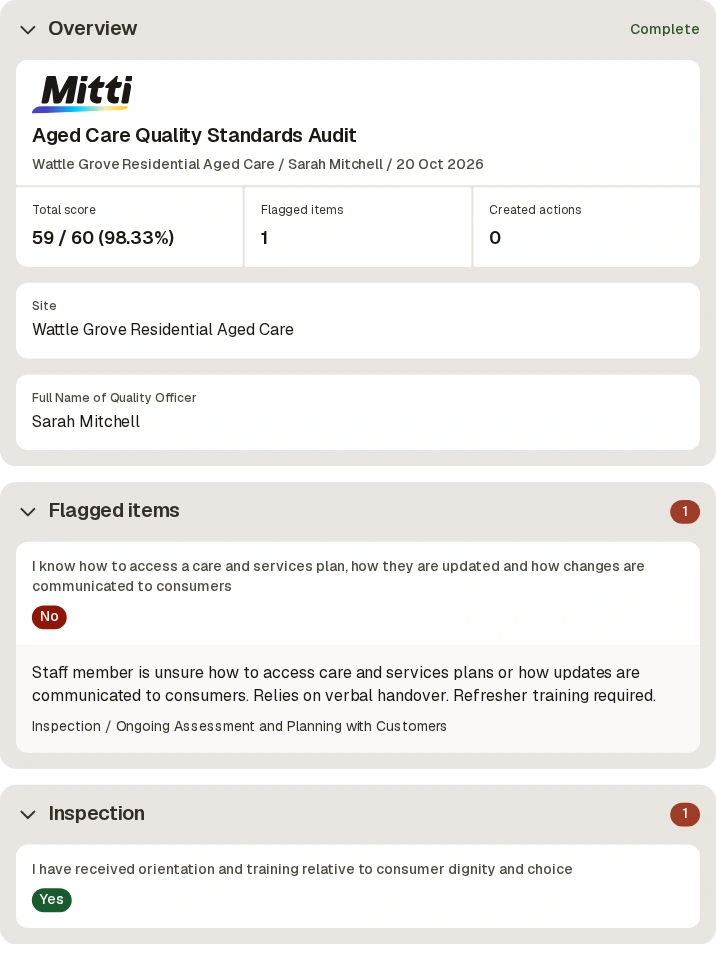
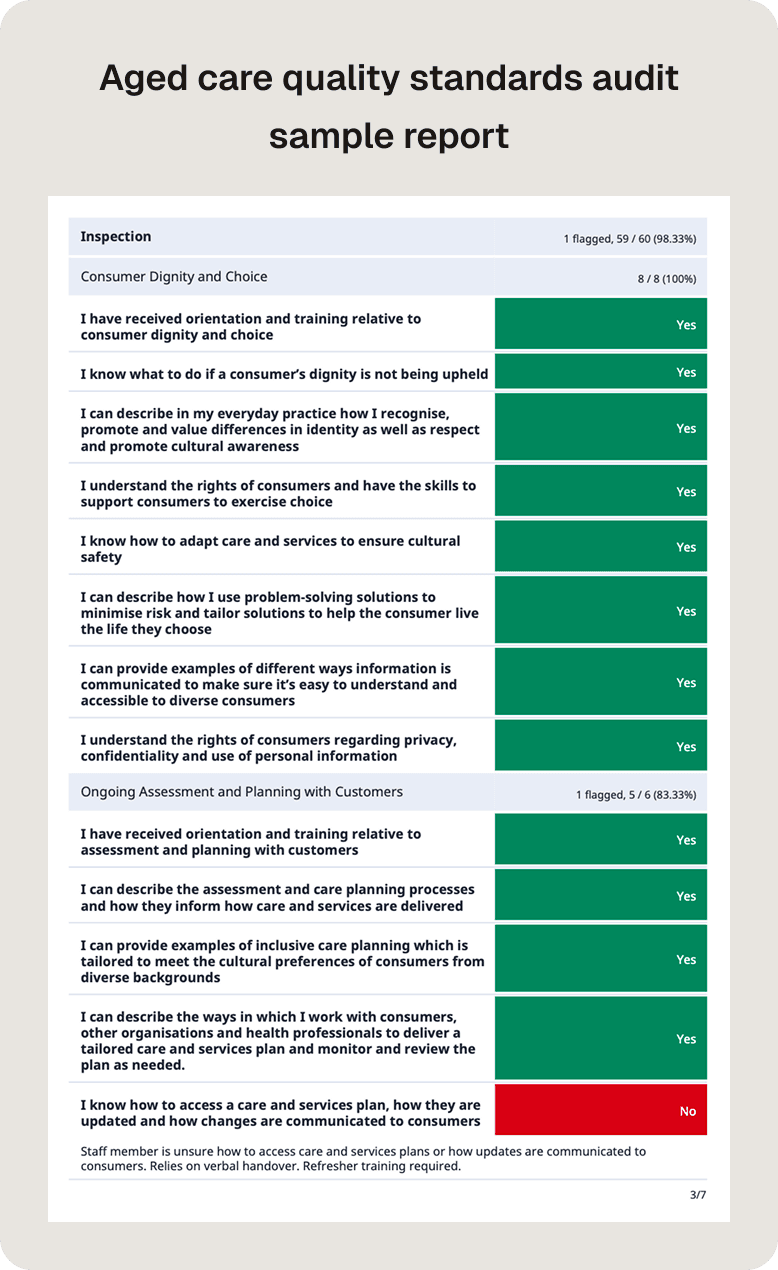
Here is an example of an aged care quality standards audit.

Still looking for a checklist?
Search, filter, and customize 60,000+ templates across industries and use cases.
FAQs about aged care quality standards audits
Article by
Mitti (by SafetyCulture) Content Team
Mitti (by SafetyCulture) Content Contributor
View author profile