Mitti by SafetyCulture
Pricing
Log inSign up for free
  1. Home
  2. Checklist guides
  3. Health
  1. Home
  2. Checklist guides
  3. Health
Mitti by SafetyCulture

The way the world works

Follow us

App Store
Google Play

Product

  • Pricing
  • Book a demo
  • Product updates
  • Mitti (by SafetyCulture)

Support

  • Help center
  • Contact us
  • API developer documentation
  • Digitize your checklist

Resources

  • Content library
  • App & software guides
  • Checklist guides
  • Topic guides
  • eBooks
  • Blog

Company

  • About
  • Careers
  • News room
  • Meet the leadership team
  • Events & webinars
Copyright © 2026 Mitti
StatusLegalPrivacyTerms & ConditionsSecurity

SafetyCulture has a new name. Say hello to Mitti. Learn More.

Powered by

Allergen Checklist

Evaluate and control food safety hazards for allergic consumers with an allergen digital checklist.

Rated 4.6/5 stars on Capterra | 3k+ app store reviews
Use templatePreview template
Allergen Checklist
Mobile Preview
See the template in action (opens in new tab)

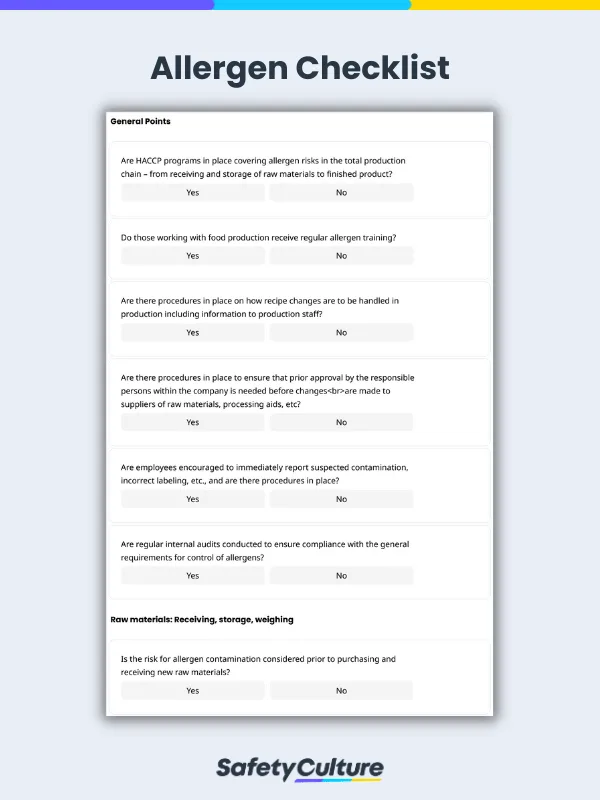
Use this allergen checklist to assess areas of food production procedures. Ensure that allergen control measures are implemented and executed properly. This checklist was converted using Mitti (by SafetyCulture) and covers a review on raw materials, production, premises, equipment and cleaning.

Allergen Checklist
Mobile Preview
See the template in action (opens in new tab)

Why Mitti digital checklists?

  • Free to use for up to 10 users

  • Eliminate paperwork with digital checklists

  • Generate reports from completed checklists

Use template
  • What is an Allergen Checklist?
  • What are the Major Food Allergens?
  • How Can Allergies Be Managed?
  • What are the Challenges of Implementing an Allergen Control Policy?
  • How Can Allergen Management Procedures be Improved?
  • Essential Components of an Allergen Checklist

In this article

  • What is an Allergen Checklist?
  • What are the Major Food Allergens?
  • How Can Allergies Be Managed?
  • What are the Challenges of Implementing an Allergen Control Policy?
  • How Can Allergen Management Procedures be Improved?
  • Essential Components of an Allergen Checklist

Eliminate paperwork with digital checklists

Skip the setup and get to work in seconds.

Use template

Article by

Jairus Andales

|

4 min read

|

9 Jul 2025

What is an Allergen Checklist?

An allergen checklist is a tool used by food manufacturers and businesses to evaluate allergen control measures during food production. Using an allergen checklist ensures that food products are safe from food allergens that pose negative health risks to allergic consumers. Food businesses should follow allergen information rules set by the local government to avoid legal ramifications, penalties, or business closure.

What are the Major Food Allergens?

According to the FDA, more than 160 foods can cause allergic reactions in people with food allergies. Through thorough food allergy research, the FDA has defined the top 8 most common allergenic foods:

  1. Milk

  2. Eggs

  3. Fish

  4. Crustacean shellfish

  5. Tree nuts

  6. Peanuts

  7. Wheat

  8. Soybeans

The above-mentioned foods or any of their derivatives are required by governments to be listed on product labels to help allergic consumers easily avoid them. Allergen checklists, compliance with Hazard Analysis and Risk-based Preventive Controls (HARPC), and the right HACCP programs should also cover these foods to ensure food safety for allergic consumers.

How Can Allergies Be Managed?

There are a few key things that can be done to help manage allergies:

  1. An allergen checklist is helpful in identifying and controlling allergens. This checklist can be used by food suppliers and manufacturers, as well as by consumers.

  2. A food allergen checklist can help grocery stores and restaurants determine and control potential allergens in the food they serve.

  3. An allergen policy template can also be used to create an allergen management procedure for a business. This policy should identify the allergens that are of concern, the steps that will be taken to control them, and the personnel responsible for implementing and monitoring the policy.

  4. An allergen checklist can help individuals with food allergies verify and avoid potential allergens.

What are the Challenges of Implementing an Allergen Control Policy?

Many establishments have difficulty implementing an allergen control policy because it can be difficult to keep track of all the allergens in the food. Hence, establishments need to have a system in place to track the allergens in their food. They also need to have procedures in place for handling food allergies. Another important step is to properly and thoroughly train employees on how to handle food allergies.

How Can Allergen Management Procedures be Improved?

Food allergens are one of the leading causes of food-related illness in the United States, with an estimated 8 percent of children in the United States affected, according to the Centers for Disease Control and Prevention (CDC). With this significant finding, allergen management procedures are essential for reducing the risk of food-related illnesses and skin reactions, such as occupational dermatitis. Such management procedures can be improved by using allergen checklists. These checklists help food suppliers and manufacturers identify and control allergens in their products and allow food service operators to create allergen-free menus.

Essential Components of an Allergen Checklist

1. General Points

This evaluates if your HACCP programs cover allergen risks in the total production chain and assess if the food production staff receives regular allergen training. It also checks if regular internal audits are conducted to ensure compliance with the general requirements of allergen control and how allergy symptoms and cases of suspected contamination are handled by employees.

2. Raw materials

This evaluates the receiving, storage, and weighing process for raw materials to minimize risks of allergen contamination. For example, one of the questions in an allergen checklist checks for proper handling and labeling of raw materials.

3. Production, premises, and equipment

This part of the checklist assesses the availability of instructions on contamination and allergy prevention and if hygienic rules—whether in printed or digital form—are present within the premises. The design of premises, equipment, and work tools are also checked to see if they are easy to clean and if they help minimize contamination between production lines.

4. Cleaning and controls

This part checks if cleaning instructions are present, clear, and easily accessible within the premises. There should be clear cleaning instructions between the production of different products in the same production line to avoid cross-contamination between allergenic and non-allergenic food.

Content library templates

Still looking for a checklist?

Search, filter, and customize 60,000+ templates across industries and use cases.

Browse Library
JA

Article by

Jairus Andales

Mitti (by SafetyCulture) Content Specialist

View author profile

Related resources you might like

Templates

Powered by

Allergen Control Checklist (Catering Premises)

An allergen control checklist is used by local authority enforcement officers during inspection of catering premises. Use this checklist as a guide in performing an audit on allergen control measures.

View template in library

Powered by

Allergen Checklist for Suppliers and Manufacturers

This allergen checklist is specifically made for suppliers and manufacturers to ensure safety on food products for consumers with food allergies, and prevent costly recalls.This allergen checklist for suppliers and manufacturers was derived from the Canadian Food Inspection Agency and was converted using Mitti (by SafetyCulture).

View template in library

Articles

Healthcare Compliance Software

Healthcare compliance software is a digital solution that helps professionals manage and protect patients’ health, safety, and privacy.

Learn more

Achieving Zero Blood Culture Contamination

Learn what blood culture contamination is, why it occurs, and proven strategies to prevent false-positive results.

Learn more

Physical Therapy SOAP Note

Download free physical therapy SOAP note templates that you can use in documenting accurate PT patient details using the SOAP note method.

Learn more