Mitti by SafetyCulture
Pricing
Log inSign up for free
  1. Home
  2. Checklist guides
  3. Health
  1. Home
  2. Checklist guides
  3. Health
Mitti by SafetyCulture

The way the world works

Follow us

App Store
Google Play

Product

  • Pricing
  • Book a demo
  • Product updates
  • Mitti (by SafetyCulture)

Support

  • Help center
  • Contact us
  • API developer documentation
  • Digitize your checklist

Resources

  • Content library
  • App & software guides
  • Checklist guides
  • Topic guides
  • eBooks
  • Blog

Company

  • About
  • Careers
  • News room
  • Meet the leadership team
  • Events & webinars
Copyright © 2026 Mitti
StatusLegalPrivacyTerms & ConditionsSecurity

SafetyCulture has a new name. Say hello to Mitti. Learn More.

Powered by

Fall Risk Assessment

Identify common fall risk factors, assign a fall risk rating, and implement risk interventions.

Rated 4.6/5 stars on Capterra | 3k+ app store reviews
Use templatePreview template
morse fall risk assessment form
Mobile Preview
See the template in action (opens in new tab)

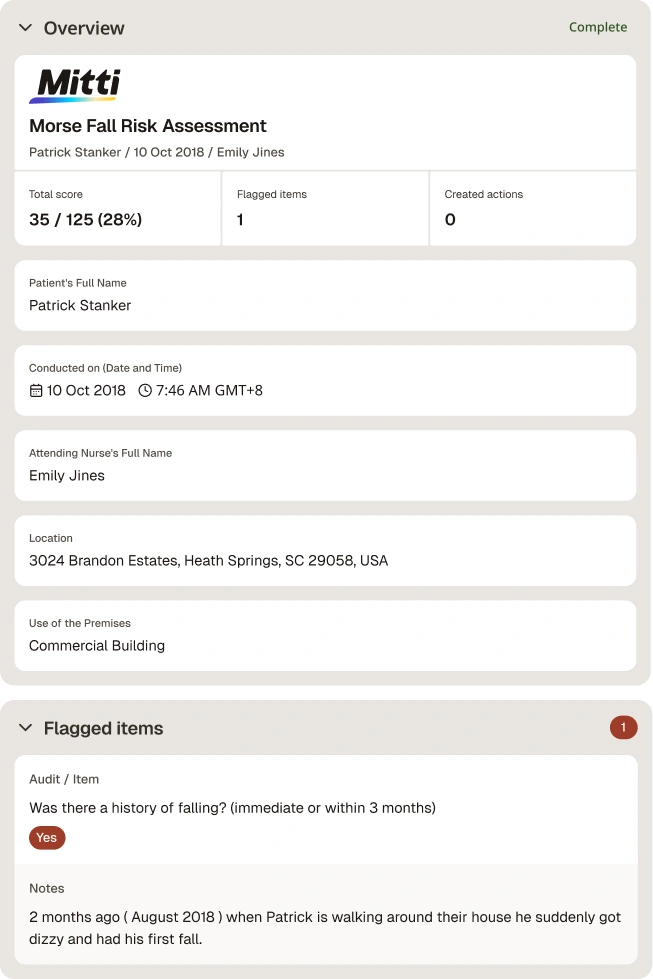
This Morse Fall Risk Assessment Tool derived from the Morse Fall Scale (MFS) was converted using Mitti (by SafetyCulture) and is used to help assess a patient’s likelihood of falling. Perform this Morse Fall Risk Assessment by answering 6 essential questions:

  • Was there a history of falling? (immediate or within 3 months)

  • Was there a secondary diagnosis?

  • What ambulatory aid is used?

  • Was there an intravenous apparatus or a heparin lock inserted?

  • How was the patient’s gait or transferring mode?

  • What is the mental status of the patient?

This template includes a risk rating table which will help you assign a fall risk rating (High, Medium, Low) based on the responses to the 6 essential questions.

morse fall risk assessment form
Mobile Preview
See the template in action (opens in new tab)

Why Mitti digital checklists?

  • Free to use for up to 10 users

  • Eliminate paperwork with digital checklists

  • Generate reports from completed checklists

Use template
  • What is a Fall Risk Assessment?
  • Fall Risk Assessment Frequency
  • What to Include in a Fall Risk Assessment Checklist?
  • Fall Risk Assessment Process
  • Frequently Asked Questions about Fall Risk Assessment Checklist

In this article

  • What is a Fall Risk Assessment?
  • Fall Risk Assessment Frequency
  • What to Include in a Fall Risk Assessment Checklist?
  • Fall Risk Assessment Process
  • Frequently Asked Questions about Fall Risk Assessment Checklist

Eliminate paperwork with digital checklists

Skip the setup and get to work in seconds.

Use template

Article by

Jona Tarlengco

|

4 min read

|

29 May 2025

What is a Fall Risk Assessment?

A fall risk assessment is primarily carried out by nursing staff to evaluate the likelihood of falling for elderly patients. Fall assessments help ensure patient safety as falls are the leading cause of injury and accidental death for people aged 65 years and over. A patient fall risk assessment usually includes fall risk ratings to help prioritize fall prevention measures for elderly patients.

Fall Risk Assessment Frequency

Generally, a fall risk assessment should be completed upon admission of the patient to effectively prevent falls or reduce the risk of falling. Apart from the initial assessment, fall risk assessments should also be completed immediately after a fall, when there is a change in the patient’s condition or medication, and before each shift for high-risk patients. Through early risk identification and reassessments, appropriate preventive measures can be in place.

What to Include in a Fall Risk Assessment Checklist?

A comprehensive fall risk assessment checklist should cover several key items to properly identify factors that may cause an accident. Here are the essential elements to include:

  1. History of Falls

    • Any falls in the past year? How many?

    • Injury: Were you injured in a fall?

    • Circumstances: What caused or triggered the fall?

  2. Balance, Gait, and Mobility

    • Unsteadiness: Feel unsteady when standing or walking?

    • Walking aid: Use a cane, walker, or other device?

    • Weakness: Trouble standing up from a chair or stepping onto curbs?

    • Test results: Timed Up and Go, Chair Stand, or Balance Test results (if available).

  3. Physical and Sensory Factors

    • Dizziness: Light-headedness or dizziness, especially when standing?

    • Low blood pressure: Postural hypotension (drop in blood pressure when standing)?

    • Foot pain or poor footwear: Foot pain lasting a day or more, or inappropriate shoes?

  4. Environmental Hazards

    • Workplace safety: Loose rugs, poor lighting, clutter, or slippery floors?

    • Are safety signages and safety practices being followed?

morse fall risk assessment form sample report

Morse Fall Risk Assessment Form Sample Report | Mitti (by SafetyCulture)

Fall Risk Assessment Process

Derived from the fall risk assessment tool developed by Johns Hopkins, listed below are the 5 key steps of the falls risk assessment process:

Step 1: Be aware of the patient’s medical history

Having a clear understanding of the patient’s medical history, especially in areas most critical to fall risks, can help nursing personnel to carry out a fall risk assessment correctly. Knowing if the patient has a history of falls, recurrent falls, and took diuretics or narcotics, among others, can greatly inform a fall assessment, leading to a more accurate risk rating.

Step 2: Identify high or low fall risks based on certain conditions

The process of coming up with a fall risk score can be foregone when a patient is immediately identified either as a high fall-risk or a low fall-risk. A patient is automatically considered a high fall-risk if he/she has a history of more than one fall within 6 months before admission, has experienced a fall during a hospitalization period, and is deemed high fall-risk per organizational protocol (e.g. seizure precautions).

On the other hand, a patient is considered a low fall-risk when he/she is completely immobilized or in a state of complete paralysis. Either way, interventions per protocol should be implemented accordingly.

Step 3: Determine fall risk ratings based on common risk factors

When the aforementioned conditions are non-existent, the assessor should continue in the process of determining a fall risk rating by evaluating common fall risk factors such as age, medication, patient care equipment, mobility, and cognition. Assigning fall risk ratings generally follows the principle of direct correlation—the more points are earned from each risk factor, the higher that patient’s risk of falls.

Step 4: Implement risk interventions per protocol

Risk interventions vary depending on the protocols set by the healthcare institution. Sample interventions for high fall-risks include close supervision of the patient with attempts to address the patient’s risk factors and appropriate post-fall care with injury prevention measures in the case of recurrence, while the most basic risk intervention for low-risk patients is improving environmental safety, or practicing universal fall precautions such as:

    • Familiarize the patient with the environment.

    • Keep the patient’s personal possessions within patient safe reach.

    • Have sturdy handrails in patient bathrooms, stairs, room, and hallway.

    • Keep hospital bed brakes locked.

    • Keep wheelchair wheel locks in a “locked” position when stationary.

    • Keep non-slip, comfortable, well-fitting footwear on the patient.

    • Keep floor surfaces clean and dry. Clean up all spills promptly.

    • Keep patient care areas uncluttered.

    • Follow safe patient handling practices.

Step 5: Update patient records and reassess fall risks as required

Monitor the effectiveness of fall preventive measures applied according to a patient’s fall risk, notify all key healthcare staff, and document changes accordingly. Keeping patient records up-to-date is crucial to successfully carry out a fall prevention plan aligned with the individualized care plan.

Content library templates

Still looking for a checklist?

Search, filter, and customize 60,000+ templates across industries and use cases.

Browse Library

Frequently Asked Questions about Fall Risk Assessment Checklist

JT

Article by

Jona Tarlengco

Mitti (by SafetyCulture) Content Specialist

View author profile

Related resources you might like

Templates

Powered by

Patient Fall Risk Assessment Template

This fall risk assessment template is used to evaluate a patient’s probability of falling. It includes fields to record a patient’s fall history, current medication, and medical test results (vision, peripheral sensation, and mobility). Record the patient’s fall risk rating (Low, Medium, High) depending on the number of accumulated risk factors.

View template in library

Powered by

Environmental Fall Assessment Form

This environmental fall assessment form can be used to evaluate the facilities, equipment, and safety of an aged care center or hospital because an accidental fall may not only be caused by a patient’s medical condition but also by an environmental hazard. Use Mitti (by SafetyCulture) to perform environmental fall assessment using mobile devices to thoroughly inspect and maintain cleanliness and orderliness to keep your patients’ safe from environmental fall hazards.

View template in library

Powered by

Fall Incident Report Form

This Fall Incident Report template can be used to document the critical information, person(s) involved in the incident, injuries, near misses, and cause of the fall. Use Mitti (by SafetyCulture) to capture photo evidence of the incident. Generate a detailed fall incident report and affix it with a digital signature.

View template in library

Articles

Healthcare Compliance Software

Healthcare compliance software is a digital solution that helps professionals manage and protect patients’ health, safety, and privacy.

Learn more

Achieving Zero Blood Culture Contamination

Learn what blood culture contamination is, why it occurs, and proven strategies to prevent false-positive results.

Learn more

Pediatric SOAP Note

Download free pediatric SOAP note templates that you can use in documenting accurate pediatric patient details using the SOAP note method.

Learn more