Importance of Being LEED Certified
The LEED certification standards were created by the U.S. Green Building Council (USGBC) to set and maintain standards for “green building,” which is a concept centered around reducing negative environmental impact, saving natural resources, and improving human health. This means that a LEED-certified building was created sustainably through humane practices and using earth-friendly means. A LEED certification also means that the building is maintained in such a way that it amplifies its positive effects on the environment and mitigates or completely removes the negative ones.
LEED-certified buildings are also energy-efficient, conserving energy and using renewable energy sources as much as they can. Said buildings are also equipped with waste disposal practices and different mechanisms to preserve or repurpose different sources of energy such as rain or toilet water as energy efficiency is one of the major goals LEED wants to achieve. Buildings with LEED certification are also understood to be conscious of their carbon dioxide emissions and are thus trying to reduce them.
Studies have also shown that LEED-certified buildings are more likely to generate income for building owners and contractors. This is because demand and rent for LEED-certified buildings are higher than non-LEED certified ones and are seen to further increase in value as the years go on.
LEED-certified buildings are also proven to promote better work environments. A 2018 survey showed that 84% of modern employees are now more conscious of their impact on the environment, and so working with employers who implement more earth-friendly efforts is slowly becoming the preferred work environment. Similarly, around 79% of the respondents said they would rather choose a job where the office is inside a LEED-certified building than one that isn’t. Additionally, 85% of employees in LEED-certified buildings have also been found to have happier work lives as having access to natural sunlight, enhanced air circulation, and outdoor views boosts their productivity and happiness.
Levels of LEED Certifications
The levels for LEED certification are determined by the number of points that a project accumulates based on their respective category checklists. Detailed below are the levels and their respective point ranges:
Certified (40-49 points)
Silver (50-59 points)
Gold (60-79 points)
Platinum (80 points and above)
Kinds of LEED Certifications
There are six purposes or categories wherein LEED can be applied. These are:
LEED for Building Design and Construction (LEED BD+C): for the creation and major renovations of buildings
LEED for Operations and Maintenance (LEED O+M): for minor improvement work and construction to existing buildings
LEED for Interior Design and Construction (LEED ID+C): for complete interior designing and construction
LEED for Neighborhood Development (LEED ND): for any stage of residential land development and redevelopment
Each purpose will require a different checklist specific for it. Regardless, all checklists will contain sections on:
materials used;
energy saving and efficiency;
waste management and disposal; and
indoor air and environmental quality.
A checklist is essential in attaining and maintaining a LEED certification. The USGBC requires all building owners and contractors interested in having a LEED certification to follow their checklists depending on the kind of building they are working with and the tasks they plan to do.
However, many building owners and contracts also prefer to have an additional checklist for their own use. This is to take into account any other issues that may have been missed in the initial inspection, as well as for frequent maintenance.
What to Include in Your LEED Checklist?
The items included in LEED checklists are quite straightforward. They can also easily be answered with a yes or no and can help create a corrective action to adequately address any potential issues found. The practices consistently observed using a LEED checklist enable relevant stakeholders to increase the chances of being LEED-certified.
Here are several sample questions you can ask in your LEED checklist:
Housekeeping
General housekeeping should be observed in any construction area. Consider including these questions in your LEED checklist:
Are areas clear from debris and clutter?
Is debris placed in designated areas?
Are there trash bins provided all over the site?
Are “No Smoking” signs in place and easily visible?
Are there no spills observed in the area?
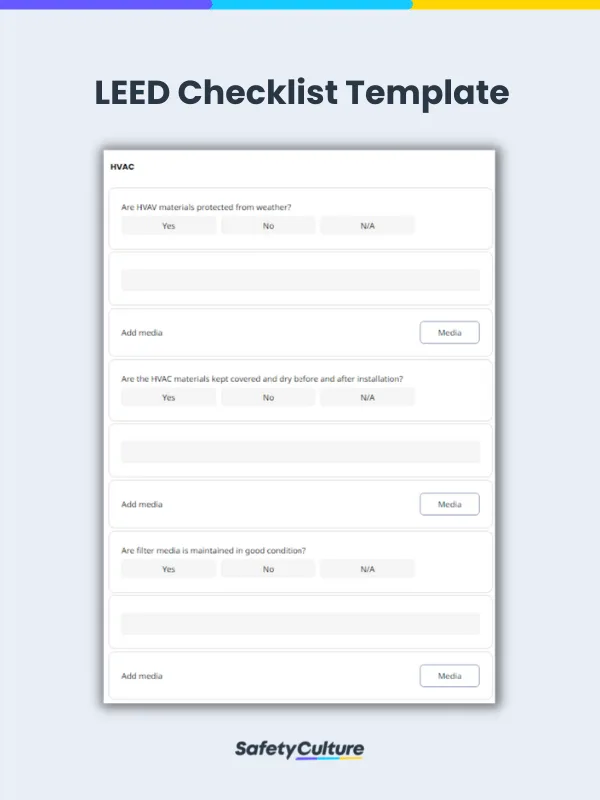
HVAC and Source Control
LEED checklists should allow you to easily identify which areas to check and which practices to follow. HVAC and source control questions can be:
Are HVAC materials well maintained and protected from the weather?
Are absorbent materials such as drywall and insulation, stored off the ground in a cool dry place?
Are filter media maintained in good working condition?
Are low-emitting materials for paints, adhesives, and caulking, among others, utilized?
Do work activities keep air-borne dust to a minimal level?
Pathway Interruption and Scheduling
Since the main goal of a LEED checklist is to maintain a sustainable and healthy construction environment, you can ask the following questions concerning pathway interruption and scheduling:
Are barriers placed in the boundary of excavation areas and finished floors?
Are mats, poly, tarps, or other temporary materials used to protect areas from dust and overspray?
Are areas kept ventilated using fans?
Are regular gas checks performed and reported?
Are high-pollution activities conducted during off-hours to limit the exposure of workers?