Mitti by SafetyCulture
Pricing
Log inSign up for free
  1. Home
  2. Checklist guides
  3. Compliance
  1. Home
  2. Checklist guides
  3. Compliance
Mitti by SafetyCulture

The way the world works

Follow us

App Store
Google Play

Product

  • Pricing
  • Book a demo
  • Product updates
  • Mitti (by SafetyCulture)

Support

  • Help center
  • Contact us
  • API developer documentation
  • Digitize your checklist

Resources

  • Content library
  • App & software guides
  • Checklist guides
  • Topic guides
  • eBooks
  • Blog

Company

  • About
  • Careers
  • News room
  • Meet the leadership team
  • Events & webinars
Copyright © 2026 Mitti
StatusLegalPrivacyTerms & ConditionsSecurity

SafetyCulture has a new name. Say hello to Mitti. Learn More.

Powered by

Non Conformance Report Template

Hand over reports in real-time and resolve issues efficiently with a non-conformance report template.

Rated 4.6/5 stars on Capterra | 3k+ app store reviews
Use templatePreview template
non-conformance-report
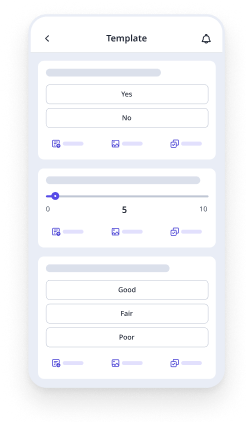
Mobile Preview
See the template in action (opens in new tab)

Use this free non-conformance report form template for manufacturing to document any deviation or any non-conformances in quality observed in the workplace. With this, you can improve quality control check processes as it can help with the following:

  • Reporting issues spotted during daily tasks and quality inspections

  • Creating and managing corrective or preventive actions to be implemented

  • Assigning action points to responsible teams or professionals to take necessary actions

  • Recording machinery and equipment status for recordkeeping purposes

  • Collaborating with other teams or organizations by generating reports in Word, Excel, PDF, and Weblink formats

non-conformance-report
Mobile Preview
See the template in action (opens in new tab)

Why Mitti digital checklists?

  • Free to use for up to 10 users

  • Eliminate paperwork with digital checklists

  • Generate reports from completed checklists

Use template
  • What is a Non Conformance Report Template?
  • What is a Non-Conformance Report?
  • Why Report Non-Conformances?
  • What to Include in a Non-Conformance Report Template
  • Non-Conformance Report Sample
  • How to Complete a Non-Conformance Report: A Step-by-Step Guide
  • Best Practices
  • FAQs About Non-Conformance Report

In this article

  • What is a Non Conformance Report Template?
  • What is a Non-Conformance Report?
  • Why Report Non-Conformances?
  • What to Include in a Non-Conformance Report Template
  • Non-Conformance Report Sample
  • How to Complete a Non-Conformance Report: A Step-by-Step Guide
  • Best Practices
  • FAQs About Non-Conformance Report

Eliminate paperwork with digital checklists

Skip the setup and get to work in seconds.

Use template

Article by

Jona Tarlengco

|

5 min read

|

22 Aug 2025

What is a Non Conformance Report Template?

A non-conformance report (NCR) template is a tool used by manufacturing managers, workers, and supervisors to record any non-compliance or plan deviation, how it occurred, and corrective measures to prevent similar events from recurring. It’s also used to determine a resolution with a client and to document any corrective changes applied.

This template serves as a guide for documenting the necessary information related to the non-conformance reported in a consistent and organized manner, aiming to standardize the reporting process while leaving room for customization based on the needs and requirements of various industries and projects.

What is a Non-Conformance Report?

A non-conformance report is a document commonly used in the manufacturing and production industries to document work that has not met required quality standards. These reports are an essential part of the quality control process and aim to mitigate risks by implementing corrective actions and preventing similar situations from recurring.

Why Report Non-Conformances?

Non-conformances can pertain to products that don’t meet quality standards or specifications, processes that create bottlenecks or waste, and deviations from set standards. Manufacturing equipment that do not work as intended can also be counted as a non-conformance, especially when they affect other operational tasks and pose health and safety risks.

As non-conformance comes in different formats, hence the need for a template in some organizations.  One of the biggest benefits of using a non-conformance report template is that it allows the tracking and monitoring of products and processes, which can then help with identifying and proactively correcting any issues before they become bigger problems. From a business perspective, on the other hand, non-conformance reports can help better understand customers and their needs.

Other benefits of having a non-conformance report template include the following:

  • Streamlined identification, reporting, and communication of quality issues

  • Comprehensive compliance with customer and regulatory quality and safety requirements, including ISO 9001:2015 —the globally recognized standard for quality management systems.

  • Protected brand reputation by preventing defective products from reaching customers

  • Enhanced consistency and completeness of non-conformance reports

  • Effective quality management of manufacturing processes and products

  • Sustainable establishment of a culture of accountability and corrective action

What to Include in a Non-Conformance Report Template

An effective non-conformance report form template fundamentally contains these 4 key elements:

  1. Detailed observation of the non-conformances

  2. Corrective actions to be implemented

  3. Rectification process

  4. Closure of the case

Non-conformance reports serve as a document for detailing any issue or discrepancy found in current manufacturing processes, tracking the cause of the non-conformance, as well as recording any corrective actions that need to be taken to rectify the discrepancy.

It’s important to note that the items found in one can vary depending on the business or industry that the organization belongs to. The most common items that can be found on a non-conformance report are the following:

  • Title page, report number, department, and company or site location

  • Product name and description

  • Date and the lot number

  • Type of non-conformance and the corresponding corrective action/s taken

  • Names and signatures of the person who raised the issue and verified the report

Non-Conformance Report Sample

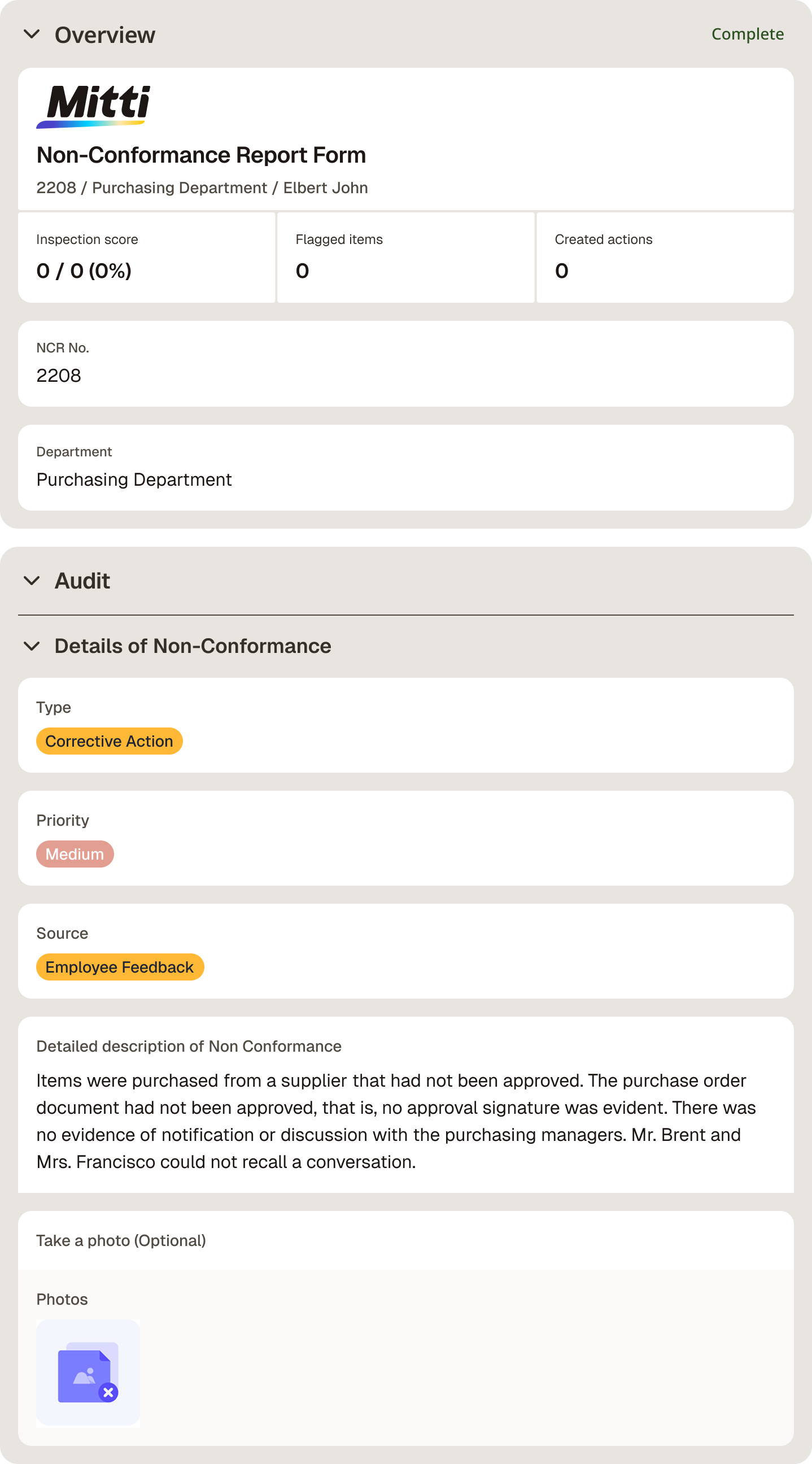
Here is an example of a non-conformance report template in use:

non-conformance-report PDF Image

Non-Conformance Report Template Sample Report | Mitti (by SafetyCulture)

How to Complete a Non-Conformance Report: A Step-by-Step Guide

Here is a guide based on common Standard Operating Procedures (SOPs) for manufacturing businesses on how to spot and report non-conformances with a dedicated non-conformance report template:

  • Step 1: Immediate Identification and Documentation: As soon as a non-conformance is detected during any task, especially during quality inspections, employees should fill out the non-conformance report template with all relevant details and a clear description of the issue. Attach supporting evidence such as photos, test results, or measurements if available.

  • Step 2: Control and Containment: Segregate or isolate the non-conforming product or process to prevent further use, production, or shipment. In some cases, the processes involved may also have to be stopped.

  • Step 3: Assign Responsibility: Use the non-conformance report template to specify the personnel responsible for investigating the identified issues, implementing corrective actions, and verifying results. Assign deadlines for each action to ensure accountability.

  • Step 4: Root Cause Analysis: While reporting the non-conformance, make sure to also document the investigation process and root cause findings within the template. Use structured methods to identify underlying causes, and cross-reference current processes with what is considered standard, such as ISO 9001 guidelines.

  • Step 5: Disposition and Corrective Actions: Clearly state the disposition of the affected product or process in the template. Detail corrective and preventive actions to address both the immediate issue and prevent recurrence.

  • Step 6: Verification and Closure: After corrective actions are implemented, verify their effectiveness and document the results in the template. Close the report only after confirming the non-conformance has been resolved and the corrective actions are effective.

  • Step 7: Recordkeeping and Trend Analysis: Store completed reports for audits and ongoing quality improvement, ideally in a cloud where they can be easily accessed by anyone in the team as needed. However, even after time has passed, make sure to review non-conformance data to identify trends, recurring issues, or process weaknesses, and use this information to drive continuous improvement.

Best Practices

Additionally, here are some best practices to keep in mind before, during, and after using non-conformance report templates:

  • Train staff on when and how to use the template as part of their daily routines

  • Integrate non-conformance reporting into shift handovers, daily production meetings, and digital quality management systems for real-time tracking

  • Monitor all manufacturing processes and products daily to ensure timely resolution and prevent bottlenecks in production

Woods Glass (Thermosash Group) Customer Logo

Thermosash was able to achieve ISO certification in six months using the Mitti Platform by centralizing workflows, boosting visibility, enhancing accountability, and streamlining quality control through QA checks and automatic corrective action alerts.

Thermosash Mitti (by SafetyCulture) customer Story
Read success story

manufacturing quality management collection image

Strengthen quality control with a ready-to-use collection

Practical quality control courses and templates to help teams stay consistent and catch issues earlier

Browse collection

FAQs About Non-Conformance Report

JT

Article by

Jona Tarlengco

Mitti (by SafetyCulture) Content Specialist

View author profile

Related resources you might like

Templates

Powered by

ISO 9001:2015 Supplier Deviation Request Form

This Supplier Deviation Request form was developed by a Mitti (by SafetyCulture) Industry Expert Partner. It can be used to document and approve supplier-proposed deviations or non-conformances from specified requirements while ensuring compliance with quality and regulatory standards, supporting ISO 9001:2015 Clause 8.4.2 (Control of externally provided processes, products, and services).

View template in library

Powered by

Supplier Non-Conformance Report Template

Use this template to record any non-conformances concerning supplies, raw materials, or any incoming goods which are received by the organization. Include the date of NCR closure and the signatures of relevant stakeholders.

View template in library

Powered by

Product Non-Conformance Report

The purpose of this document is to identify non-conformances in manufactured products. Use this for quality checking, creating and assigning corrective and preventive actions, and conducting case analyses.

View template in library

Powered by

ISO 9001:2015 Nonconformance Report Template

Developed in coordination with a manufacturing industry partner, this template helps manufacturing companies identify defects and non-conformances in compliance with ISO 9001:2015 Clause 8.7 (Control of Nonconforming Outputs) and Clause 10.2 (Nonconformity and Corrective Action).

View template in library

Articles

REACH Compliance Software

Explore 7 of the best REACH compliance software to enhance regulatory adherence and chemical management for businesses.

Learn more

A Comprehensive Guide to Creating a Risk Treatment Plan

Learn how to write a risk treatment plan, align it with ISO 27001 and 31000, and monitor it over time with practical steps and examples.

Learn more

ISO 17025 Checklist

Use this free ISO 17025 checklist template to help your lab meet accreditation requirements and digitize preparations for certification.

Learn more