Mitti by SafetyCulture
Pricing
Log inSign up for free
  1. Home
  2. Checklist guides
  3. Operations
  1. Home
  2. Checklist guides
  3. Operations
Mitti by SafetyCulture

The way the world works

Follow us

App Store
Google Play

Product

  • Pricing
  • Book a demo
  • Product updates
  • Mitti (by SafetyCulture)

Support

  • Help center
  • Contact us
  • API developer documentation
  • Digitize your checklist

Resources

  • Content library
  • App & software guides
  • Checklist guides
  • Topic guides
  • eBooks
  • Blog

Company

  • About
  • Careers
  • News room
  • Meet the leadership team
  • Events & webinars
Copyright © 2026 Mitti
StatusLegalPrivacyTerms & ConditionsSecurity

SafetyCulture has a new name. Say hello to Mitti. Learn More.

Powered by

DMAIC Template

Standardize your product and process improvement initiatives for business growth with ready-to-use DMAIC templates

Rated 4.6/5 stars on Capterra | 3k+ app store reviews
Use templatePreview template
DMAIC Template
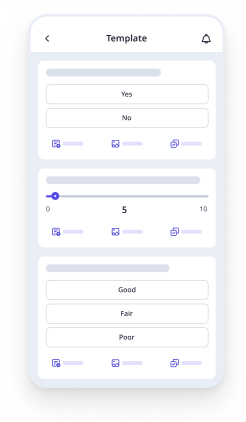
Mobile Preview
See the template in action (opens in new tab)

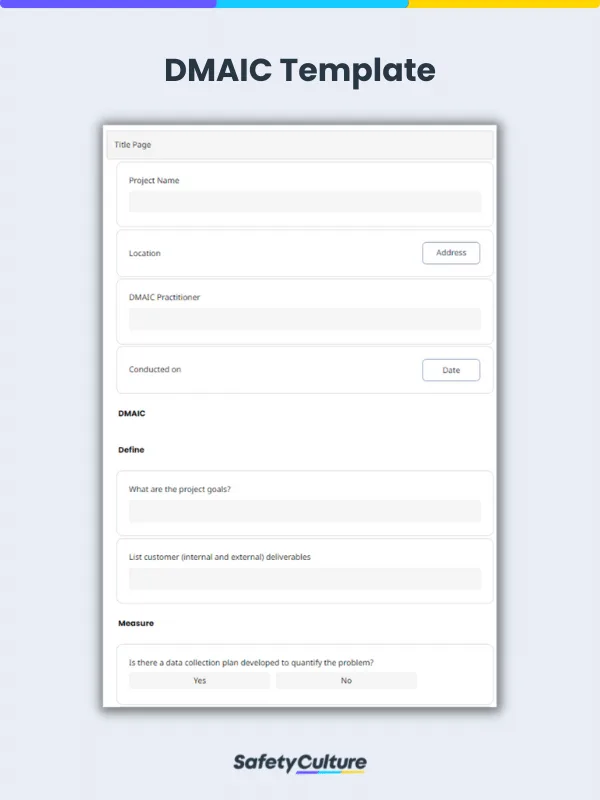
This DMAIC template allows Six Sigma professionals, project managers, and other project stakeholders to perform DMAIC studies for enhancing products and processes. Use this tool to delve deeper into the roots of the existing problems and develop appropriate solutions to resolve them. Fill out this template following these five steps:

  1. Define the goals of the project and their corresponding deliverables.

  2. Measure the current performance against quantifiable benchmarks.

  3. Analyze collected data to determine the root cause of the problem.

  4. Improve the process, system, or design by reviewing possible steps to address inadequacies.

  5. Control and keep track of the process or system in place.

DMAIC Template
Mobile Preview
See the template in action (opens in new tab)

Why Mitti digital checklists?

  • Free to use for up to 10 users

  • Eliminate paperwork with digital checklists

  • Generate reports from completed checklists

Use template
  • What is a DMAIC Template?
  • Why Use a DMAIC Template?
  • 5 Phases of DMAIC
  • Example of a DMAIC Template
  • FAQs about DMAIC Templates

In this article

  • What is a DMAIC Template?
  • Why Use a DMAIC Template?
  • 5 Phases of DMAIC
  • Example of a DMAIC Template
  • FAQs about DMAIC Templates

Eliminate paperwork with digital checklists

Skip the setup and get to work in seconds.

Use template

Article by

Leizel Estrellas

|

4 min read

|

18 Dec 2024

What is a DMAIC Template?

A DMAIC (Define-Measure-Analyze-Improve-Control) template is a tool used to systematically tackle deficiencies in existing practices and strategize process improvement initiatives. It follows the five-step structure of the DMAIC method as a best practice for Six Sigma practitioners. This DMAIC template is ideal for enhancing underperforming products, services, and systems in sectors such as manufacturing and healthcare.

Why Use a DMAIC Template?

The DMAIC method takes a data-driven angle to process and product improvement. Using a systematic approach, they can implement targeted solutions for resolving issues down to their roots. However, drafting DMAIC reports from scratch can take time to complete.

Enter the DMAIC template, a more streamlined route to carrying out the DMAIC method. Having a ready-made template allows Six Sigma practitioners to gather data efficiently, as they only need to fill out the form in the order it’s structured. They no longer need to create reports from the beginning, for they can save this template on their device for future use.

By simplifying the paperwork side of things using a DMAIC template, Six Sigma professionals can focus their efforts on applying DMAIC effectively, improving the quality of their processes.

5 Phases of DMAIC

The DMAIC template consists of five components representing the phases of the DMAIC model: Define, Measure, Analyze, Improve, and Control. This section explores each of these phases as follows:

Define

The first element in a DMAIC template calls for the project goals. In this section, you must specify the primary objective or problem of the DMAIC study in detail. Here are some guide questions to help you answer this portion effectively.

  • What goal are you aiming to achieve? / What issue are you trying to address?

  • Why is it important?

  • What are its corresponding customer deliverables (both internal and external)?

Measure

After determining the main goal or issue, it’s also essential to include quantifiable metrics in obtaining the data you need. Consider the following guide questions when establishing benchmarks for your DMAIC report:

  • Is there a data collection plan for quantifying the problem?

  • Is the current performance of the process determined through measurable targets?

  • On what basis can you determine if the data collection plan is successful?

  • What outcomes are you looking for in the process?

Analyze

The analysis component adds another layer to your DMAIC process template. In this portion, you will investigate the roots of the problem and categorize possible causes or key processes into different priority levels.

A sound DMAIC analysis follows the set of questions listed below:

  • What are the performance objectives?

  • What are the steps that add or provide no value to the process?

  • Why did the issue happen?

  • How does it impact the process outcomes?

  • What are the primary root causes of the problem?

Improve

This component explains the possible courses of action to enhance underperforming processes or products. In this part, you will implement potential solutions based on the data you’ve gathered and analyzed in the previous section.

The following guide questions will steer you in the right direction while testing and setting out improvement measures:

  • What solutions can you implement to resolve the issue?

  • Are operating tolerances of the potential system well-defined?

  • Were design experiments performed?

  • Were potential improvements validated through pilot studies?

  • Were potential solutions assessed and re-evaluated?

Control

The DMAIC process doesn’t end after selecting the most viable solution for the goal or issue. There must also be a system to keep track of and maintain these enhanced processes in the long run. Here are some questions to guide you in monitoring your improvement initiatives:

  • What is the monitoring and control system in place?

  • Was the statistical process control applied?

  • How will the handoff to the process owner proceed?

  • Were benefits, cost savings/avoidance, and profit growth verified?

Example of a DMAIC Template

The image below illustrates how a DMAIC template works as a data-driven process improvement tool.

In this example, the company investigates the reason for the increasing costs in three of its branches. Through this template, they can map out the problem, determine its root cause, and implement solutions to reduce their expenses.

DMAIC Sample Report

DMAIC Template Sample Report | Mitti (by SafetyCulture)

Content library templates

Still looking for a checklist?

Search, filter, and customize 60,000+ templates across industries and use cases.

Browse Library

FAQs about DMAIC Templates

LE

Article by

Leizel Estrellas

Mitti (by SafetyCulture) Content Specialist

View author profile

Related resources you might like

Templates

Powered by

Root cause analysis template

Use this root-cause analysis template to identify the root causes of different problems and eliminate them as needed. This template can be used with the 5W1H template for a more comprehensive problem-solving analysis.

View template in library

Powered by

5 whys template

Use this 5 whys template to resolve the root cause of a problem so that your business teams can avoid encountering them again. Begin by clearly stating the problem and answer why the problem occurred until the root cause is discovered. To complete the 5 whys template, provide a solution to the root cause of the problem and create actions.

View template in library

Powered by

Failure Modes and Effect Analysis (FMEA) Template

Use this template to Define and Analyze potential deficiencies in a product, service, process, or system and prevent their adverse effects. Begin by describing the process function and determine its potential modes of failure. Next, rate each mode’s severity and impact, and identify their Risk Priority Number (RPN). Create and complete corrective actions and validate the FMEA with digital signatures.

View template in library

Articles

Recreation Management Software

Explore top recreation management software to streamline operations, enhance user experience, and simplify managing recreational activities.

Learn more

Transportation and Logistics: What’s the Difference?

Learn about the importance of transport and logistics within the supply chain and how it is used in business operations.

Learn more

Restaurant Checklist

Download free restaurant checklists for opening, closing, cleaning, safety, and health inspections—with templates for every shift.

Learn more