Businesses, non-profit, and government agencies use RFPs with the goal of selecting the proposal that would best cater to their needs.
Requests for proposals also detail the scope, schedule, goals, and budget of the endeavor and are best used for more complex projects that require a great deal of information and analysis of details from various subcontractors or suppliers.
When to Use RFPs
Knowledge in knowing if RFP’s should be used could help in proper sourcing and in future decision making for the business. Below are some scenarios where RFP is best utilized:
Procurement – An essential aspect of the process of sourcing out goods and services. An RFP is one of the documents prepared to complete the whole procurement procedure and it helps organizations choose the best vendor according to their set expectations.
Complex projects – Whether the organization is a business, non-profit, or government agency, projects that require a lot of consideration and include a bunch of stakeholders are best handled using RFPs as it allows entities to carefully determine which proposal would meet their needs the most. RFPs can be utilized from the start of the project planning so it would be easily trackable.
Generally requires comparison – RFPs should also be used when a project requires a lot of comparisons, negotiation, and analysis from different suppliers. The bidding process can help organizations decide which among the possible vendors can best cater to their specifications, as well as discover options that weren’t initially thought of.
Please note, however, that some projects are simple and straightforward enough that they may not require the use of a request for proposal. Take into consideration also the time spent on creating one, and the possibility of limiting the options because of contractors that don’t meet some of the requirements.
What to Include
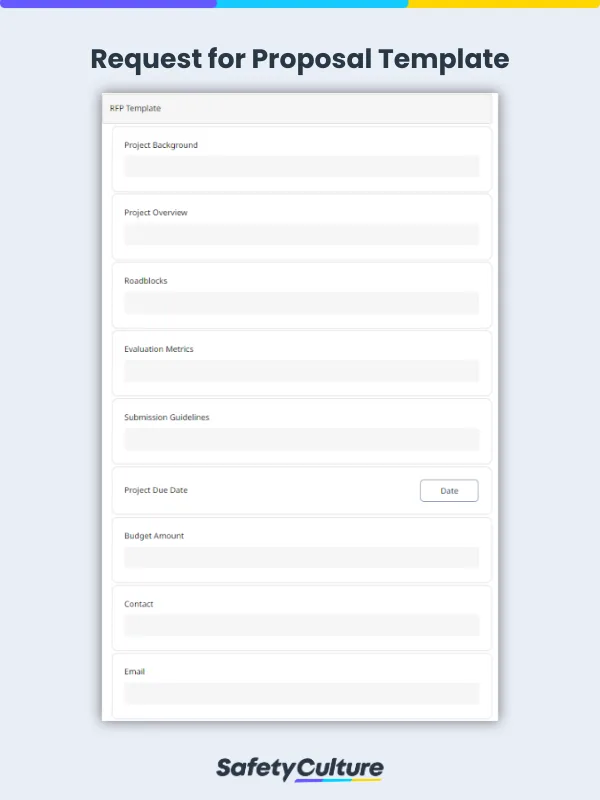
The RFP process and its details could vary depending on your business requirements and project specifications, but it generally includes the following information.
Background
This includes any background information of your company that you consider important for the suppliers to know. It would generally consist of who founded the company and where, its locations, what type of services or products you provide, and what makes you different from industry competitors.
Project Overview
In this section, you would provide a detailed description of the project. Be as specific as possible with the project scope so vendors would have a sound understanding of your goals and objectives.
Deadlines/schedules
It is important to specify the timeline of your project so suppliers would know if they can accommodate it or not. This part should include key dates like the selection schedule, time and place of submission proposal, or any additional notes you think may be helpful to the project timeline.
Materials/elements
This would consist of a list of materials you would want to receive from the bidders. Be as specific as possible with this part as it could help you in further assessing if a supplier would be able to meet your project requirements.
Evaluation Metrics
It’s crucial to outline the criteria you would want the possible suppliers to meet so they can also evaluate on their end. This could include technical requirements, decisions based on cost estimates, or samples of past work.
Possible Roadblocks
This would include any obstacles that might prevent a supplier from accomplishing the project. It could also help in further assessing which vendors can overcome those challenges, hence, would help you narrow down possible suppliers.
Budget
This would include the amount you’re willing to pay for the goods or services the supplier offers.
Guidelines
In this section, you can list down other important details that are relevant to the submission of a proposal but weren’t mentioned in the initial overview.
Using traditional paper forms for RFPs may still be in practice but it can be time consuming and would require a lot of back and forth between the people involved. Transition RFPs from paper forms into digital tools in order can get the job done and reap benefits like:
Consolidated information for a more streamlined process. Handling multiple projects that require various documents can be very tedious and hard to manage. Using digital tools for RFPs can make this process more efficient.
Time-saving opportunity. Using digital tools can help reduce the time required in creating a proposal. It can also lessen the time stakeholders spend in the whole process, therefore increasing productivity.
Integrated process. Utilizing digital tools for RFP creation can help integrate with the whole procurement system, and ensure that all data used in the process is up-to-date.