
Powered by

Scope of Work Template
Protect your project from going beyond scope and over budget
Why Mitti digital checklists?
Free to use for up to 10 users
Eliminate paperwork with digital checklists
Generate reports from completed checklists
Powered by
Protect your project from going beyond scope and over budget
Why Mitti digital checklists?
Free to use for up to 10 users
Eliminate paperwork with digital checklists
Generate reports from completed checklists
A Scope of Work (SOW) template is used to define and document the work to be done on a project as agreed upon between a client and project manager. An SOW should align parties on the project’s deliverables, timeline, costs, and acceptance criteria. A scope of work form is commonly used in construction projects to protect parties from going beyond the scope, over budget, and into legal disputes.
A well-defined SOW template serves as a blueprint for keeping construction projects within agreed-upon boundaries. It can help project managers avoid scope creep —a dreaded reality that could lead to conflict, an unsatisfied client, and potential legal/ financial risks.
A 2015 study by the auditing firm KPMG found that almost 70% of construction projects were not able to stay within budget limits, and 75% of them did not meet their original deadlines. This shows that scope creep is a reality in construction projects, making the creation of an effective SOW document a critical skill for construction project managers.
An effective scope of work checklist can provide project managers with a project roadmap so goals and milestones can be easily achieved within schedule.
A well-written SOW is critical for project managers to manage scope and client expectations. But, an SOW can be very time-consuming and difficult to create. To help you out, here are a few steps you can follow when writing an SOW for your next project. We have also provided free SOW templates to help you create your own SOW.

Define the project goals – This is the reason you are doing the project for the client—expressed in the Project Statement. Begin by knowing why the project was initiated in the first place and what exactly the client wants to achieve when it is completed. To help prevent miscommunication and disputes down the line, project managers should craft a glossary of terms and ensure that everyone involved is on the same page regarding the project’s purpose.
Establish the project deliverables – Simple and straightforward language must be used when defining deliverables to avoid confusion. A project can have a number of deliverables, which can range from simple documents to complex tasks such as planning and procurement
Specify the people responsible for them – Having specific people accountable for certain deliverables can help project managers avoid delays by knowing exactly who to contact when needed. Adding these people to the SOW also eases the process of tracking the project’s progress.
Create a project timeline – Defining the schedule is critical as it sets out the project’s different development phases. It can also help identify important milestones, like approval of execution plans and post-construction equipment tests. Attaching supporting schedule documentation also helps ensure that all involved parties are on the same page when it comes to the project calendar.
Summarize the project costs – Projects often have a tendency of going over budget, making it more important for project managers to do a cost-benefit analysis beforehand. This can determine the right mix of resources (e.g. labor, machinery, safety facilities, and security) and their optimal price. Consult experts to get precise costing for manpower, tools and equipment, and other requirements.
State the signatories – Never begin project work without securing critical signatures/approvals; these make the SOW enforceable. Project managers must get all key signatories to agree on each project objective and milestone before finalizing the SOW. This will help protect all parties in case of legal disputes and will strengthen the integrity of the SOW as an official project document.
Considering the 5 critical guide questions above can help you write a good scope of work. As an example, below is a sample scope of work statement for a kitchen remodeling project:
“ To remodel the kitchen within the existing structure of the residential unit in a period of four weeks, to be delivered by March 29, at a cost of no greater than $14,000. This includes the design, preparation and installation to US Standards and ergonomically designed for the clients use.
Kitchen remodel project plan, color scheme, design layout, and strata sign off
Kitchen that includes the following:
Curved center island with space for 4 bar stools
White tile countertops
High-end vitroceramic cooktop with island mount chimney hood
Upper and lower slab cabinets (cranberry red color) with crown molding “

Scope of Work Template Sample Report | Mitti (by SafetyCulture)

Search, filter, and customize 60,000+ templates across industries and use cases.
Powered by
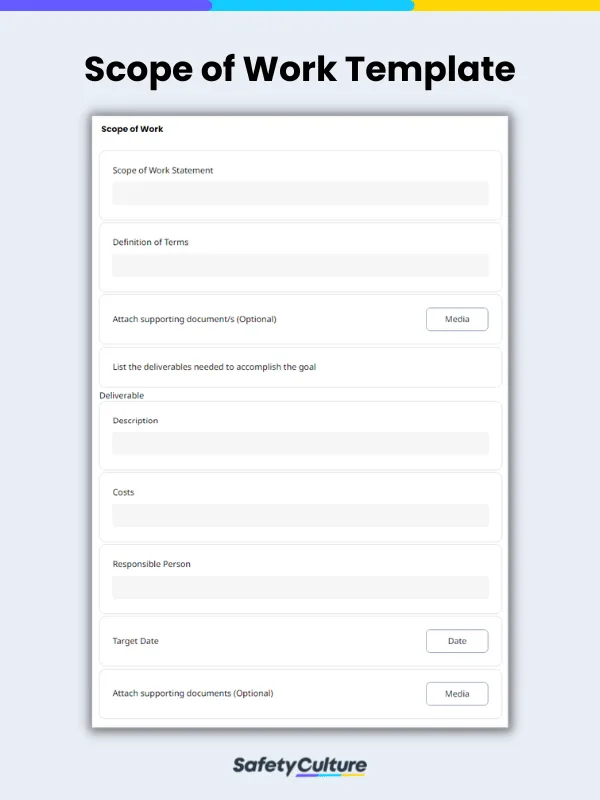
This SOW template for construction project management can be used and customized to outline critical details, such as deliverables, tasks, manpower, cost, and timeline for projects. This template enables email notification of task assignments to individuals and securing of electronic signatures for sign offs.
Powered by
This customizable digital checklist can help project managers list guide questions when preparing an SOW. Use this template to help you remember and accomplish important to-do items before getting your SOW ready for sign off.