5 Red Flags to Lookout For During Garments Quality Control
Reworks, due to garment defects and quality control issues, have been quite usual for the garment manufacturing industry. These result in manufacturers and suppliers wasting valuable time and money due to red flags that could have been caught early on.
When creating garments quality control checklists, here are 5 red flags quality control officers should watch out for to ensure a streamlined garments quality control process:
1. Communication Gaps
Misunderstandings are one of the main reasons that lead to disjointed garment quality assurance procedures. This red flag can lead to critical information not being passed to the right people at the right time, or inspection procedures that cannot be easily understood by garment quality inspectors.
What to do: Garment suppliers and manufacturers should constantly communicate and collaborate to ensure that everyone has the same level of understanding of product and packing requirements. Addressing communication gaps early on will help address any issue that may arise in a timely manner and avoid delays that hamper manufacturing timelines.
2. Insufficient Information
Garment quality officers should keep a keen eye on every detail of garment quality control processes. Incomplete tech packs (a design blueprint) and incoherent statements of quality standards are warnings that should be immediately rectified to avoid misinterpretation, frustration, and additional production costs.
What to do: A detailed and comprehensible garment quality control checklist will play a crucial role in how the finished garment meets the required specifications. Clarify requirements for testing procedures, desired sample size, testing schedules, and the garment quality control professional who is assigned to conduct the tests.
3. Lack of Staff Training
If checkers do not have a complete understanding of the level of quality expected of the products, low-quality garments would most likely end up on the sales floor, resulting in unsatisfied customers.
What to do: Quality inspectors play an important role in ensuring that only high-quality garments reach customers. It is important that they receive appropriate job training in order for them to properly carry out the process with a garment quality control checklist.
4. Faulty Garment Machinery and Equipment
Apart from being aware of potential communication and training gaps, garment quality officers should also pay attention to garment manufacturing hardware. There may be faulty machinery that may not have been maintained for years which can result in cutting, sewing, needling, and pressing garment defects.
What to do: Inspection of garment machinery and equipment can be included in a garment quality control checklist to ensure that no malfunctioning machines are in the line.
5. Frequent Changes in Production Planning
There may be designers or buyers that will send instructions to suddenly revise the design even when production is about to start. Abrupt changes, big or small, can significantly affect the production timeline and cause major delays and low-quality garments.
What to do: To address this red flag, the garment quality control checklist can be used to stipulate deadlines and the maximum frequency for changes in the design or production process. Stakeholders must agree to abide by the terms to maintain a smooth production timeline.
How to Check the Quality of a Garment in 5 Steps
Before starting each quality control inspection, internal and third-party quality control officers should have a clear set of requirements to compare with for the particular batch of garments. Once it’s secured, include all the key information needed to distinguish this batch from others, like the product order number, product description, and item number.
Then, proceed to the quality check by following these steps:
1. Check garment style and color.
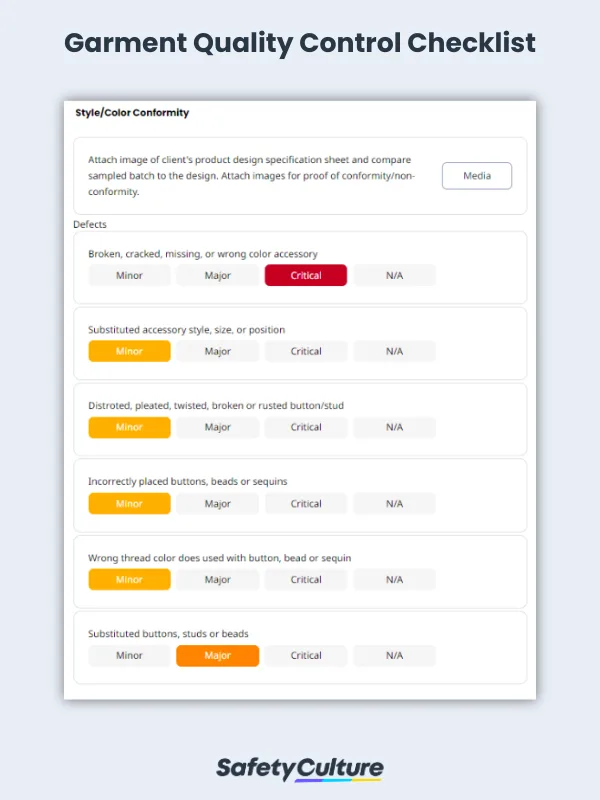
Perform a visual and detailed inspection of the garment’s color and style. Watch out for defects such as wrong color shade, incorrectly placed accessories, use of different materials and fabrics, or any other observations that are not according to the set specifications. For this inspection, you can use a table format to save time in checking these items. It will be helpful to attach a photo or video as proof of the recognized defect.
2. Measure garment dimensions.
Measurement is also one of the most important elements to inspect during garment quality control checks. Clothing done by hand is especially prone to dimension errors compared to that sewn using machines. As such, checking and taking note of the measurements using a table will help ensure that customers won’t receive wrongly-sized items.
3. Review quantity conformity.
Provide the essential details regarding the number of items in the inspected batch. This can include elements such as product reference number, order quantity, and available quantity based on pieces packed and unpacked, among others. Declaring and taking note of these details can help ensure that items are according to the expected quantity.
4. Do physical tests for buttons, zippers, and other accessories.
Specify the number of sample tests per batch and do a physical inspection of them. The goal is to make sure that the items are durable and free of underlying defects. This process typically consists of a pull test, fatigue test, stretch test, and buttonhole test.
A pull test involves pulling accessories with a fixed force for around 10 seconds. A fatigue test, on the other hand, involves QC inspectors repeatedly testing the accessories for their intended use at least 50 times. To be considered a pass, the accessories must remain undamaged after the test.
Stretch tests are mainly for elastic fabrics and straps where they are pulled and tested for proper elasticity without the fibers of the clothing breaking. Meanwhile, buttonhole tests, as the name suggests, are where buttons and buttonholes are checked for defects such as incorrectly-sized holes, incomplete stitching, or uncut holes.
5. Inspect marking, label, and packaging.
Lastly, quality check tests also involve inspecting the overall packaging of the products to ensure that it complies with brand specifications, market regulations, and industry standards. Accurate product labeling is also legally required in many markets, and failure to meet these requirements can result in fines and other penalties.
Following the above steps is easier when businesses and quality control officers use tools, such as digital apps or pre-made and highly-customizable garment quality control checklists.
Key Elements of an Effective Garment Quality Control Checklist
For an efficient and effective garment quality control process, what should a comprehensive checklist really include? To make it easier for you to find a reference, we’ve listed the essential items below:
Date and location of inspection/quality check
Inspector’s name
Report number
Client
Supplier
Product description
Product order number
Item number
Order quantity
Inspection type
Sampling standard
Specification sheet
Style and color conformity
Measurement check
Quantity check
Marking/label/packaging
Pull test
Fatigue test
Stretch test
Buttonholes test
Completion
Preview Garment Quality Control Sample PDF Report