What is a gemba walk checklist?
A gemba walk checklist is a tool used by management leaders to capture first-hand observations of what is exactly going on at the actual place where work happens. It helps document insights from discussions with employees and serves as a reference tool for improving processes and reducing existing waste.
Importance of using checklists for gemba walks
Gemba walks help leaders identify potential workplace hazards, maintain high safety and manufacturing standards, and monitor continuous improvement efforts using a mobile platform. Using checklists and templates plays a key role in their effectiveness and success. Here are some top reasons why you should consider it:
Focus and structure: Gemba walk checklists help leaders and managers maintain focus on key areas of interest, ensuring that important aspects of the workplace are not overlooked.
Consistency: The consistency of a Gemba walk checklist’s framework aids in making accurate comparisons and identifying patterns or trends across different observations.
Standardized benchmarking: Organizations can use a checklist to evaluate different areas or teams to identify gaps, share best practices, and drive overall process improvement based on standardized criteria.
Comprehensive data collection: Gemba walk checklists help leaders and managers capture diverse aspects such as safety, quality, workflow, and employee engagement.
Documentation and follow-up: The filled-out checklist can be a reference point for follow-up discussions, ensures that identified issues are not forgotten or overlooked, and aids in tracking progress and monitoring the effectiveness of improvement initiatives.
What to include in a gemba walk checklist
A general gemba walk checklist should help leaders explore the workplace and gain first-hand insight into themes such as safety, productivity, and cost efficiency, helping determine if work processes are performed according to standards.
Common gemba walk questions, grouped by focus area:
General Information
Department
Description of Work
Participants List
Process Analysis
Do you think the standard or process is clear?
What are we doing to meet the standard or process?
What is the goal we’re trying to achieve with this process?
Problem-Solving
What kind of problems are you running into here?
Why is this a challenge?
What have you done to determine the root cause?
Tools and Resources
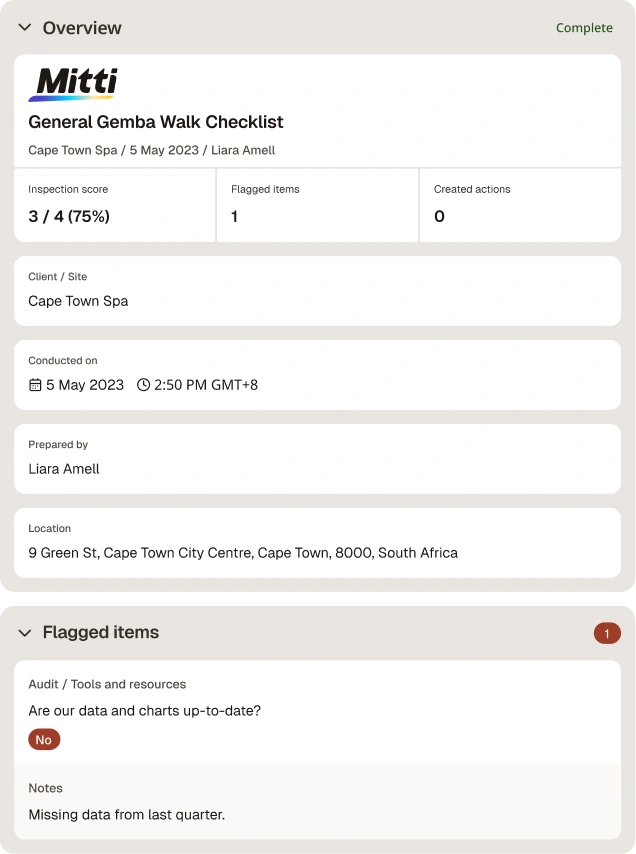
Are our data and charts up-to-date?
Do you have everything you need for this process?
What would help break down barriers to solving problems?
Continuous Improvement
What is today’s priority and why?
What do you intend to improve today?
Are there any other questions you want to raise?
Observations and Recommendations
In addition, remember to adapt the checklist based on your organization’s specific processes, industry, and goals. Involve employees in the checklist development process to ensure it captures their perspectives and needs. Safety-focused items should also reflect the hazard identification and Personal Protective Equipment (PPE) requirements set out in OSHA 29 CFR 1910 and the broader ISO 45001 occupational health and safety framework.
How to create one
Here’s a step-by-step guide on how you can create an effective checklist that can help you streamline your process of conducting gemba walks:
Describe the work process and list the names of participants.
Ask employees about the challenges they face on a regular basis.
Walk around the workplace and observe if processes are done according to standards and produce intended results.
Use techniques such as the 5 Whys to identify problematic areas and address root causes, and include them in your checklist.
Create your gemba walk checklist in collaboration with relevant stakeholders, employees, and leaders.
Once your checklist is ready for use, take note that you need to do the following as well:
Analyze observations and review checklist findings to gain insights into patterns, trends, or recurring issues.
Document recommendations and act on findings to create a solid action plan and prevent recurrence.
For manufacturing environments specifically, make sure to define the production line or cell you're walking, involve a shift supervisor who knows the daily variances, and time the walk to overlap with a shift changeover so you can observe handoff quality too.
Here is a free sample PDF report of a gemba checklist in use for reference:

Preview Gemba Walk Checklist PDF Report
Mitti Supply: Your one-stop work gear and equipment shop
During gemba walks, one key area to check is if workers are equipped with the proper PPE and other safety gear. To further help you improve and sustain your safety initiatives, Mitti Supply is here as your one-stop shop for all work gear and equipment needs. Get on-demand access to top quality and specialized work gear from trusted equipment brands in the industry—all in one centralized location.

Sydney Festival manages 60 venues, 150 events, 334 performances, and 900 artists using customized Mitti (by SafetyCulture) templates for inductions, toolbox talks, pre-event checks, incident reporting, and daily reports, enhancing safety and operations across all sites.


Still looking for a checklist?
Search, filter, and customize 60,000+ templates across industries and use cases.