What is an IATF audit?
An IATF audit is the process of evaluating an automotive manufacturer’s Quality Management System (QMS) compliance with the IATF 16949:2016 standard. This standard replaced ISO/TS 16949 and it intends to prevent defects, reduce waste, and facilitate continuous improvement.
A complete IATF 16949 audit checklist walks through every clause of the standard, covering leadership and planning, support and resource management, and operational controls. It should also capture objective evidence, nonconformance tracking, and sign-off fields so auditors can score compliance and flag corrective actions in one pass.
What is the IATF standard?
The IATF 16949:2016 standard was developed by the International Automotive Task Force (IATF), a global group of manufacturers and business organizations in the automotive industry that aims to build consensus on benchmarks for product quality and processes in the automotive supply chain.
Car manufacturers that are members of IATF require their suppliers to be certified for the new IATF 16949:2016 standard. Implementing the international standard, however, has some challenges.
Challenges of implementing the IATF 16949:2016 standard
Implementation isn't just a paperwork exercise. There are real challenges in transitioning to the new standard and maintaining compliance after the fact, particularly for the auditors and shop-floor teams who run it day to day. . Here are 3 of the common challenges in the implementation of the IATF QMS standard:
Challenge #1: Storing mandatory records
Compliance with the IATF standard requires documentation of every process you run. It also requires proof of audits conducted and corrective actions taken whenever nonconformance is observed. These records show whether issues are addressed and continuous improvement is actually happening. For teams using paper-based checklists, this creates real recordkeeping challenges. Paperwork piles up fast, and all of it needs to be manually stored, maintained, and organized.
Challenge #2: Providing timely action
Actions taken to address nonconformance need to be timely, easy to monitor, and properly documented. Addressing issues quickly prevents further defects and reduces waste across the supply chain. With paper-based checklists, data has to be manually entered into a database before a report can even be created. That delay defeats the purpose of a timely response.
Challenge #3: Maintaining accountability and competency
The IATF standard requires accountability from management and proof of competency from workers and auditors alike. Regular audits reinforce adherence to the QMS standard and demonstrate competency, both of which show up in the audit reports. With paper-based audits, proving accountability and competence is a challenge. Once paperwork piles up, the evidence becomes unmanageable.
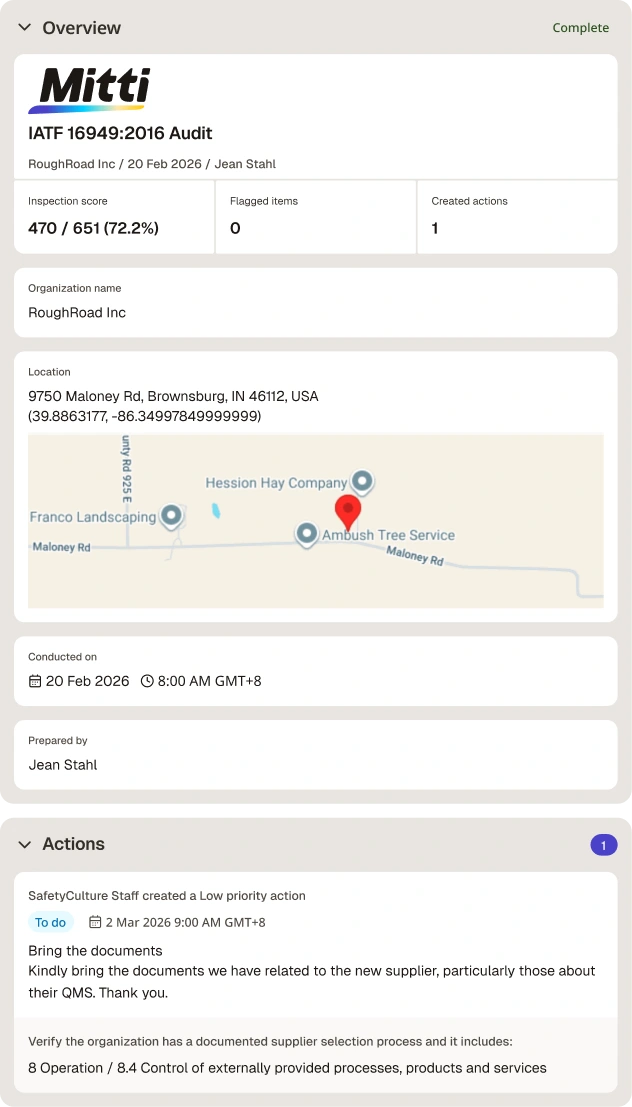
Sample IATF audit report
Platforms like Mitti (by SafetyCulture) make this easier by pairing your checklist with corrective action tracking, trend reports, and shared visibility across every shift and site. Here is a sample IATF audit report:

Common IATF 16949 audit nonconformances
Third-party auditors and OEM customers tend to flag the same handful of gaps. Common findings include:
Incomplete or outdated control plans and PFMEAs that don't match the current production process
Missing objective evidence for internal audits, especially layered process audits (LPAs)
Gaps in supplier management, including missing second-party audit records
Customer-specific requirements (CSRs) that aren't documented or mapped into the QMS
Calibration records that lapse or don't cover all measurement equipment
Build your checklist to test for these specific gaps rather than just the clause text, and you'll catch most nonconformances before a certification body does.

Still looking for a checklist?
Search, filter, and customize 60,000+ templates across industries and use cases.