Mitti by SafetyCulture
Pricing
Log inSign up for free
  1. Home
  2. Checklist guides
  3. Quality
  1. Home
  2. Checklist guides
  3. Quality
Mitti by SafetyCulture

The way the world works

Follow us

App Store
Google Play

Product

  • Pricing
  • Book a demo
  • Product updates
  • Mitti (by SafetyCulture)

Support

  • Help center
  • Contact us
  • API developer documentation
  • Digitize your checklist

Resources

  • Content library
  • App & software guides
  • Checklist guides
  • Topic guides
  • eBooks
  • Blog

Company

  • About
  • Careers
  • News room
  • Meet the leadership team
  • Events & webinars
Copyright © 2026 Mitti
StatusLegalPrivacyTerms & ConditionsSecurity

SafetyCulture has a new name. Say hello to Mitti. Learn More.

Powered by

Kaizen Report Template

Easily implement and monitor continuous improvement efforts using a mobile app.

Rated 4.6/5 stars on Capterra | 3k+ app store reviews
Use templatePreview template
Kaizen Report Template
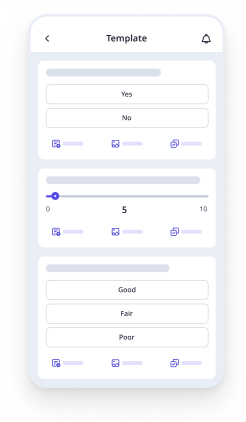
Mobile Preview
See the template in action (opens in new tab)

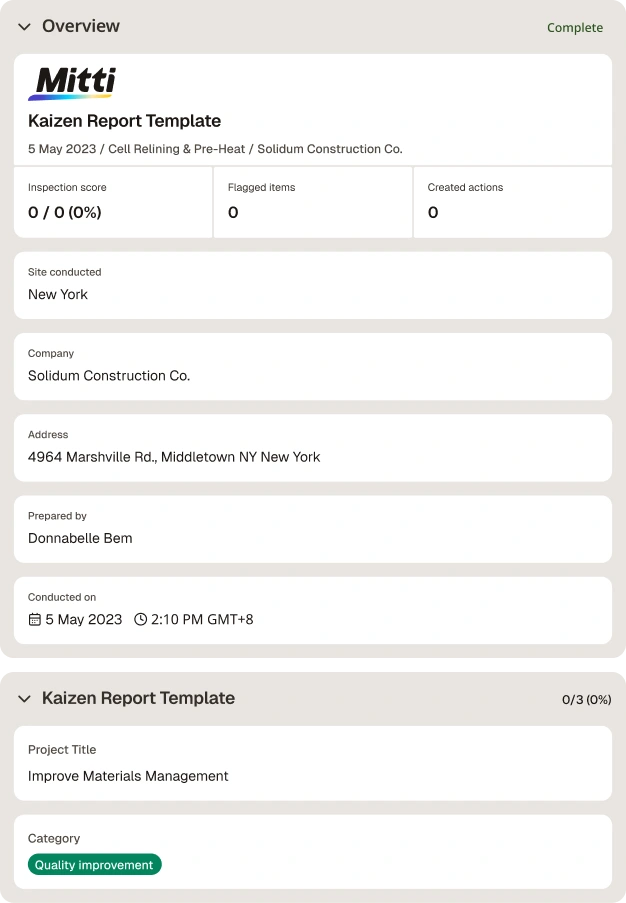
A kaizen report template is used by kaizen implementers to present changes in job tasks or processes after continuous improvement efforts. This kaizen report template has been designed to make it easier for employees and management to identify any of the 8 wastes and eliminate them for increased morale, productivity, and competitiveness. Use this kaizen report template to easily perform the following:

  1. Define the project, category, and section/process

  2. Identify the root cause of the problem, including 8 wastes

  3. Capture photo/video evidence before and after implementing kaizen

  4. Specify improvement measures such as 5S, Gemba, etc.

  5. Include additional or general comments then indicate the name and designation of participants

  6. Complete the kaizen report with a digital signature

Kaizen Report Template
Mobile Preview
See the template in action (opens in new tab)

Why Mitti digital checklists?

  • Free to use for up to 10 users

  • Eliminate paperwork with digital checklists

  • Generate reports from completed checklists

Use template
  • What are Kaizen Tools?
  • What is the Importance of Kaizen Tools?
  • What is the Kaizen Technique?
  • What are the 5 Main Kaizen Principles?
  • Kaizen Tools: Success Factors
  • See these factors in a kaizen report

In this article

  • What are Kaizen Tools?
  • What is the Importance of Kaizen Tools?
  • What is the Kaizen Technique?
  • What are the 5 Main Kaizen Principles?
  • Kaizen Tools: Success Factors
  • See these factors in a kaizen report

Eliminate paperwork with digital checklists

Skip the setup and get to work in seconds.

Use template

Article by

Jona Tarlengco

|

3 min read

|

29 Feb 2024

What are Kaizen Tools?

Kaizen tools are primarily used in the manufacturing industry to eliminate 8 wastes or DOWNTIME (Defects, Overproduction, Waiting, Non-utilized talent, Transportation, Inventory, Motion, and Extra-processing) and optimize business processes for global competitiveness. Kaizen tools help employees and management implement and monitor continuous improvement efforts in the workplace.

What is the Importance of Kaizen Tools?

Since kaizen means “change for the better”, the use of kaizen tools results in more efficient ways of doing tasks and more effective communication between shifts, work areas, and organization levels. Taking advantage of mobile-ready kaizen tools and templates can help cross-functional teams easily identify wastes, execute action plans, and report new changes.

What is the Kaizen Technique?

Kaizen as a business improvement technique is often practiced through a top-down approach, where the management demonstrates its commitment to operational efficiency. The kaizen technique of eliminating wastes to streamline workflows can be practically applied through a project-based format, which is often called a kaizen blitz.

What are the 5 Main Kaizen Principles?

There are actually 5 fundamental kaizen principles according to the Kaizen Institute, founded by Masaaki Imai—widely considered as the Father of Kaizen. It is unknown how the notion that there are “4 main kaizen principles”, sometimes 10 or even 15, developed, but they are probably variations or compressed/expanded versions of the 5 kaizen principles:

  • Principle #1: Know Your Customer

  • Principle #2: Let It Flow

  • Principle #3: Go to Gemba

  • Principle #4: Empower People

  • Principle #5: Be Transparent

Kaizen Tools: Success Factors

Continuous improvement begins with the admission that every organization has problems that provide opportunities for change. Here are 3 key factors cross-functional teams can do to successfully implement kaizen :

1. Focus on improving the process

Organizations usually fail in implementing kaizen because of reverting to a conventional approach of continuous improvement: “employees are the problem”. In implementing kaizen, apply a process-emphasis approach with kaizen tools by measuring performance, eliminating waste, and changing the process for the better. Employees and management should understand how their job fits in the process because good processes bring good results.

2. Enable people to do better

The people most knowledgeable about a task are those that perform it, so ownership of the process is raised to its highest level by involving them and showing confidence in their capabilities. Kaizen tools enable cross-functional teams to go where the real work happens and grasp the current situation because big results come from small changes everyone does on a daily basis.

3. Commit to data-driven decisions

Performance and improvements should be tangible and visible, so everyone is constantly reminded of implementing kaizen. Employees and management should practice speaking with data and managing facts.

See these factors in a kaizen report

Three three success factors look a bit different once they're put into practice. Take a look at this sample kaizen report to see how a team documented process issues, tracked the changes they made, and backed each decision with real data.

Kaizen Report Image

Preview Sample Kaizen Report PDF

Content library templates

Still looking for a checklist?

Search, filter, and customize 60,000+ templates across industries and use cases.

Browse Library
JT

Article by

Jona Tarlengco

Mitti (by SafetyCulture) Content Specialist

View author profile

Related resources you might like

Templates

Powered by

5s Audit Checklist

This 5s audit checklist template can be used by organizations as a guide in implementing and conforming to the 5s principle (sort, systematize, shine, standardize, and sustain).

View template in library

Powered by

Gemba Walk Checklist

Use this Gemba Walk checklist to document interviews, challenges and opportunities identified from your Gemba Walks. Begin the inspection with the description of work and list down the names of participants. Ask the employees if they are meeting the goals set for them and get their input about the process. Observe how employees solve their challenges and document their solutions and resources used for the job. Ask employees if they have concerns that they wanted to raise to the management. Lastly, provide your input on how to put in place and sustain a better process.

View template in library

Powered by

5 whys template

Use this 5 whys template to resolve the root cause of a problem so that your business teams can avoid encountering them again. Begin by clearly stating the problem and answer why the problem occurred until the root cause is discovered. To complete the 5 whys template, provide a solution to the root cause of the problem and create actions.

View template in library

Powered by

7 Wastes Checklist

A 7 wastes checklist is used by quality managers to reduce the 7 wastes of lean manufacturing: transport, inventory, motion, waiting, overproduction, overprocessing, and defects. Use this digital 7 wastes checklist to easily detect any of the 7 wastes, ensure the efficiency of daily processes and achieve operational excellence.

View template in library

Powered by

8 Wastes Checklist

An 8 wastes checklist is used by area supervisors to identify any of the 8 wastes (based on 7 wastes with non-utilized talent as 8th waste) and eliminate them in the workplace. This intuitive 8 wastes checklist include potential causes for each waste such as waiting for information, materials, and equipment too long or steps in the process that do not add value to the customer.

View template in library

Powered by

6S Lean Safety Checklist

Use the 6S Lean Safety Checklist to identify hazards or potential risks while performing tasks in the workplace. This 6S lean safety checklist is based on the 5S principles (sort, set in order, shine, standardize, sustain) with safety as the 6th “S”. Take a photo of steps or activities conducted and generate a report onsite.

View template in library

Powered by

8D Report Template

An 8D report template is used to document a comprehensive root-cause analysis based on the 8 Disciplines of Problem-Solving popularized by the Ford Motor Company. 8D Teams can use this template to generate their 8D report after completion.

View template in library

Powered by

FMEA template

Manufacturing engineers can use this FMEA template to help prevent production issues caused by industrial machinery failures. Observe trends of failure modes, effects, and causes. All Mitti (by SafetyCulture) templates can be customized to fit the needs of your business.

View template in library

Powered by

DMAIC Template

A DMAIC template can help ensure that Six Sigma practitioners apply the DMAIC methodology (Define, Measure, Analyze, Improve, Control) as a root-cause analysis for process improvements.

View template in library

Articles

CAPA Software

Discover the best CAPA software and efficiently mitigate risks and resolve persistent issues in your company with your top pick.

Learn more

A Short Guide on Certificate of Analysis

Learn what a certificate of analysis is, how it works, who needs it, its importance, and how to make one.

Learn more

IATF Audit

Assess IATF 16949:2016 compliance with a free IATF audit checklist. Capture evidence, score conformance, and flag corrective actions.

Learn more