
Best Practices
Regulation 79 is here for high-risk construction work in Western Australia (WA)
By Rafael Villamor29 Sept 20264 min read
From 1 October 2026, Western Australia's (WA) high-risk construction sector must follow Regulation 79.
Regulation 79 requires a set order of fall controls, rather than a fixed height limit.
Compliance means proving the right control was documented every time, not just once.
Important notice
The information contained in this article is general in nature and you should consider whether the information is appropriate to your specific needs. Legal and other matters referred to in this article are based on our interpretation of laws existing at the time and should not be relied on in place of professional advice. We are not responsible for the content of any site owned by a third party that may be linked to this article. Mitti disclaims all liability (except for any liability which by law cannot be excluded) for any error, inaccuracy, or omission from the information contained in this article, any site linked to this article, and any loss or damage suffered by any person directly or indirectly through relying on this information.
Falling one metre, you might get away with a scratch or two. Two metres is a different story.
Just last year, in July 2025, a construction worker fell 2.2 metres into an unfinished concrete swimming pool at a private property near Wootatting, WA. At that stage, it was just a hard concrete shell, essentially a pit in the ground.
The pool had been protected by scaffolding earlier in the build, but someone removed it to let work continue, and nothing was put back in its place.
WorkSafe WA fined a construction company $750,000, and its director a further $45,000.
That was not a freak accident. Their own safety plan had flagged this exact risk. Nobody followed through.
Which is why starting 1 October 2026, high-risk construction in WA loses its exemption from following Regulation 79 when it comes to falls from height. Everyone follows the same rules.
From 1 October 2026, WA's high-risk construction industry can no longer follow the old edge-protection rule for falls from 1996. Regulation 79 of the Work Health and Safety (General) Regulations 2022 becomes the operative rule in full, with no more grace period behind it.
This means no more fixed height numbers, like only requiring edge protection at two metres off scaffolds or formwork, or three metres off other edges. Instead, Regulation 79 sets a fixed sequence for working at heights, spelling out which fall control measures to try, and in what order, no matter the exact height involved.
If you fail to comply with these changes, WorkSafe WA inspectors can issue you a prohibition notice, which stops all work on the spot until the risk is fully addressed. Officers and directors can be held personally liable through due diligence duties under the same Act.
Better late than never, since falls from height accounted for 13 percent of all worker fatalities nationally in 2024, the second-highest cause of workplace death in the country behind vehicle incidents.
As stated before, Regulation 79 does not give a prescribed height. So the trigger isn't a number anymore. The trigger is whether a fall could cause an injury or not.
But what Regulation 79 does give, is an order of controls, and skipping straight to the easiest option isn't allowed if a better one could reasonably be used.
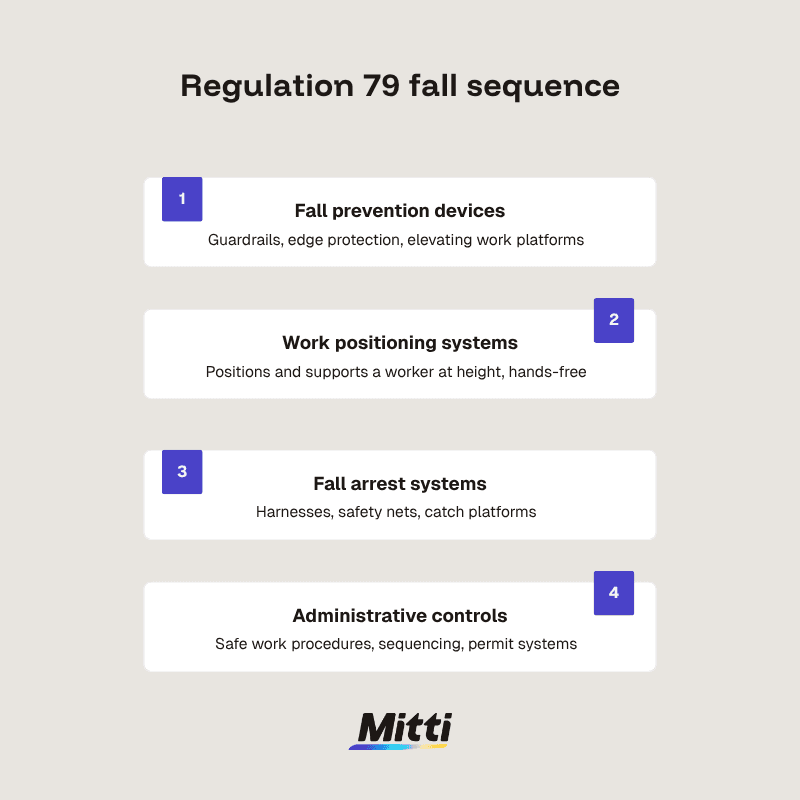
Regulation 79 fall sequence
A fall prevention device: If it's reasonably practicable to provide guardrails and edge protection so a worker can do their job like in roof work.
A work positioning system: If a prevention device isn't reasonably practicable, equipment that holds and supports a worker in place, hands-free, so they can do their job.
A fall arrest system: Only if neither of the above is reasonably practicable, harnesses and safety nets are the last resort so a worker can do their job.
Administrative controls: If a single control isn't enough on its own, safe work procedures, sequencing, permit systems and signage used alongside the others so a worker can do their job.
A combination of these can be used together when needed. But what can't happen is jumping straight to a harness because it's cheaper or faster than installing guardrails. That's exactly the shortcut this update closes off for high-risk construction.
Regulations like this aren't really about doing it once and forgetting. It's about proving, site after site and shift after shift, that the right control was chosen and documented before work started.
The best way to keep track of compliance is with an operations system like Mitti (by SafetyCulture). It gives your site supervisors a pre-loaded SWMS and fall-risk checklist, both fully editable, that your team can run before work begins. You can even attach photos and tag safety hazards in real time, and if WorkSafe asks for records six months later, your audits are already there, timestamped and tied to the specific job.
William Hare, a UK structural steel fabricator with 2,400 employees, moved from paper-based inspections to Mitti. A decade in, the company has logged over 180,000 inspections and stays audit-ready year-round.


