
Best Practices
By the end of September, England says one staircase isn't enough
By Rafael Villamor28 Sept 20264 min read
From 30 September 2026, every new residential building over 18 metres in England needs two staircases.
The rule traces back to Grenfell, where 72 people died with only one staircase serving the entire tower.
Approved Document K sets the staircase-dimension rule: twice the riser plus the going should land between 550mm and 700mm.
Important notice
The information contained in this article is general in nature and you should consider whether the information is appropriate to your specific needs. Legal and other matters referred to in this article are based on our interpretation of laws existing at the time and should not be relied on in place of professional advice. We are not responsible for the content of any site owned by a third party that may be linked to this article. Mitti disclaims all liability (except for any liability which by law cannot be excluded) for any error, inaccuracy, or omission from the information contained in this article, any site linked to this article, and any loss or damage suffered by any person directly or indirectly through relying on this information.
It's also worth noting that you can't just build any kind of staircase and call it a day. There are certain dimensions you need to abide by, and in England, that's set out in the Approved Document K.
Approved Document K uses a simple formula: (2 × riser) + going = 550mm to 700mm. So if your riser is 175mm, your going should land somewhere between 200mm and 350mm to stay in range.
This doesn't just apply to buildings taller than 18 metres. It applies to every new staircase built in England, regardless of height.
A second staircase eats into a floor plate. Less usable space per floor means fewer units, and in England especially, that's already showing up as a real constraint on how many homes get built.
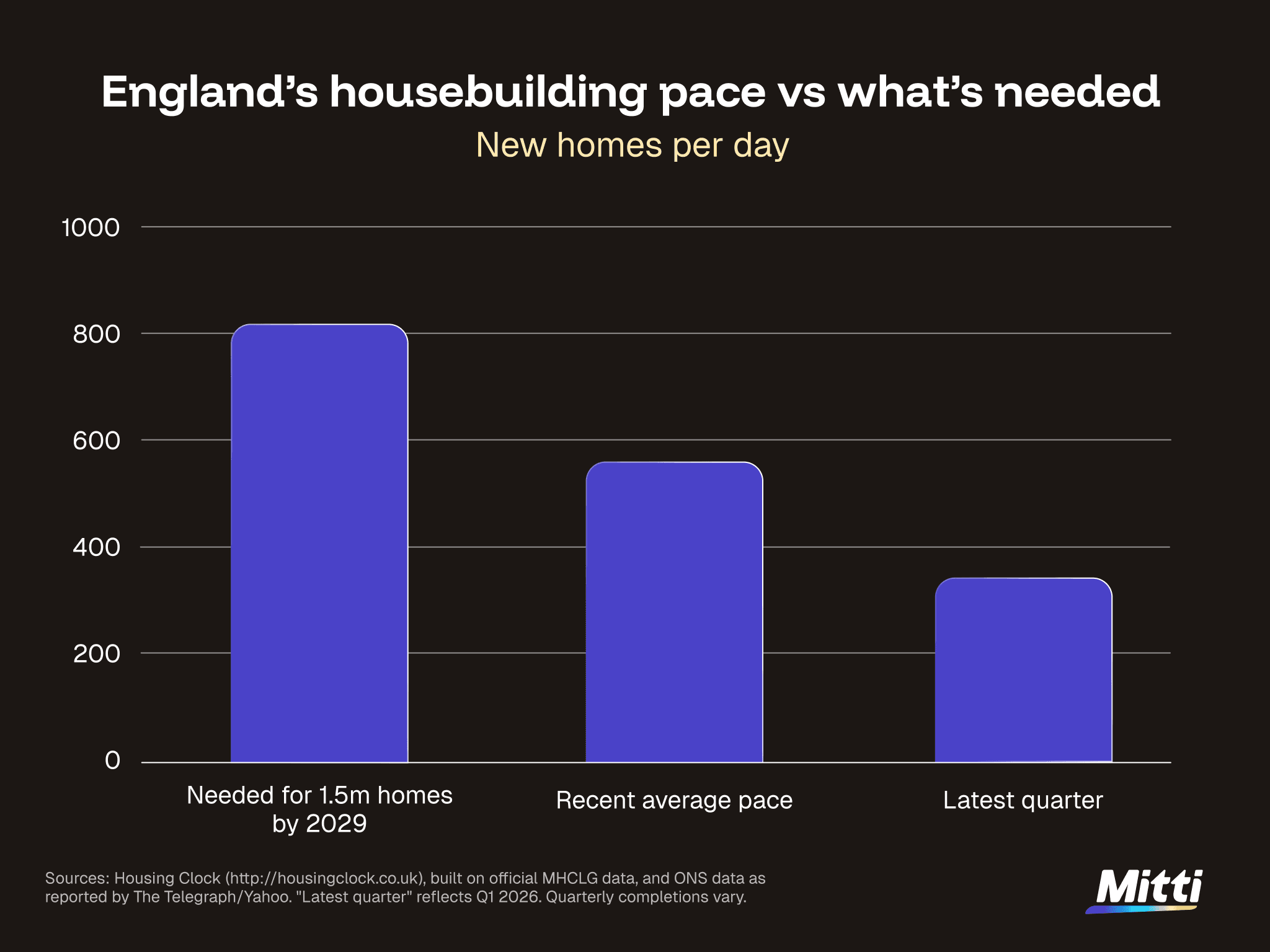
England's housebuilding crisis
England needs roughly 800 new homes built every day to hit its 1.5-million target by 2029, but the most recent quarter came in at less than half that pace. London has been hit hardest by the uncertainty leading up to the rule, with 38,000 homes on major developments stuck in the pipeline, according to London Assembly figures.
Also, with the addition of the second staircase, one widely shared estimate from consultancy Place Base puts the number at close to 90,000 fewer new homes over five years, roughly the size of Milton Keynes.
Centre for Cities also pushed back on some of that modelling, arguing that a properly maintained building with the right fire safety protocols will rarely have a fire that blocks one staircase for long, outside the very tallest towers.
The housing crisis is real, and poor fire safety protocols deserve their share of blame too. But neither of those facts makes safety any less important.
Right now, the most important thing when managing a construction project is the paper trail. Inspection records, sign-offs and knowing the exact date someone complained about a loose stair railing matter more now. A digitized fire risk assessment keeps your checks current, and gives you an audit trail that holds up, through an operations system like Mitti (by SafetyCulture).
ArcelorMittal Construction, a steel and building-envelope manufacturer operating 43 production sites across Europe, switched from paper-based audits to Mitti. It now runs almost 5,000 audits a year, cuts audit time by 50% and reports incidents in one minute instead of 10.
Built in the early 70s and standing at 24 storeys tall, Grenfell Tower was a revolution back in the day. But there was one flaw, and it was a big one. It only had one staircase.
So on 14 June 2017, a fire broke out, and residents were told to stay put because the flat where the fire started was said to contain it.
But the fire was so strong it found a way out and started spreading. With elevators offline, everyone had exactly one way down, the one staircase, and it was chaos.
Smoke started filling the stairwell, with people rushing down and firefighters running up to help people and let fire equipment through. All in one staircase.
Seventy-two people died in the fire, with property damage estimated at up to £1 billion.
Because of this, the second staircase rule was campaigned hard for. Starting 30 September 2026, every new residential building over 18 metres in England needs a second staircase.
The second staircase rule is a fire safety requirement under English building regulations. New residential buildings over 18 metres tall now need two separate protected stairways instead of one.
The rule sits inside Approved Document B, the technical guidance attached to the Building Regulations 2010. The Building Safety Act 2022, which also just got updated, is the biggest contributor to this. It created the Building Safety Regulator and the 18-metre risk threshold the second staircase rule reuses.
“We carry out almost 5,000 audits a year, and we also expect to report 8,000 hazardous situations or actions by 2022. This represents a huge workload for our managers. We had to find a solution to make their job easier and save them time.”


