
Powered by

Food allergy form
Proactively manage food allergies with a mobile app
Why Mitti digital checklists?
Free to use for up to 10 users
Eliminate paperwork with digital checklists
Generate reports from completed checklists
Powered by
Proactively manage food allergies with a mobile app
Why Mitti digital checklists?
Free to use for up to 10 users
Eliminate paperwork with digital checklists
Generate reports from completed checklists
A food allergy form is used for early recognition and management of allergic reactions to food. This is used by facilities involved in regularly serving food to a certain set of people (e.g., schools, daycare centers, etc.) Keeping a record of food allergies can help prevent serious health consequences that can be life-threatening.
Food allergy forms contain the following:
Participant information (e.g., participant and guardian name, contact number, etc.)
Food allergy (e.g., dairy, soy, eggs, peanuts, fish, etc.)
Food intolerance (e.g., gluten, lactose, fructose, histamines, etc.)
Dietary needs (e.g., soy butter, gluten-free breads, soy milk, etc.)
Food allergies are on the rise, affecting more than 30 million Americans as of 2020. In some cases, severe food allergies can be life-threatening. For this reason, those caring for someone with a food allergy must be aware of the allergy and know how to respond when an emergency arises.
A food allergy form can aid parents and caregivers in this task. For one, it helps the person with the allergy or their caregiver track the food items the person has eaten and note their reactions to them. This way, they have all the information needed, such as the type of allergy, what foods to avoid, and what to do during intense allergic reactions.
Moreover, having these details in one place can ensure that the person with the allergy is safe and that those who need to know about the allergy are aware of it. For example, it becomes easier to inform those preparing the person’s food of their dietary restrictions. Medical personnel can also use the information on the form to help them respond in the event of an emergency.
There is no known risk associated with using a food allergy form. However, it is important to ensure that the details to be placed in the document are accurate and verified by your doctor.
When in doubt, it’s best to ask your doctor before making any significant changes to the information written in the food allergy document. This is especially applicable to details about taking care of allergic reactions and modifying your diet. Food allergies can be dangerous to handle without professional supervision, so it’s vital to reach out to your doctor so that they can help you create a safe and healthy diet that meets your needs.
Food allergy forms are essential for individuals with allergies and their caregivers, as they can help track and manage food allergies. They come in different kinds, giving varying levels of information depending on what a person needs.
The first type is simple: a checklist of common food items that trigger people’s allergies. This checklist can help keep track of the foods a person needs to avoid an
d can also be helpful for the doctor if the person needs to be tested for food allergies. For this reason, it sets a good starting point for those who are just starting to track their food allergies.
Next, you have allergy forms filled out by a doctor. This document provides more detailed information, such as what symptoms a person experiences after eating a certain food. This type allows users to track current and past allergies, from the foods that caused a reaction to the treatments used. The doctor’s notes section in this type of form can be useful for monitoring the long-term effects of allergies.
Lastly, comprehensive food allergy templates can easily be tailored to a person’s needs. They would include information about their particular allergies, typically from a doctor’s allergy form. These forms can be supplemented with a food allergy action plan form, a guide for non-medical persons for handling emergencies related to allergies.
A food allergy action plan form or a food allergy and anaphylaxis emergency care plan outlines the recommended treatment instructions in case of an allergic reaction. This form is designed to help non-medically trained personnel to perform the appropriate treatment for severe allergic reactions like anaphylaxis in the event of an emergency.
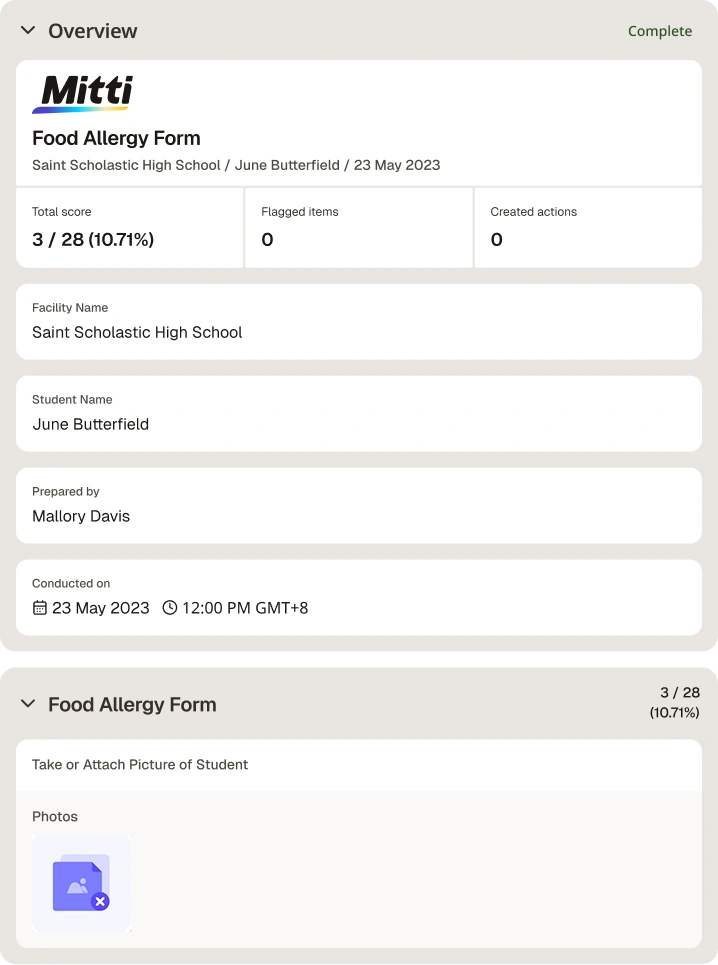
Here's a sample food allergy form in use for reference:

There is no cure for food allergies and intolerances, but you can avoid life-threatening situations caused by allergic reactions by fostering a proactive approach with the use of a food allergy action plan form.
Below are 5 elements that should be found in a food allergy action plan form:

Criteria A symptoms criteria will help the person responsible for treatment to identify the type of allergic reaction, whether it is: mild, moderate, or severe. This will determine which treatment instructions will be most appropriate to effectively manage the allergic reaction.
Medications and dosages Create a fillable section to identify the brand and dosage of epinephrine and antihistamine given to the participant with allergic reactions.
Treatment instructions A good food allergy action plan form should include instructions on how to recognize anaphylaxis and demonstrate how to give life-saving epinephrine.
Required signatures The allergy action plan form should be signed by a physician and the parent/guardian if the participant is a minor; otherwise, the patient will sign it to verify the information provided in the form.
Emergency contacts Emergency contacts are comprised of (but are not limited to) a rescue squad, doctor, parent/guardian, or any other relative. After treating the participant, the emergency contacts provided in the form will be contacted.

Search, filter, and customize 60,000+ templates across industries and use cases.
Powered by
A food allergy action plan form is used to provide a treatment plan for the participant in case of an emergency. Use this checklist as a guide in treating mild or severe allergic reactions.
Powered by
Local authorities and food establishment owners can use this checklist to determine the presence of potential allergens used in food preparation and prevent them from being mishandled. Mishandling these allergens can result in unfavorable scenarios that could negatively affect businesses and harm customers. This specific checklist helps ensure a streamlined allergen-handling process by covering the following areas:
Staff training
Suppliers
Purchase and delivery of goods
Storage of goods
Handling and preparation
Cooking
Hot holding, display, and service
Cooling and chilled holding
Cold display
Purchase by customer
Consumption on the premises
Washing up and general cleaning
Reuse of leftovers