What is a competency assessment template?
A competency assessment template is a tool used to systematically measure skills gaps for specific roles across an organization. An effective competency assessment template should cover three key competency categories when assessing an employee’s capability: technical, behavioral, and organizational.
What is a competency assessment?
A competency assessment measures an employee’s skills, knowledge, and behavior against the requirements of their role to find gaps worth closing.
Competency assessment is the process used by organizations to identify an employee’s suitability for a given role. It is conducted either initially or periodically by a qualified individual assigned by the organization to measure an employee’s skills, knowledge, and performance against pre-defined benchmarks and job requirements. This test aims to determine gaps in skills and performance of an employee to determine the appropriate corrective actions such as providing training.
Why perform these assessments?
Competency assessments are used to help identify gaps between an organization’s strategic plans and its existing employee competencies. They can assist with evaluating how employees use their knowledge and skills in on-job situations. Conducting competency tests can also help prioritize areas for further development and support focused on hiring decisions to fill those gaps.
The US Office of Personnel Management treats job analysis as the foundation of every assessment and selection decision, because it links each task to the competencies needed to do it and gives the process legal defensibility.
To simplify this process, using a competency assessment template can be a game-changer. Here are the top reasons to utilize this template in your organization:
Consistency – By outlining specific competency benchmarks and scoring systems, evaluators can carry out assessments consistently with no room for ambiguity or subjectivity.
Efficiency – Templates provide a ready-to-use framework, reducing the time and effort needed to develop competency assessment tools.
Focus and Direction – A well-designed template enables organizations to target specific skills and behaviors crucial for job success, making it easier for HR teams to find skill gaps and tailor training and development programs to address them.
Scalability – These forms can be tailored for a wide range of competencies, which allows organizations to deploy competency evaluations across diverse teams and departments.
Adaptability – Templates can be revised based on changing organizational needs, ensuring alignment with ever-evolving business goals and industry trends.
What to include in a competency assessment template
Competency assessment forms may have varying structures based on the job or task to be evaluated. But in general, they must cover the following components:
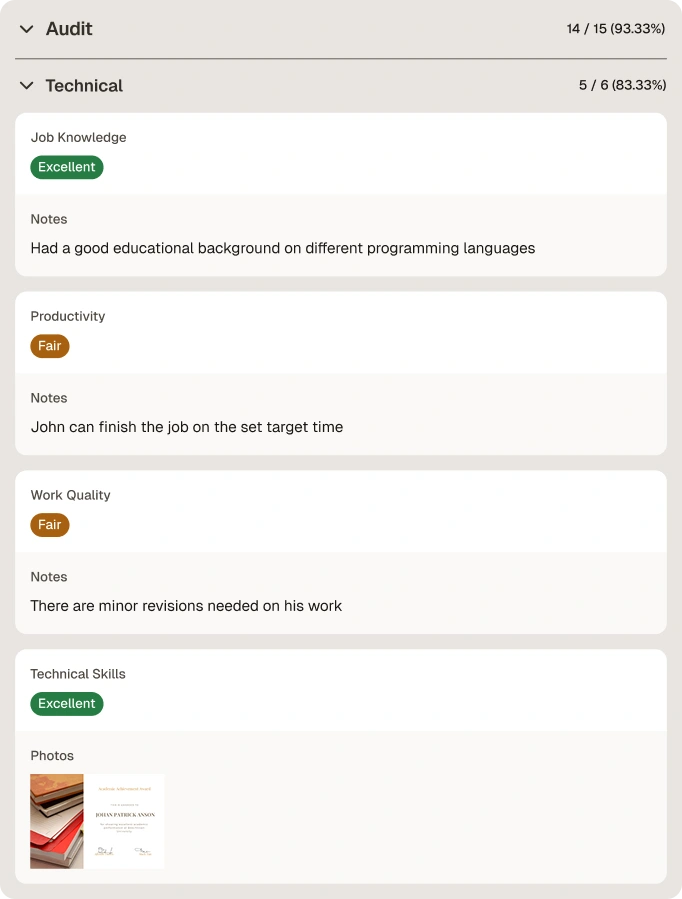
Technical – job knowledge, productivity, work quality, technical skills, creativity, communication skills
Behavioral – enthusiasm, cooperation, attitude, initiative, punctuality, attendance
Organizational – work consistency, work relations, dependability
Recommendations – key points for improvement
Overall competency assessment rating – competent, needs work, not suitable
Keep the list tight. Federal assessment guidance suggests four to eight competencies per assessment, each measuring one thing and each clearly tied to the role. Longer lists take more time to complete and give you weaker signal.
How to use a competency assessment template
Start from the role, not the form. These nine steps take you from role requirements to a completed assessment you can reuse each cycle.
Define the purpose and objectives of the competency assessment.
Establish a competency framework for the role. List the competencies the job actually requires, group them as technical, behavioral, and organizational, and set the required rating for each one. Pull the requirements from the job description and from people currently doing the work well.
Choose the assessment method that fits each competency. Direct observation and practical demonstration work for equipment and technical skills. Behavioral interviews suit judgment and communication. Self-assessment paired with a peer evaluation or supervisor review shows where someone’s view of their own work differs from what the floor sees.
Set specific benchmarks for each competency included in the assessment.
When administering the competency assessment, give clear and comprehensive instructions to both employees and evaluators.
Once the assessment is complete, analyze the results to identify patterns and determine strengths and weaknesses for individual employees and the overall workforce.
Based on the competency test results, design personalized development plans to strengthen the identified competencies effectively.
During the implementation process, regularly monitor the employee’s progress on their development plans.
Run periodic reviews to evaluate the effectiveness of the assessment template and adjust as needed to get the best results.
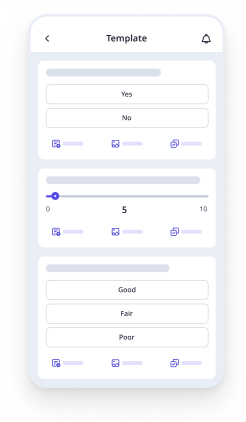
Assessments happen where the work happens. Assessors can run the form on a phone or tablet at the jobsite, attach a photo as evidence, and sign off on the spot. Platforms like Mitti (by SafetyCulture) then connect the result to what comes next: a failed competency raises a corrective action, and a gap that repeats across a team feeds into a training course people complete on the same app. If you’re assessing at scale, our roundup of competency assessment software compares the options, and risk assessment training covers how competency reviews fit into a wider training program.
Sample competency assessment
To better illustrate how things work, here’s a sample employee competency assessment report for your reference:


Still looking for a checklist?
Search, filter, and customize 60,000+ templates across industries and use cases.