What is an investigation report template?
An investigation report template is a standardized document designed to record the findings for an investigation. It provides a structured format to ensure that all critical aspects of the investigation are covered, organized, and easy to understand. A template for an investigation report can be used in workplace incidents and other inquiries that require a comprehensive documentation.
Investigation report vs. incident report
An incident report captures what happened. An investigation report explains why it happened and what should change. The incident report gets filed within hours by whoever was on the scene. The investigation report comes later, once someone has gathered evidence, interviewed witnesses, and reached a conclusion.
Purpose: An incident report records the facts of the event. An investigation report establishes cause, findings, and recommendations.
Who writes it: A supervisor or the worker involved files the incident report. An impartial, trained investigator writes the investigation report.
Timing: The incident report goes in immediately after the event. The investigation report follows evidence gathering and interviews.
What it contains: The incident report covers date, location, people, and what happened. The investigation report adds evidence analysis, witness statements, a conclusion, and recommended actions.
How it ends: The incident report becomes a filed record. The investigation report ends with a substantiated, unsubstantiated, or inconclusive finding.
The two work together. A thorough incident investigation starts from the incident report and ends with the investigation report. OSHA recommends investigating every incident, including near misses, because a close call this month is often the injury next month.
Step-by-step guide to conducting workplace investigations
Now that you know what to include in investigative reports, here’s a step-by-step guide on how to run a thorough workplace investigation:
1. Assess whether to investigate
Before launching a full investigation, determine if a formal process is necessary. This typically applies when there are serious allegations such as harassment, discrimination, safety violations, or recurring misconduct rather than minor or purely interpersonal issues.
2. Take immediate interim measures (if needed)
If there’s any immediate risk to safety or fairness, put temporary measures in place, such as team reassignments or paid leave, but avoid actions that could be perceived as punitive.
3. Plan the investigation
Choose an investigator who is impartial and trained, internally or externally, with no conflicts of interest. Develop a plan by drafting a timeline, and list interviewees, evidence sources, confidentiality protocols, and documentation procedures. Acas guidance suggests appointing someone more senior or experienced where the case involves gross misconduct, discrimination, or bullying.
4. Maintain confidentiality and transparency
Explain that while sensitive information stays private, some details may need to be shared on a need-to-know basis for the process to be fair. Everyone involved has rights that apply throughout, and setting those out early prevents disputes later.
5. Gather evidence
Secure relevant emails, files, policies, surveillance footage, physical evidence, and incident reports. Maintain a clear chain of custody. Platforms like Mitti (by SafetyCulture) let investigators attach photos, files, and notes to the report from a phone at the scene, with a timestamp on every entry, which keeps that chain intact.
6. Conduct interviews
Identify interview subjects such as complainants and witnesses, and formulate necessary questions. Take detailed notes or record the session with consent, and preserve the integrity of the record.
7. Review and analyze evidence
Look for consistency, credibility, corroboration, or discrepancies among statements and evidence. Consider reliability, demeanor, potential bias, and alignment with other evidence.
8. Take appropriate action
Implement proportionate and consistent actions, ranging from training and warnings to disciplinary measures. Also communicate outcomes separately to complainant and respondent, offering sufficient context without breaching confidentiality.
What to include in an investigation report template
Investigative reports can differ based on the industry of a business. There are, however, certain important elements that should always be included in a comprehensive report. Here are the primary details to include and create an effective investigation report checklist:
B ackground information of the case
N ames and titles of investigators
O rganization name
T ype of case (complaint, violation, incident, or accident)
C ase summary
P roof or evidence such as photos, footage, email records
I nterview (as needed)
C ase conclusion, findings, and recommended actions
R equired signatures
How to use an investigation report template
The accuracy of an investigation report lies in its structure. It is also ideal if investigation reports are performed in a tool that allows easy collaboration, documentation in one safe location, and real-time report generation. For example, an effective internal investigation report template follows this format:
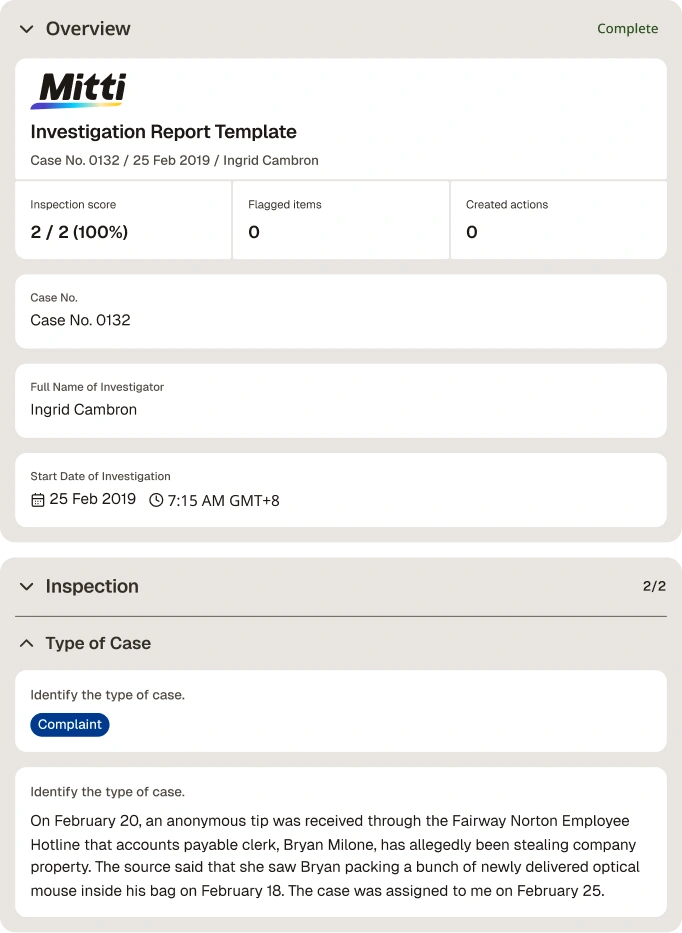
Ask for basic information: This is the backbone of the investigation report. Include the name, subject, contact details, the party conducting the investigation, the assigned investigator’s name, case number, and the dates that the case was created and completed (if applicable).
Specify the type of case: Before proceeding with the report, identify the type of case to be investigated. It can be a case of a complaint, violation, incident, or an accident. Specifying this helps you collect the right data needed for a cohesive report.
Gather supporting details: Provide a summary of the complaint by detailing initially known facts. It will also be helpful to include who was involved in the case and how the report was received.
Provide evidence: Strengthen the report by attaching a photo of tangible evidence. This evidence can be in the form of footage, email records, security records, computer login records, documents, and physical objects, among others. It will also be ideal to conduct interviews with people involved or those who witnessed the incident firsthand.
Arrive at a conclusion: After reviewing case notes and analyzing claims and evidence, the investigator will then formulate a conclusion and indicate whether the case is substantiated, unsubstantiated, or inconclusive.
Investigation report example
Below is an actual investigation report example that shows and follows how to write an investigative report:
Alicia Bates alleges that Clark Nichols, a payroll clerk, has been falsifying his timesheet. Alicia says that she noticed a discrepancy when she reviewed the timesheets in preparation for the January 2019 payroll. On February 4, Alicia required Clark to explain in writing said discrepancies and saw that it did not align with the hours that he reported.
CCTV footage shows that Clark was not in the office during the times he reported in his timesheet. I interviewed Clark on February 11, and he denied the allegations. He said that he would start as early as 4 AM sometimes and go to a local fast food chain for breakfast by 8 AM, which he argued explained his absence. Clark sought the assistance of a fellow payroll clerk, Alfred Mariano, to cover up his conduct. I interviewed Alfred on February 12, and he said that he usually sees Clark in the office after their lunch break.
There is clear evidence to prove that the subject falsified his timesheet, a violation of the Company Code of Conduct Section 3. Therefore, the complaint is substantiated.
Sample investigation report
To give you a better idea of what an investigation report looks like, below is a final investigation report sample PDF we’ve created using an investigation report template.
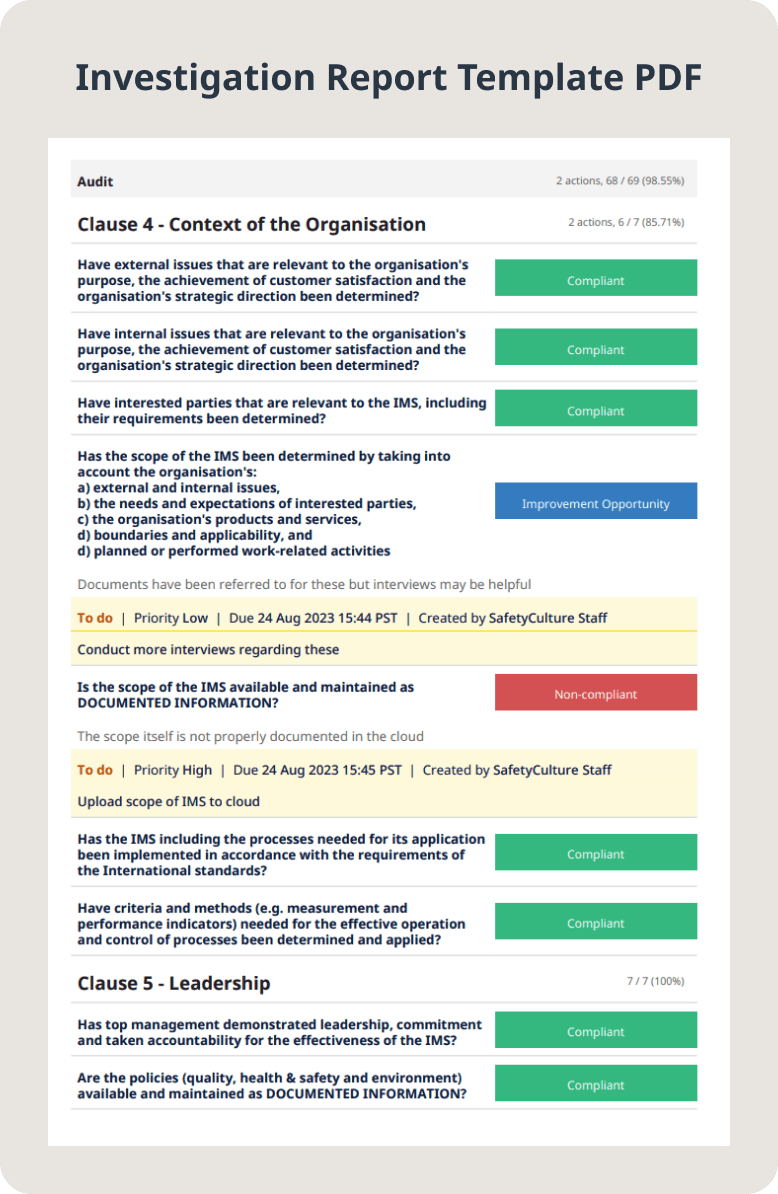

Their teams use custom investigations templates to learn from incidents, resulting in faster, more thorough reviews and early hazard detection—preventing small mistakes from becoming significant problems.


Still looking for a checklist?
Search, filter, and customize 60,000+ templates across industries and use cases.