Mitti by SafetyCulture
Pricing
Log inSign up for free
  1. Home
  2. Checklist guides
  3. Operations
  1. Home
  2. Checklist guides
  3. Operations
Mitti by SafetyCulture

The way the world works

Follow us

App Store
Google Play

Product

  • Pricing
  • Book a demo
  • Product updates
  • Mitti (by SafetyCulture)

Support

  • Help center
  • Contact us
  • API developer documentation
  • Digitize your checklist

Resources

  • Content library
  • App & software guides
  • Checklist guides
  • Topic guides
  • eBooks
  • Blog

Company

  • About
  • Careers
  • News room
  • Meet the leadership team
  • Events & webinars
Copyright © 2026 Mitti
StatusLegalPrivacyTerms & ConditionsSecurity

SafetyCulture has a new name. Say hello to Mitti. Learn More.

Powered by

Project Initiation Document Template

Lay the groundwork for your project at its early stages with a Project Initiation Document (PID) template.

Rated 4.6/5 stars on Capterra | 3k+ app store reviews
Use templatePreview template
Project Initiation Document Template
Mobile Preview
See the template in action (opens in new tab)

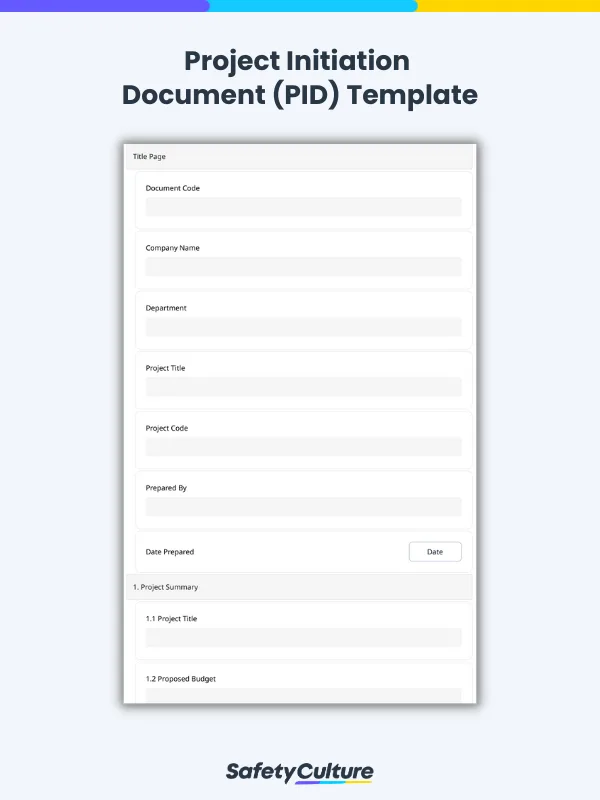
Project managers can use this project initiation document template to outline basic project details—from its scope and objectives to its approach and performance parameters. Before carrying out a project, set everyone’s expectations by:

  • Writing a summary of the project

  • Defining the project’s purpose, objectives, scope, and key deliverables

  • Determining the performance metrics and delivery approach

  • Attaching relevant project documents

  • Signing off the document for approval

Project Initiation Document Template
Mobile Preview
See the template in action (opens in new tab)

Why Mitti digital checklists?

  • Free to use for up to 10 users

  • Eliminate paperwork with digital checklists

  • Generate reports from completed checklists

Use template
  • What is a Project Initiation Document (PID)?
  • Why is it Important?
  • What to Include in a Project Initiation Document Template
  • How to Make a Project Initiation Document
  • FAQs about PID Templates

In this article

  • What is a Project Initiation Document (PID)?
  • Why is it Important?
  • What to Include in a Project Initiation Document Template
  • How to Make a Project Initiation Document
  • FAQs about PID Templates

Eliminate paperwork with digital checklists

Skip the setup and get to work in seconds.

Use template

Article by

Leizel Estrellas

|

5 min read

|

23 Apr 2024

What is a Project Initiation Document (PID)?

A Project Initiation Document (PID) lays out foundational information about the project, such as its context, purpose, scope, management, and success metrics. It provides project teams with an initial overview of how things will work before carrying out the project. With a PID, project teams can confidently take the first step in the right direction toward successful project implementation.

Why is it Important?

A project initiation document is essential for two purposes: guidance and buy-in. First, it maps out all the necessary details to help teams kickstart the project before the project planning stage. By setting the tone and context of the project, team members will know what to expect once the project commences. It also serves as a basis for critical decisions at the early stages of the project.

Aside from this, a PID is crucial for securing stakeholder buy-in for the project. Creating a solid PID, alongside a compelling business case, can build your stakeholder’s trust and confidence in carrying out the project, which is key in convincing them to get on board with your project.

What to Include in a Project Initiation Document Template

Project managers can benefit from using a project initiation document template to simplify the writing process. Managers simply need to fill in the information in this template and submit their proposals with ease.

Generally, a PID template consists of the following parts:

  • Summary – Briefly discuss project details such as its title, code, budget, and timeline.

  • Definition – Introduce the project to the readers by explaining its background, purpose, scope, and deliverables.

  • Cost-benefit analysis – Describe how the project can add value and drive business growth and what setbacks the project teams might encounter while implementing it.

  • Roles and responsibilities – Designate persons and teams responsible for specific tasks in the project. Establish a clear structural hierarchy with an organizational chart.

  • Project strategy – Map the specific steps that the team will take to reach the project goals and targets. This can also include performance metrics, monitoring mechanisms, and communication strategies.

  • Approval – Provide a space for the project owner or manager to approve the document.

How to Make a Project Initiation Document

After learning the items to include in a PID template, this section will walk you through the steps in creating your own project initiation document:

1. Give Context to the Project.

When writing a PID, the first thing to establish is the project’s background. What exactly are the business drivers that necessitate this project? It can be an opportunity for business growth or a problem that needs to be solved.

2. Establish the Project Framework.

Once you’ve contextualized the project, proceed with discussing its general framework. This section keeps your team aligned with the approach of the project in line with its goals. Some details to consider while writing this section include the following:

  • Objectives – Describe specific outcomes that the project aims to achieve.

  • Scope and limitations – Briefly summarize what areas fall under and outside the scope of the project.

  • Key deliverables – List the specific outputs that the project aims to deliver.

3. Present Your Business Case.

After polishing the basic project details, it’s time to justify your project’s use case to the board and stakeholders. Explain how your project will benefit the company and balance it with the potential constraints you might face before or during its implementation.

This section is crucial for getting everyone on board with the project, so make sure to dedicate enough time to present your case. A business case template proves to be a helpful tool for this endeavor.

4. Assign Roles and Responsibilities.

Upon completing your business case, you can now designate who’s responsible for specific tasks in the project. In this section, specify the role, the person assigned, and a short description of their responsibilities. Doing so lets team members know what their job is and what they are accountable for.

It also helps to have an organizational chart that clearly illustrates the project hierarchy. This chart informs everyone of whom to report to, especially in case of troubleshooting issues.

5. Define Specific Steps and Control Mechanisms.

Lastly, a project initiation document should include your initial project strategy. In this section, you can map out a tentative project timeline and specify mechanisms for project control.

Start by having a rough sketch of the project milestones, deadlines, and specific deliverables. Follow this by outlining benchmarks for success and mechanisms to monitor the progress of the project, including communication channels with stakeholders. You can also attach your initial project plan or project plan template in this section for further details.

To illustrate this case, here’s an example of a project initiation document template when completed in a digital format:

Project Initiation Document Template Sample Report

Project Initiation Document Template Sample Report | Mitti (by SafetyCulture)

Content library templates

Still looking for a checklist?

Search, filter, and customize 60,000+ templates across industries and use cases.

Browse Library

FAQs about PID Templates

LE

Article by

Leizel Estrellas

Mitti (by SafetyCulture) Content Specialist

View author profile

Related resources you might like

Templates

Powered by

Project Process Documentation Template

This project process documentation template is ideal for project managers who need to accurately document project processes. It has separate pages for the 5 process groups in project management—initiation, planning, execution, monitoring, and closing. Each page contains different sections that include the following process documentation elements:

  • Owner

  • Boundaries

  • Inputs

  • Outputs

  • Activities

  • Tasks

  • Steps

View template in library

Powered by

Business Case Proposal Template

This business case proposal template is based on an excerpt from the detailed template provided by an AU-based state department of industry, tourism, and trade. Use this template to cover the details of the proposed project with a focus on the problem to be addressed or opportunity to be harnessed. It mainly consists of the background, what initiated the project, why its sponsors want to do the project, options analysis and its outcome, and conclusion.

View template in library

Powered by

Scope of Work Template

Project managers can use this Scope of Work (SOW) template to clearly define all the work needed to fulfill a client’s requirement and create an enforceable document. Determine the key deliverables and their costs before handing things to the client and contractor for approval.

View template in library

Powered by

Project Charter Template

Project managers can use this project charter template to outline the details of a project prior to its execution.

View template in library

Articles

Recreation Management Software

Explore top recreation management software to streamline operations, enhance user experience, and simplify managing recreational activities.

Learn more

Transportation and Logistics: What’s the Difference?

Learn about the importance of transport and logistics within the supply chain and how it is used in business operations.

Learn more

Restaurant Checklist

Download free restaurant checklists for opening, closing, cleaning, safety, and health inspections—with templates for every shift.

Learn more