Mitti by SafetyCulture
Pricing
Log inSign up for free
  1. Home
  2. Checklist guides
  3. Operations
  1. Home
  2. Checklist guides
  3. Operations
Mitti by SafetyCulture

The way the world works

Follow us

App Store
Google Play

Product

  • Pricing
  • Book a demo
  • Product updates
  • Mitti (by SafetyCulture)

Support

  • Help center
  • Contact us
  • API developer documentation
  • Digitize your checklist

Resources

  • Content library
  • App & software guides
  • Checklist guides
  • Topic guides
  • eBooks
  • Blog

Company

  • About
  • Careers
  • News room
  • Meet the leadership team
  • Events & webinars
Copyright © 2026 Mitti
StatusLegalPrivacyTerms & ConditionsSecurity

SafetyCulture has a new name. Say hello to Mitti. Learn More.

Use template
  • What are Vessel Arrival and Departure Checklists?
  • Why are Arrival and Departure Checklists Important?
  • What are the Main Points to Review in Pre-Arrival and Pre-Departure Checklists?
  • Vessel Arrival and Departure Checklist FAQs

In this article

  • What are Vessel Arrival and Departure Checklists?
  • Why are Arrival and Departure Checklists Important?
  • What are the Main Points to Review in Pre-Arrival and Pre-Departure Checklists?
  • Vessel Arrival and Departure Checklist FAQs

Eliminate paperwork with digital checklists

Skip the setup and get to work in seconds.

Use template

Article by

Mitti (by SafetyCulture) Content Team

|

4 min read

|

25 Jul 2025

What are Vessel Arrival and Departure Checklists?

Also called pre-arrival and pre-departure checklists, these are tools used by mariners to ensure that a ship is ready to dock at ports or is seaworthy before departure for the next destination. These checklists help with conducting inspections and document all findings through a systematic process.

Vessel arrival and departure checklists serve as a guide for seafarers to guarantee that all necessary and crucial steps are taken to help promote safety and comply with international regulations and standards.

Why are Arrival and Departure Checklists Important?

How does having a pre-departure and pre-arrival checklist help you? Vessel arrival and departure are time-sensitive and depending on current circumstances at sea and shipyard port, can be challenging and dangerous. Through checklists, seafarers can prepare for arrival and departure of ships more efficiently as well as promote the following:

• Security and safety of the crew and passengers

Arrival and departure checklists help the crew go through all the essential steps to ensure the safety of the ship’s arrival and departure—both for the people on board as well as those at the seaport.

• Damage prevention

The checklists contain steps on what to check first to make sure that the ship, its cargo, and the port are safe for docking and departure.

• Timely departure and arrival

Using a checklist can help with efficiency, thus saving time, and help the ship stay on schedule. Inefficiency and delays can result to costly recurring penalties and damage business reputation.

What are the Main Points to Review in Pre-Arrival and Pre-Departure Checklists?

Pre-arrival and pre-departure checklists aim to cover all essentials beforehand, in compliance with international and local regulations and standards. Here are some of the main points covered by arrival and departure checklists:

Arrival

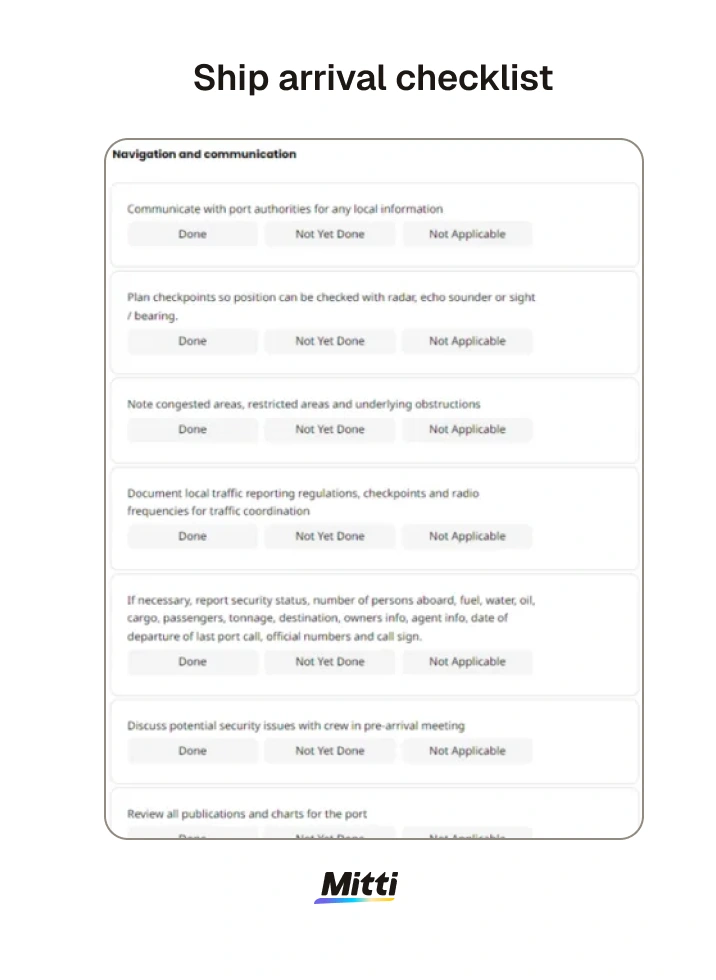
  • Navigation and communication

    • Provide all ship information required by the port authorities

    • Meet the crew and inform them of any potential security concerns

    • Check lights and test inter-ship communication

    • Be aware of any obstruction to the ship’s arrival

  • Documentation

    • Prepare all documentation needed for the port call, ensuring that they have the ship’s official stamp and signature of the Master

  • Steering and propulsion

    • Test the steering gear (per SOLAS Regulation)

  • Safety

    • Check the perimeter of the ship and secure mooring lines, cables, and straps

    • Ensure that the main engine gear boxes are in good working condition

    • Secure any loose objects on the bridge

  • Crew

    • Brief the crew on duties during mooring

    • Remind crew of protocol regarding suspicious activity

  • Pilot

    • Be ready for the pilot’s arrival and boarding

    • Be briefed on any security issues, regulations, etc, at the port

  • Secured along side

    • Inform engineering when ready to secure engines

    • Put radar on standby

    • Monitor communications with port authorities using radios

Departure

  • Navigation and communication

    • Ensure crew members are oriented on vessel duties (per SOLAS Regulation)

    • Check that voyage plan has an updated crew list

    • Ensure that authorities have provided permission to depart

    • Check lights and test inter-ship communication

    • Test radars and other essential equipment to ensure good working condition

    • Ensure that the flag hoisted is appropriate for the destination

  • Documentation

    • Record the vessel’s draft in the logbook (per 46 CFR 131.510)

    • Ensure that log compasses are on and gyro settings are correct

    • Check and log if the Global Maritime Distress and Safety System (GMDSS) is in good working condition

    • Check all marine crew certificates and log if all are qualified and affix the signature of the Master

  • Steering and propulsion

    • Test the steering gear (per SOLAS Regulation) and once engines are running, check that gauges are in working order

  • Safety

    • Ensure that flashlights and emergency lights are working properly

    • Check life rafts, rings, strobes, and smoke buoys

    • Secure any loose objects on the bridge

  • Before cast-off

    • Ensure that those aboard are intended to be there before departure. Check for stowaways

    • All watertight doors and hatches should be secured

    • Loose gear on all decks should be secured

    • Clear all obstructions or floating debris around the vessel

    • Ensure proper PPE for all at mooring lines

    • Inform engine room before cast-off

  • After cast-off

    • Activate radars that are in standby mode

    • Ensure that mooring lines are properly stowed

  • In open water

    • Secure anchor windlass

    • Update port authorities of ship status

Content library templates

Still looking for a checklist?

Search, filter, and customize 60,000+ templates across industries and use cases.

Browse Library

Vessel Arrival and Departure Checklist FAQs

MT

Article by

Mitti (by SafetyCulture) Content Team

Mitti (by SafetyCulture) Content Contributor

View author profile

Powered by

Vessel Arrival and Departure Checklist

Ensure safety and efficiency when preparing for the arrival and departure of vessels at ports around the world

Rated 4.6/5 stars on Capterra | 3k+ app store reviews
Use templatePreview template
Vessel Arrival and Departure Checklist
Mobile Preview
See the template in action (opens in new tab)

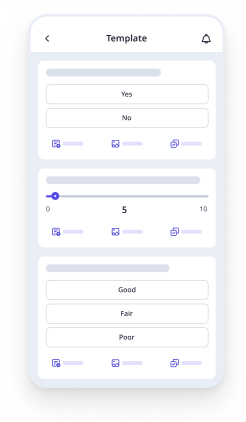
Mariners at the bridge and in the engineering team can use this vessel arrival checklist to help ensure that the ship is ready for port arrival. Based on a pre-arrival-checklist, use this 72-96 hours before the intended arrival to prepare navigation and communication, documentation, steering and propulsion, safety, crew, etc. With the Mitti (by SafetyCulture) app, you can:

  • Ensure that all the important points are done right

  • Make relevant notes or take photos for any issues encountered

  • Assign tasks to appropriate crew members

  • Send and receive reports in real-time

  • Make recordkeeping convenient and secure

  • Create, edit, and share checklists that fit your vessel’s needs

Vessel Arrival and Departure Checklist
Mobile Preview
See the template in action (opens in new tab)

Why Mitti digital checklists?

  • Free to use for up to 10 users

  • Eliminate paperwork with digital checklists

  • Generate reports from completed checklists

Related resources you might like

Templates

Powered by

Ship Departure Checklist

Mariners can use this vessel pre departure checklist to help prepare the vessel and the crew before navigating into open waters. A pre departure checklist provides mariners a guide on which ship items and details to review with the aim of a smooth ship departure. Created with international and local regulations in mind, this ship pre departure checklist allows you to do the following:

  • Check navigation and communication

  • Check documentation

  • Check steering and propulsion

  • Check and ensure safety

  • Review before and after cast-off

  • Review ship while in open water

View template in library

Powered by

Vessel Arrival Checklist - Engine Room

The team of marine engineers can use this vessel pre-arrival checklist upon receipt of the one hour notice from the bridge in order to prepare the ship for arrival at the port.

View template in library

Powered by

Vessel Departure Checklist - Engine Room

The engineering team can use this vessel pre-departure checklist upon receipt of the one hour notice for departure in order to prepare the ship for departure from the port to open water.

View template in library

Powered by

Bonus! Port State Control Inspection Checklist

A Port State Control (PSC) inspection checklist is used by mariners to help ensure compliance with international regulations on the condition, operation, and manning of a vessel. Use this PSC inspection checklist that includes reminders for items and other details required by SOLAS Ch III Reg 37 and other requirements.

View template in library

Articles

Recreation Management Software

Explore top recreation management software to streamline operations, enhance user experience, and simplify managing recreational activities.

Learn more

Transportation and Logistics: What’s the Difference?

Learn about the importance of transport and logistics within the supply chain and how it is used in business operations.

Learn more

Project Handover Template

Download and use free project handover templates to ensure efficient communication and turnovers across various project stakeholders.

Learn more