Mitti by SafetyCulture
Pricing
Log inSign up for free
  1. Home
  2. Checklist guides
  3. Safety
  1. Home
  2. Checklist guides
  3. Safety
Mitti by SafetyCulture

The way the world works

Follow us

App Store
Google Play

Product

  • Pricing
  • Book a demo
  • Product updates
  • Mitti (by SafetyCulture)

Support

  • Help center
  • Contact us
  • API developer documentation
  • Digitize your checklist

Resources

  • Content library
  • App & software guides
  • Checklist guides
  • Topic guides
  • eBooks
  • Blog

Company

  • About
  • Careers
  • News room
  • Meet the leadership team
  • Events & webinars
Copyright © 2026 Mitti
StatusLegalPrivacyTerms & ConditionsSecurity

SafetyCulture has a new name. Say hello to Mitti. Learn More.

Powered by

Risk Assessment Template

Spot hazards before they become incidents and keep your team safe on site — no paperwork needed.

Rated 4.6/5 stars on Capterra | 3k+ app store reviews
Use templatePreview template
Risk assessment template
Mobile Preview
See the template in action (opens in new tab)

Use this risk assessment template to identify, assess, and control hazards in the workplace. While it can be utilized flexibly at any point during a project or operational phase, its optimal application is strongly recommended before the initiation of any new tasks, processes, or projects. This proactive approach ensures that potential hazards are identified and mitigated before they can cause harm. This template allows you to:

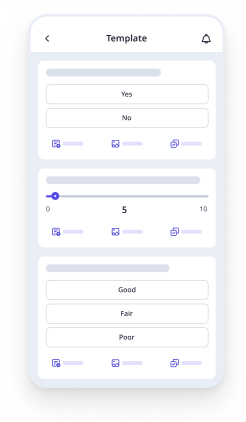
  • Identify and report risks using a table format on a mobile or tablet device.

  • Take photos and videos of hazards to document them clearly.

  • Assign corrective actions for team members so critical risks are resolved immediately.

Every completed assessment feeds directly into Mitti (by SafetyCulture)'s corrective actions and reporting tools, so risks don't just get logged — they get tracked to resolution and rolled up into analytics your team can act on.

Risk assessment template
Mobile Preview
See the template in action (opens in new tab)

Why Mitti digital checklists?

  • Free to use for up to 10 users

  • Eliminate paperwork with digital checklists

  • Generate reports from completed checklists

Use template
  • What is a risk assessment template?
  • Why perform in-house risk assessments?
  • Risk assessment requirements in different countries
  • How to write a risk assessment with a template
  • Risk assessment matrix: how to score and prioritize risks
  • How to fill out a risk assessment template step by step
  • Risk assessment example report
  • FAQs about risk assessment templates

In this article

  • What is a risk assessment template?
  • Why perform in-house risk assessments?
  • Risk assessment requirements in different countries
  • How to write a risk assessment with a template
  • Risk assessment matrix: how to score and prioritize risks
  • How to fill out a risk assessment template step by step
  • Risk assessment example report
  • FAQs about risk assessment templates

Eliminate paperwork with digital checklists

Skip the setup and get to work in seconds.

Use template

Article by

Jona Tarlengco

|

5 min read

|

14 Jul 2026

What is a risk assessment template?

A risk assessment template is a standardized document used to identify, control, and record risks in the workplace. It involves a systematic examination of a workplace and its environment to determine hazards, assess injury severity and likelihood, and implement control measures to reduce risks.

Why perform in-house risk assessments?

While outsourcing can save your team time and effort, performing in-house operational risk assessments can bolster your company’s culture in several ways:

  1. Enable workers to be proactive rather than reactive – A proactive approach to safety pays off in the long run since the majority of workplace injuries are preventable only if workers know the possible risks and how to handle the situation.

  2. Reinforce responsibility and accountability – When workers are obligated to look out for one another’s safety through in-house operational risk assessments, the habit and culture of responsibility and accountability are reinforced.

  3. Promote transparency and collaboration against operational risks – To identify, evaluate, and control operational risks, teams need to be open and transparent with their activities and processes.

Risk assessment requirements in different countries

Beyond continued business operations, unhindered by incidents caused by hazards, another key reason to conduct a workplace risk assessment is that it is legally mandated in most countries and regions:

United Kingdom (UK)

In the UK, workplace risk assessments are required under the Management of Health and Safety at Work Regulations 1999 (MHSWR). According to the Health and Safety Executive (HSE) and Regulation 3 of the MHSWR, employers must:

  • Identify hazards. Anything that could cause injury or illness.

  • Determine the likelihood and severity of harm (the risk).

  • Take action to eliminate the hazard or, if that isn’t possible, control the risk.

  • Review the risk assessment whenever there is reason to believe it is no longer valid or when significant changes occur, and update your risk mitigation plan and risk treatment plan accordingly.

  • Implement any necessary updates following the review.

If an employer has five or more employees, they must also keep written records of:

  • Significant findings from the risk assessment.

  • Any groups of employees identified as being particularly at risk.

United States (US)

In the US, workplace risk assessments—commonly referred to as hazard assessments—are required under the Code of Federal Regulations (CFR) Title 29, Part 1910, Subpart I, specifically OSHA Standard 1910.132.

Canada

In Canada, risk assessments (also known as hazard assessments) are required under Part XIX of the Canada Occupational Health and Safety Regulations.

Australia

Australia doesn’t explicitly mandate risk assessments. But Part 2 of the Work Health and Safety (WHS) Act 2011 requires employers to ensure worker health and safety. Conducting risk assessments is widely recognized as essential to meeting that duty.

How to write a risk assessment with a template

One of the main things to keep in mind on how to perform a risk assessment is the format of your report. Depending on the type of the risk assessment, this format will serve as the outline of the full risk assessment.

Once risks are recorded, use a risk treatment plan template to document how each risk will be addressed.

What is the correct format of the template?

Organize information with tables that contain the following required information:

  • Name of the hazard

  • Description of the hazard

  • Who will be at risk

  • Risk rating

  • Existing measures for risk control

Writing the title page

  • Who prepared it? Refers to the name of an individual risk assessor or the company/team working on the risk assessment report.

  • Who is it for? Indicate what or who the risk assessment is for.

  • Done on Specify the date on which the risk assessment and the report were completed.

  • Review date This indicates a specific date set for reviewing risk assessment protocols. As a general rule, a risk assessment review must be done whenever significant changes are made to operations.

Writing the main body

The two types of risks are physical and substance risks. Slips, trips, falls, getting or injuries due to falling objects all fall under physical risk. Injuries due to toxic, flammable, and caustic materials are covered under substance risks. These findings should be recorded, preferably in easily accessible risk assessment templates for future reference.

Risk assessment matrix: how to score and prioritize risks

Once hazards are identified, score them using a risk matrix that multiplies likelihood by severity. This gives every risk a rating so your team knows what to act on first.

Likelihood ↓ / Severity →

Negligible (1)

Minor (2)

Moderate (3)

Major (4)

Catastrophic (5)

Almost certain (5)

5

10

15

20

25

Likely (4)

4

8

12

16

20

Possible (3)

3

6

9

12

15

Unlikely (2)

2

4

6

8

10

Rare (1)

1

2

3

4

5

Scores of 1–4 are low risk, 5–9 are medium, 10–14 are high, and 15–25 are extreme and need immediate action. This scoring approach aligns with ISO 31000 risk management guidelines.

How to fill out a risk assessment template step by step

  1. Identify the task, area, or process being assessed and list who could be harmed.

  2. Identify hazards present, from physical risks like falls to substance risks like chemical exposure.

  3. Score each hazard’s likelihood and severity using a risk matrix.

  4. Assign control measures to eliminate or reduce each risk.

  5. Assign an owner and a review date for each control measure.

  6. Sign off the assessment and share it with affected workers before work begins.

Risk assessment example report

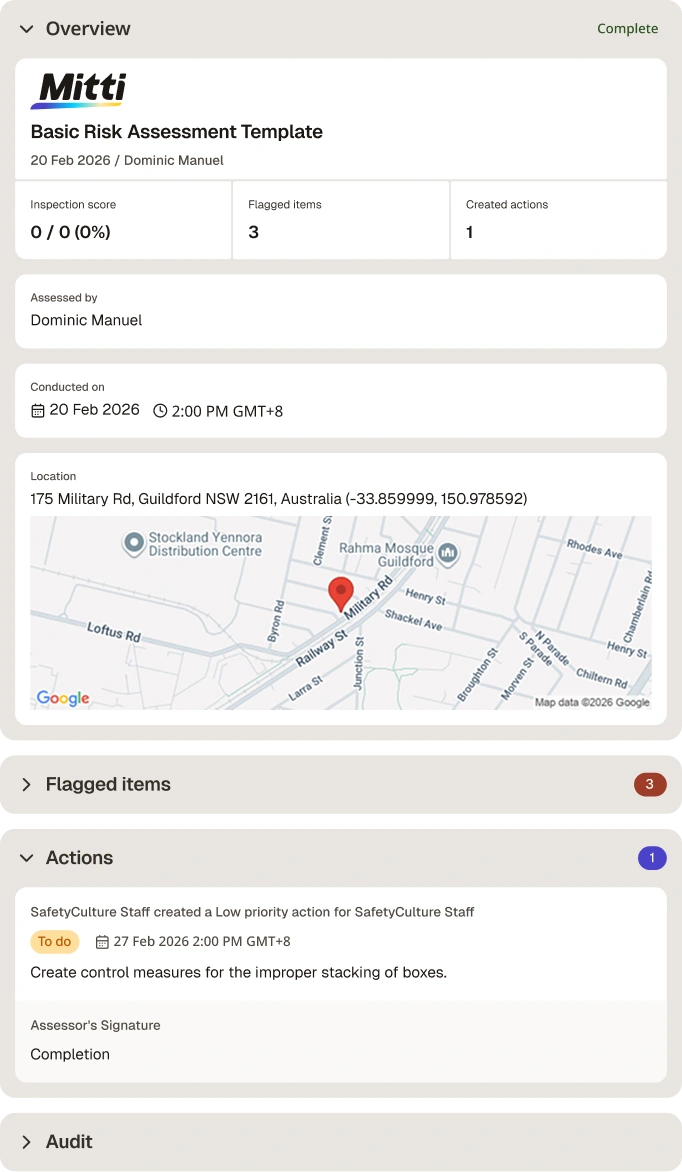
To help you visualize what a risk assessment report looks like, here’s an example report using the Risk Assessment Template.
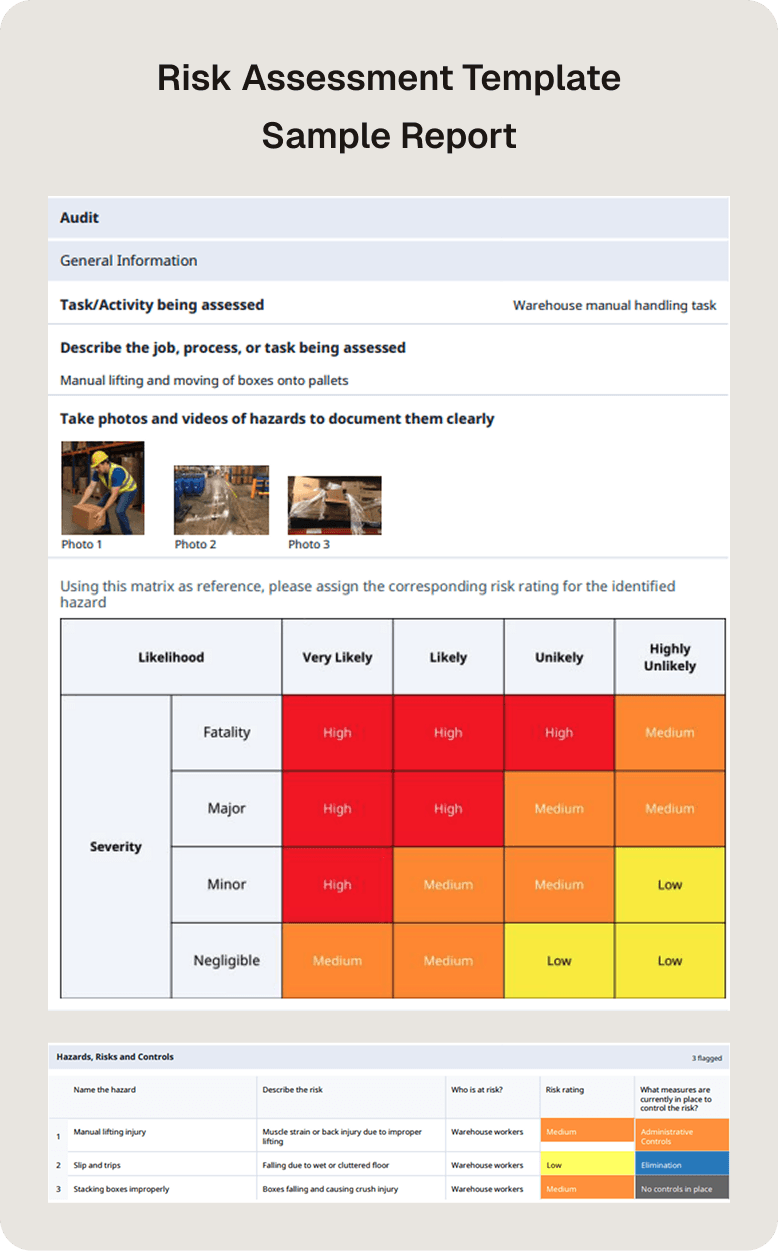

Risk Assessment Template Sample Report

Preview risk assessment sample report

byblos constructions safetyculture customer story

Byblos Construction digitized safety checklists, compliance checks, and risk assessments with Mitti (by SafetyCulture), letting teams quickly notify leaders of risks for faster action and fewer blind spots. This improved risk management, communication, and visibility for safer job sites.

byblos constructions mitti customer story western australia
Read success story

Content library templates

Still looking for a checklist?

Search, filter, and customize 60,000+ templates across industries and use cases.

Browse Library

FAQs about risk assessment templates

JT

Article by

Jona Tarlengco

Mitti (by SafetyCulture) Content Specialist

View author profile

Related resources you might like

Templates

Powered by

Basic Risk Assessment Template

Use this basic risk assessment form to identify, assess and control hazards in the workplace. This template can be used at any time when assessing risk and control measures but should be ideally conducted before commencement of tasks.

View template in library

Powered by

HSE Risk Assessment Template

Use this Health and Safety Executive (HSE) template to document a risk assessment to manage health and safety hazards in your workplace. Identify observed potential and existing hazards (e.g biological, chemical, energy, environment, etc.), assess the risk level (consequence, likelihood and risk ratings) and provide necessary control measures.

View template in library

Powered by

Legionella Risk Assessment Template

This legionnaires risk assessment template is according to the HSE’s Control of Legionella Bacteria in Water Systems for auditing cooling towers. Use this template to efficiently inspect an unlimited number of cooling towers and evaluate a site’s water treatment program and written scheme for controlling the risk from exposure to legionella bacteria.

View template in library

Powered by

COSHH risk assessment template

This Control of Substances Hazardous to Health (COSHH) risk assessment form is used to control exposure to hazardous substances to prevent serious illnesses and health problems.

View template in library

Powered by

Stress Risk Assessment Template

Use this workplace stress risk assessment to determine whether the cause of stress is because of work demand, management and control, support, relationship, role and change. This record can be used as basis for leaders to reflect what actions plans they need to take to lessen work stress.

View template in library

Powered by

Event Risk Assessment Template

Event planners can use this template to create a risk management plan to outline identified hazards and steps that need to be taken to prevent them.

View template in library

Powered by

DSEAR Risk Assessment Template

A DSEAR risk assessment template is a tool used by safety officers to identify, assess, and control safety risks that can lead to fires, explosions, and metal corrosion caused by hazardous substances in the workplace. Use this DSEAR assessment template to help maintain compliance with DSEAR and conduct risk assessments before beginning a new process or work activity.

View template in library

Powered by

Construction Risk Assessment Template

Use this construction risk assessment template to identify common construction hazards, assess the risk severity and rating, and propose control measures.

View template in library

Powered by

Environmental Risk Assessment Template

Use this environmental risk assessment to evaluate any environmental risks caused by manufacturing activity. Identify the risk and take a photo. Mention the possible impact on the environment if the risk is not mitigated. Provide some control measures and the overall risk assessment.

View template in library

Powered by

Dynamic Risk Assessment Template

Use this generic dynamic risk assessment template to capture a variable number of observed hazards.

View template in library

Powered by

Risk Assessment Matrix Template

This Risk Matrix Checklist Template can be used to assess a variable number of risks in your business.

View template in library

Powered by

Manufacturing Risk Assessment

This manufacturing risk assessment template can be used to perform workplace risk assessments for manufacturing facilities. It enables inspectors to add more hazards as required.

View template in library

Powered by

Office Risk Assessment

This office risk assessment template can be used to identify general at-risk activities in your office environment and help formulate an implementation plan.

View template in library

Powered by

Workplace Risk Assessment

Based on HSE guidance for risk assessment at work, this workplace risk assessment template can be used by employers, owners, and managers to identify hazards and the risks they caused, as well as who might be harmed by these risks. Using this template also empowers employers to develop effective risk control measures when hazards cannot be eliminated.

View template in library

Articles

Safety Audit Software

Discover the most outstanding safety audit software of 2026 and validate your organization’s safety processes with your number one choice.

Learn more

50+ Safety messages of the day

Discover 50+ safety message of the day examples and tips for offices, construction sites, and labs to help keep your workplace safe daily.

Learn more

Fuel Safety Inspection Checklist

Use this fuel safety inspection checklist to help gas stations and fleets stay compliant and manage safety effectively.

Learn more