What is a workplace exposure limits checklist?
A workplace exposure limits checklist helps you confirm that the air your workers breathe stays under the legal limit for every airborne substance on site. That means dust from cutting, fumes from welding, vapors from solvents and gases from engines.
For each substance, you compare what you measured with its limit and record the answer. If a result comes back over the limit, stop the work and fix the problem before anyone carries on. Then test again.
What are workplace exposure limits?
A workplace exposure limit is the highest airborne concentration of a substance that a worker can breathe in. In Australia, the limits are mandatory under the WHS Regulations and published by Safe Work Australia in the WEL list, which replaces the old workplace exposure standards on December 1, 2026. Other countries often call them occupational exposure limits.
Most limits are an eight-hour average. Some substances add a 15-minute limit or a peak limit, and all the limits listed for a substance apply at once.
A limit isn't a promise of safety. Some people have health effects below it, and employers still have to reduce exposure as far as reasonably practicable.
Who needs a workplace exposure limits checklist?
If dust, fumes, vapors or gases get into the air at your site, you do. That covers more places than people expect. Here's what it looks like in five industries:
Construction: respirable crystalline silica from cutting concrete, cement dust, wood dust, bitumen fumes and diesel exhaust
Manufacturing: welding fumes, manganese and zinc oxide from metal work, oil mist from machining and solvents like toluene and xylene
Baking and food production: flour dust, grain dust, ammonia from refrigeration and cleaning chemicals like sodium hydroxide and peracetic acid
Auto repair: solvents like acetone, isocyanates in two-pack paints, welding fumes and carbon monoxide from engines
Healthcare and cleaning: disinfectants like glutaraldehyde, hydrogen peroxide and peracetic acid, plus formaldehyde in labs
The duty sits with the business. Under the model WHS Regulations, a business must keep everyone at the workplace under the exposure limit, visitors included.
A safety manager or supervisor usually runs the checklist. The measuring is a different job. Safe Work Australia says a trained professional, such as an occupational hygienist, should design and run any air monitoring meant to show compliance.
What to include in the checklist
Keep each check short and each answer traceable. For every substance, record:
The substance, plus by-products like welding fume
Its limit and which type it is: eight-hour average, 15-minute or peak
The result and how you measured it
Whether it passes every limit listed for that substance
The fix, an owner and a due date for anything over
A retest date
Add a note on what was happening that day, like which task was running and whether the extraction was on.
Pull the limits from the regulator's list, not from memory. They change. The benzene limit drops from 1 ppm to 0.2 ppm on June 1, 2027, and Victoria gives 15 substances, such as bitumen fumes and diesel particulate matter, a transition period until December 1, 2029. Safe Work Australia's chemical database lists the current limits.
How to use this workplace exposure limits checklist
Think of the checklist as the record-keeping side of a workplace exposure assessment. You decide what to check, someone measures it and you write down the answer.
Walk the site first. List anything that can get into the air, and don't forget by-products. The regulator's guide says to start with a walkthrough and your chemical register and safety data sheets. A proper hazardous substances checklist and a safety data sheet checklist help with the walk.
Get it measured by a professional. Don't trust your nose, because odor isn't a reliable test. Personal samples, taken within 30 cm of the worker's nose, are the ones that count, and a sampler left at a fixed spot in the room can't show compliance. If you aren't certain you're under a limit, the regulations say you must monitor.
Compare and answer. Work out the average, check it against every limit listed and answer Yes or No.
Write down how you measured it. Note the method, the date, the task and who wore the sampler.
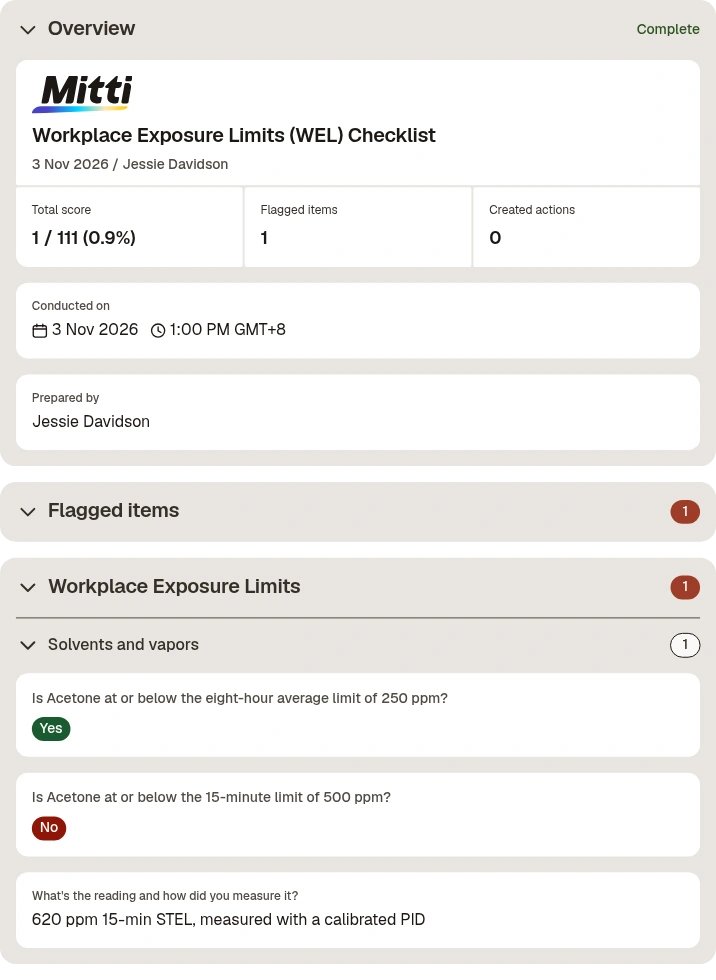
Here is a sample of completed WEL checklist.
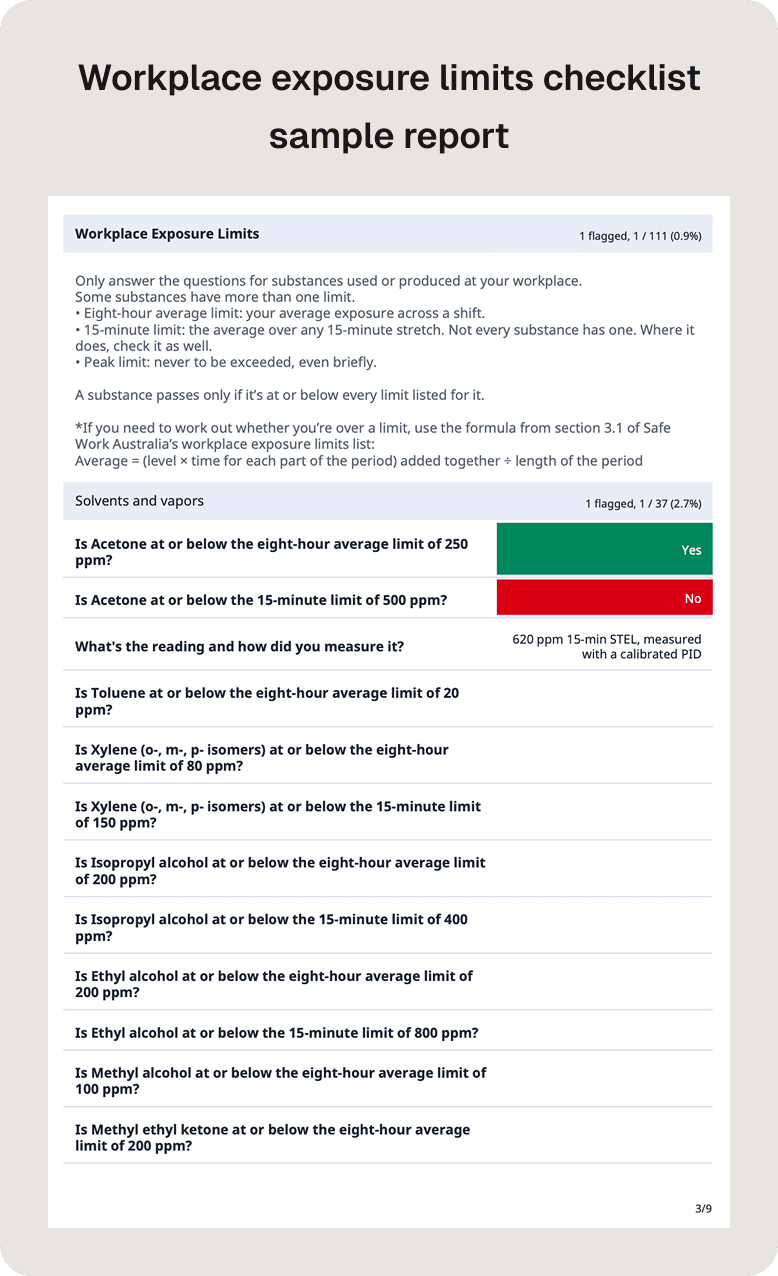
Sample workplace exposure limits PDF report
Working out whether you're over a limit
The math is simple. For each part of the period, multiply the level by the time, add the results and divide by the length of the period. Safe Work Australia's list uses this formula for the eight-hour average. Use eight hours for the shift limit and 15 minutes for the short-term one.
Average = (level × time for each part of the period) added together ÷ length of the period
Say a worker spends 7 hours at 100 ppm of acetone and 1 hour at 600 ppm. The eight-hour average is (7 × 100 + 1 × 600) ÷ 8 = 162.5 ppm, which is under the 250 ppm limit. But acetone's 15-minute limit is 500 ppm, and that hour at 600 ppm breaks it. The average hid the spike. These numbers are made up, but the limits are real.
Long shifts change the math. If people work more than 8 hours a day, more than 40 a week or get less than 16 hours between shifts, the eight-hour limit may need lowering. The 15-minute and peak limits never change, and you adjust the limit, not the measured result. Ask your hygienist to run the numbers.
What to do when exposure goes over a limit
An over-the-limit result means stop the work and fix the problem before anyone carries on. Put controls in straight away, then measure again to confirm they work. Work down the hierarchy of controls: eliminate or substitute the substance where you can, then isolate it or add engineering controls like local exhaust ventilation, then administrative controls, with personal protective equipment last.
How often to review the checklist
Review it whenever something changes: a new substance, a new process, new shift patterns or a change to the limits. Reassess exposure whenever processes, materials or work practices change, and retest after every fix.
Using this checklist outside Australia
The limits here are Australia's. Other countries set their own numbers for the same substance, so don't borrow these for a UK or US site. The guide to workplace exposure limits covers how the UK and Australia compare, and the FAQ below explains the US terms.

Still looking for a checklist?
Search, filter, and customize 60,000+ templates across industries and use cases.
FAQs about workplace exposure limits
Article by
Mitti (by SafetyCulture) Content Team
Mitti (by SafetyCulture) Content Contributor
View author profile