What is the building safety levy?
A new charge on residential developments in England, created under Section 58 of the Building Safety Act 2022 and set out in The Building Safety Levy (England) Regulations 2025. It applies to building control applications for 10 or more new dwellings, or 30 or more student bedspaces, submitted on or after 1 October 2026, and it isn't tied to a building's height, only unit count.
Does the levy apply to your project?
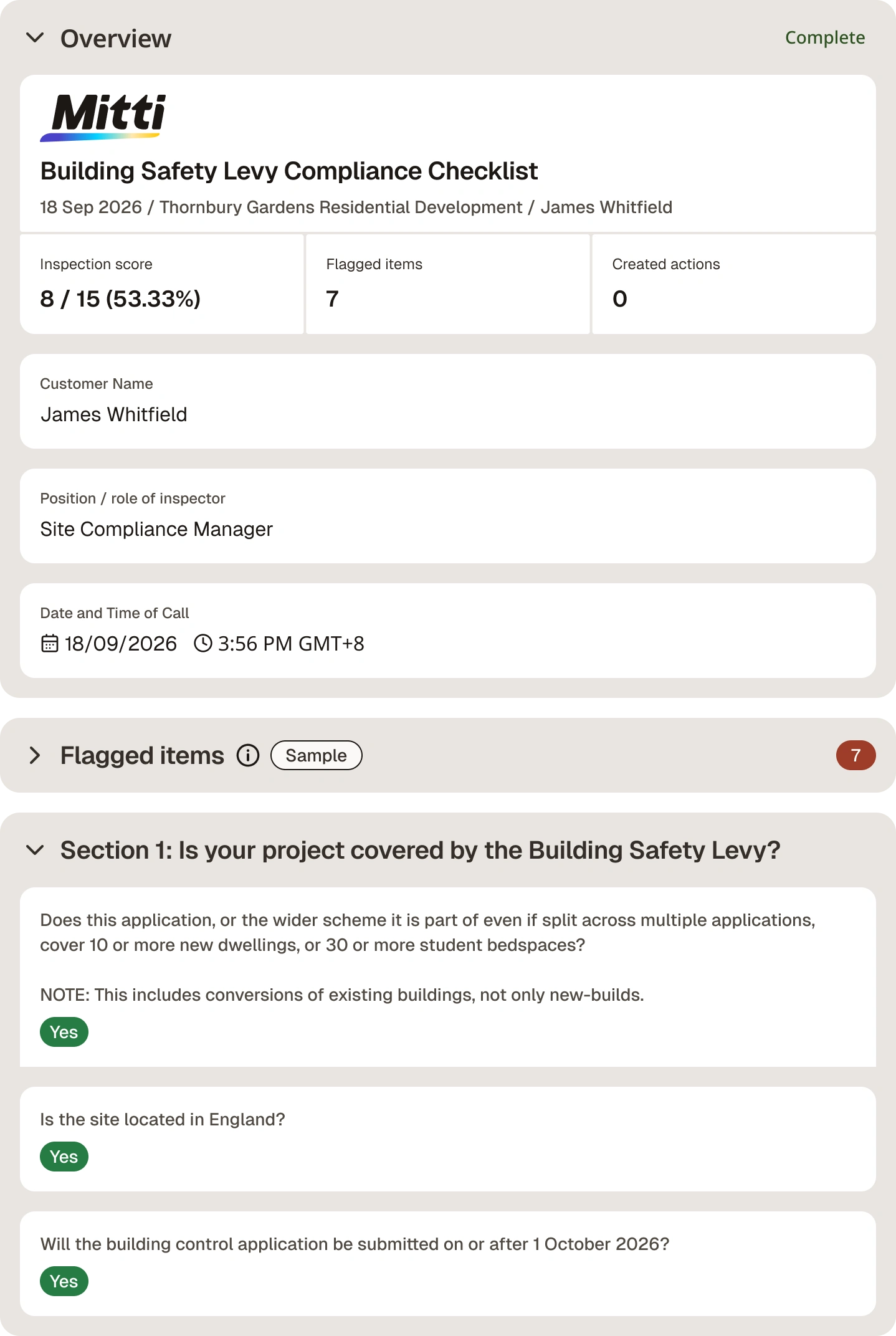
Your development includes 10 or more new dwellings, or 30 or more new student bedspaces
The site is in England
Your building control application will be submitted on or after 1 October 2026
This applies to conversions as well as new-builds, and splitting one large scheme into smaller applications doesn't get you out of it if a single planning permission covers 30+ units
If any of these don't apply, the levy isn't chargeable. Applications submitted before 1 October 2026 stay outside the levy entirely, so log the submission date now as evidence.
Projects that pass all four checks move on to the exemption check below. This is also the stage where your team should be pulling together the same kind of pre-construction documentation covered in a commissioning plan, since the levy sits alongside, not instead of, your usual building control steps.
Building safety levy exemptions checklist
Some projects qualify for exemption even if they clear the size threshold. Work through each of the following:
Is the applicant a non-profit registered provider of social housing, or a company wholly owned by one? (For-profit registered providers don't qualify, even though they're still called "registered providers.")
Is the development affordable housing?
Is it a care home, hospice or NHS hospital?
Is it supported housing, a children's home or a domestic abuse shelter?
Is it accommodation for armed forces personnel, a prison, hotel, hostel, or school (not university) student housing?
A "yes" to any of these means the project may be exempt. Keep the paperwork that proves it: registration numbers with the Regulator of Social Housing, funding agreements, or the relevant planning use class, filed alongside the building control application itself.
Teams already running safety audit checklists on site have a head start here. The same discipline that keeps inspection evidence organized works just as well for levy exemption evidence.
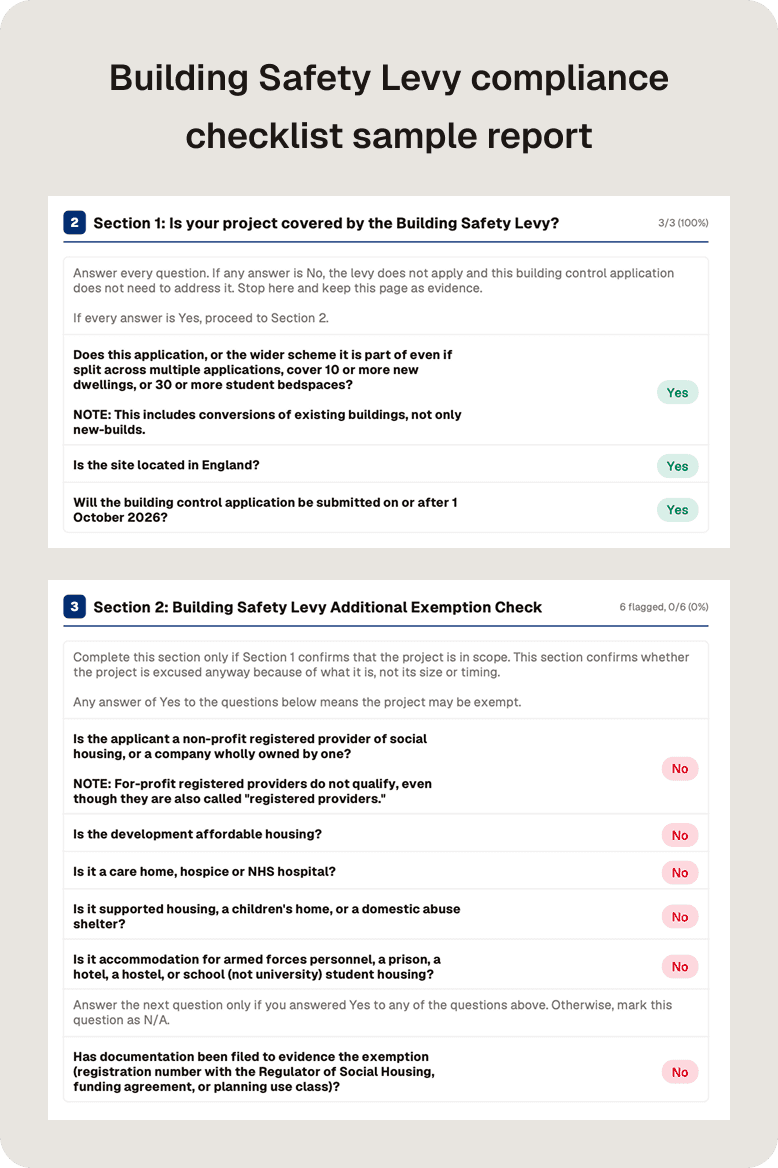
Preview building safety levy compliance checklist PDF report
Calculating and paying the levy: your compliance checklist
For projects that don't qualify for exemption, work through this before requesting sign-off:
Calculate chargeable residential floorspace in square metres
Confirm the levy rate for your local authority area, rates vary widely, from £12.70 per square metre in County Durham to £100.35 in Kensington and Chelsea
Check whether your site qualifies for the 50% previously developed land discount (at least 75% of the site must be brownfield)
Record the total levy liability and keep the payment reference or receipt
Confirm payment is complete before requesting your completion or final certificate, for phased developments, the full levy across all phases has to be paid before any one phase gets its certificate
Platforms like Mitti (by SafetyCulture) can turn levy compliance, exemption evidence and payment status into a tracked checklist item inside your safety audit software, the same way Donaldson Group digitized its paper-based safety audits.
“Being able to demonstrate to the insurance company the things we’ve done, and the risk improvements we put in place to make us a safer workplace has helped us save on insurance premiums for the last two years, when premiums were on the increase.”
How the building safety levy interacts with other charges
It sits alongside the Community Infrastructure Levy (CIL) and Section 106 obligations, and developers can owe all three on the same scheme. CIL and Section 106 trigger off planning permission; the levy triggers off the building control application. It's also distinct from the Residential Property Developer Tax, a 4% charge on profits above £25 million a year.
The levy in Scotland
England only for now. Scotland has passed its own version, the Building Safety Levy (Scotland) Act 2026, but it won't take effect until 1 April 2028. Wales and Northern Ireland don't currently have an equivalent levy planned.

Still looking for a checklist?
Search, filter, and customize 60,000+ templates across industries and use cases.