Mitti by SafetyCulture
Pricing
Log inSign up for free
  1. Home
  2. Checklist guides
  3. Safety
  1. Home
  2. Checklist guides
  3. Safety
Mitti by SafetyCulture

The way the world works

Follow us

App Store
Google Play

Product

  • Pricing
  • Book a demo
  • Product updates
  • Mitti (by SafetyCulture)

Support

  • Help center
  • Contact us
  • API developer documentation
  • Digitize your checklist

Resources

  • Content library
  • App & software guides
  • Checklist guides
  • Topic guides
  • eBooks
  • Blog

Company

  • About
  • Careers
  • News room
  • Meet the leadership team
  • Events & webinars
Copyright © 2026 Mitti
StatusLegalPrivacyTerms & ConditionsSecurity

SafetyCulture has a new name. Say hello to Mitti. Learn More.

Powered by

Dynamic Risk Assessment Template

Capture hazards via a mobile device in real time and report findings anytime, anywhere.

Rated 4.6/5 stars on Capterra | 3k+ app store reviews
Use templatePreview template
Dynamic Risk Assessment
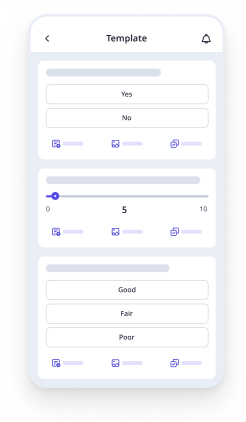
Mobile Preview
See the template in action (opens in new tab)

A dynamic risk assessment template is used to identify, assess and reduce hazard in an evolving work environment. Ensure safety by taking photos and sharing the report immediately to responsible members of the concerned department. Effectively deploy this report by following the key points below:

  1. Give a brief description of the worksite being assessed;

  2. Identify risk type, severity, likelihood;

  3. Take and annotate photos as evidence;

  4. Specify people at risk and who should address the issue;

  5. Assign corrective measures to responsible organization members and

  6. Complete the report by affixing digital signatures.

Dynamic Risk Assessment
Mobile Preview
See the template in action (opens in new tab)

Why Mitti digital checklists?

  • Free to use for up to 10 users

  • Eliminate paperwork with digital checklists

  • Generate reports from completed checklists

Use template
  • What is Dynamic Risk Assessment?
  • Why Perform Dynamic Risk Assessments
  • When is a Dynamic Risk Assessment Used?
  • What is the Difference Between a Risk Assessment and a Dynamic Risk Assessment?
  • How do you Conduct a Dynamic Risk Assessment?
  • The 5 steps to Performing a Dynamic Risk Assessment
  • Dynamic Risk Assessment Example

In this article

  • What is Dynamic Risk Assessment?
  • Why Perform Dynamic Risk Assessments
  • When is a Dynamic Risk Assessment Used?
  • What is the Difference Between a Risk Assessment and a Dynamic Risk Assessment?
  • How do you Conduct a Dynamic Risk Assessment?
  • The 5 steps to Performing a Dynamic Risk Assessment
  • Dynamic Risk Assessment Example

Eliminate paperwork with digital checklists

Skip the setup and get to work in seconds.

Use template

Article by

Jona Tarlengco

|

6 min read

|

14 May 2024

What is Dynamic Risk Assessment?

A dynamic risk assessment is a process of quickly identifying risks and hazards in a workplace where the situation is dynamic and risks can change due to rapidly changing conditions. It is conducted by competent persons in charge to implement control measures and mitigate dynamic risks.

Why Perform Dynamic Risk Assessments

Dynamic risks are those that are difficult to predict and can result from organizational and environmental changes, e.g., slip hazards caused by bad weather or physical danger from visiting someone’s home. While conducting a dynamic risk assessment is not a legal requirement, HSE recommends it as it promotes safety. Manual handling and lone workers pose a higher dynamic risk due to the nature of their work. Performing dynamic risk assessments can help businesses identify, connect, and visualize critical risk clusters present in the workplace. This can help reduce the risk of workplace accidents and injuries caused by difficult-to-predict hazards.

Workers that conduct dynamic risk assessments can experience other benefits such as:

  • Increase in risk awareness

  • Decrease in the likelihood of incidents

  • Learn quick thinking

  • Being better at reading situations and making decisions

  • Applying the correct actions

When is a Dynamic Risk Assessment Used?

Regular observations and assessments of your environment are necessary to predict unforeseen events. A dynamic risk assessment helps when risks and hazards arise from the following circumstances:

  • Introduction of new equipment/resources

  • Change of supervision approach

  • Opening a new line of business

  • Reallocation of work

  • When there are threats to safety and security

What is the Difference Between a Risk Assessment and a Dynamic Risk Assessment?

A risk assessment is conducted when there’s a new process or new equipment in the workplace in order to determine risks and proactively come up with safety measures before the implementation of the new process or use of the new equipment. A dynamic risk assessment on the other hand is more spontaneous especially in high-risk environments where it is conducted on the spot when there’s a sudden change in the situation and risks need to be immediately identified and controlled.

How do you Conduct a Dynamic Risk Assessment?

A dynamic risk assessment is conducted with the help of a dynamic risk assessment flowchart for high-risk jobs where situations and risks can drastically change. One of these high-risk jobs is that of being a firefighter and the UK Fire Service Resources (UKFRS) acknowledges these risks and thus provides resources and methods in the form of a flowchart that contains the thought process applicable in risky situations.

Dynamic Risk Assessment Flowchart

Dynamic Risk Assessment Flowchart | Mitti (by SafetyCulture)

The dynamic risk assessment flowchart has been a reliable process for h azardous work.

The 5 steps to Performing a Dynamic Risk Assessment

Anoth er method is to apply and remember these 5 steps to performing a dynamic risk assessment. These steps are similar to the earlier flowchart but explained more thoroughly. Here are the 5 steps to performing a dynamic risk assessment:

  1. Stop and look around – before starting work, make it a habit to observe the environment for any hazards present such as physical, biological, organizational, chemical or safety hazard. Identify and rate the risk level, severity and likelihood.

  2. Check and select – check for available safety systems of work and select the most appropriate for the situation.

  3. Examine – assess the chosen systems of work. Once a course of action has been determined as offensive or defensive, you need to decide whether or not the risks involved are aligned with the benefits of the outcome.If YES, proceed with allocating responsibilities and communicating safety measures and procedures.If NO, go back to step 2.

  4. Add more measures as needed – introducing additional control measures can help further reduce or eliminate risks to an acceptable level. (e.g. use of additional PPE and specialised equipment)

  5. Document and report all findings – all findings should be properly documented for review and safety planning purposes.

Dynamic Risk Assessment Example

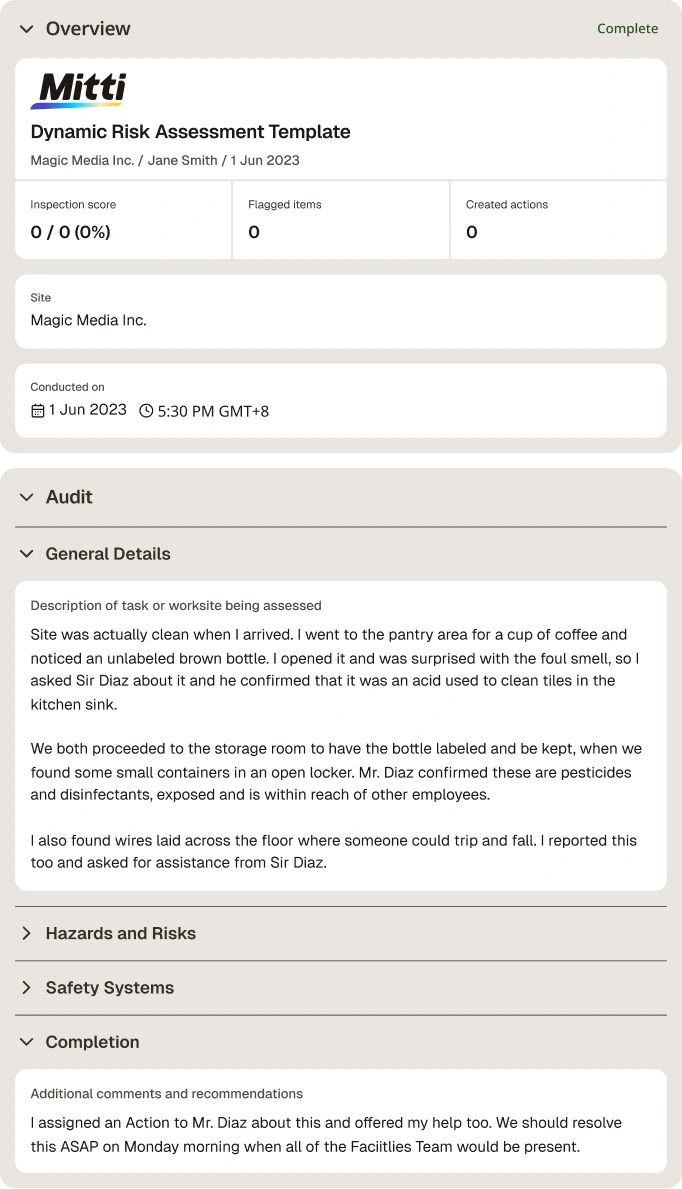
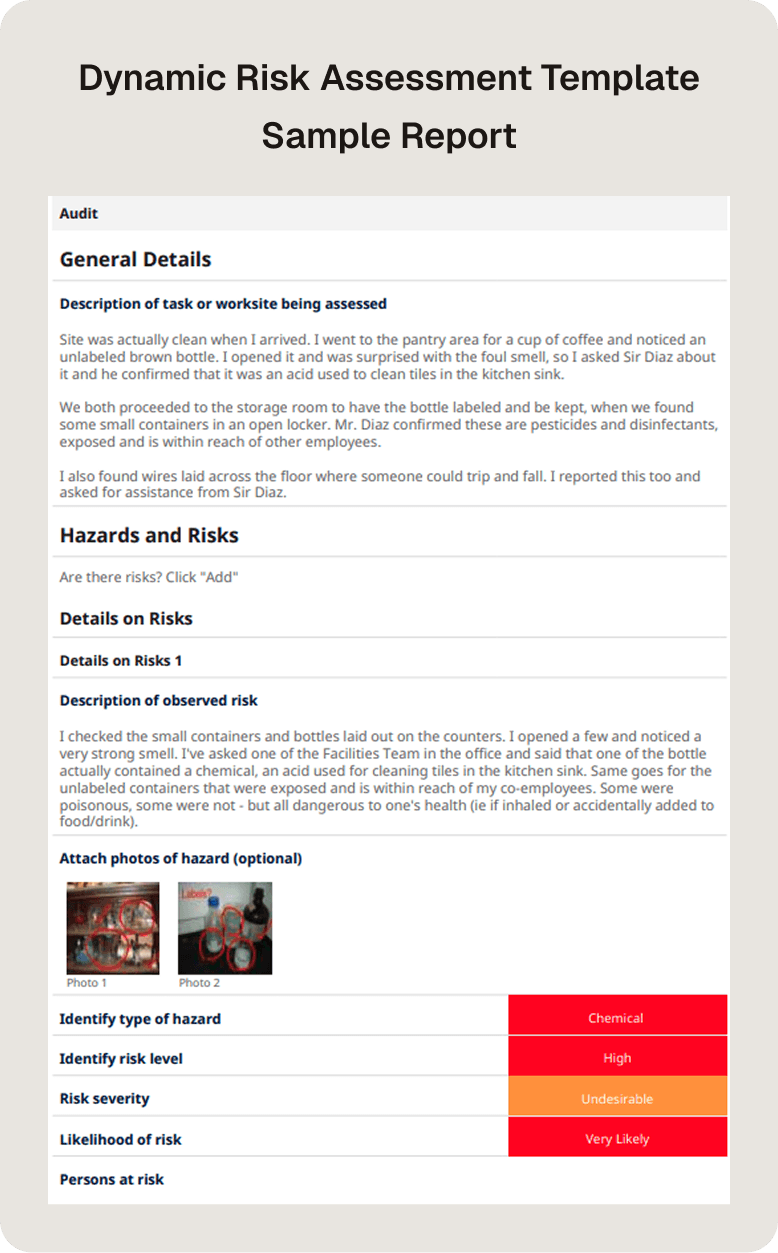
Below is an excerpt from a dynamic risk assessment example as automatically generated by the Mitti (by SafetyCulture) (formerly iAuditor) dynamic risk assessment template (click here to view the complete sample report ):

Description of task or worksite being assessed

Site was actually clean when I arrived. I went to the pantry area for a cup of coffee and noticed an unlabeled brown bottle. I opened it and was surprised with the foul smell, so I asked Sir Diaz about it and he confirmed that it was an acid used to clean tiles in the kitchen sink. We both proceeded to the storage room to have the bottle labeled and be kept, when we found some small containers in an open locker. Mr. Diaz confirmed these are pesticides and disinfectants, exposed and is within reach of other employees.

Description of observed risk

I checked the small containers and bottles laid out on the counters. I opened a few and noticed a very strong smell. I’ve asked one of the Facilities Team in the office and said that one of the bottles actually contained a chemical, an acid used for cleaning tiles in the kitchen sink. Same goes for the unlabeled containers that were exposed and are within reach of my co-employees. Some were poisonous, some were not – but all dangerous to one’s health (e.g. if inhaled or accidentally added to food/drink).

Type of Hazard

Chemical

Risk Likelihood

Very Likely

Risk Severity

Undesirable

Risk Level

Very Likely

Persons at Risk

All employees (including me) using the kitchen area. Facilities Team could be in danger too as they utilize the Storage Room for supplies and other kept machines.

Department(s) involved in implementing safety

Facilities Department, Risk and Safety Team

What needs to be done?

Chemicals in bottles and containers, whatever the size, should be properly labeled and must be kept in a cabinet with a proper lock to avoid confusion or accidental usage.

Additional comments and recommendations

I assigned an Action to Mr. Diaz about this and offered my help too. We should resolve this ASAP on Monday morning when all of the Facilities Team would be present.

Dynamic risk assessment template

Dynamic Risk Assessment Template | Mitti (by SafetyCulture)

Content library templates

Still looking for a checklist?

Search, filter, and customize 60,000+ templates across industries and use cases.

Browse Library
JT

Article by

Jona Tarlengco

Mitti (by SafetyCulture) Content Specialist

View author profile

Related resources you might like

Templates

Powered by

Risk Assessment Templates

Browse this ultimate collection of the best risk assessment templates which can be used by safety teams to identify, assess and control hazards in the workplace.

View template in library

Articles

Safety Audit Software

Discover the most outstanding safety audit software of 2026 and validate your organization’s safety processes with your number one choice.

Learn more

50+ Safety messages of the day

Discover 50+ safety message of the day examples and tips for offices, construction sites, and labs to help keep your workplace safe daily.

Learn more

5×5 Risk Matrix Template

Download free 5x5 risk matrix templates today. Learn how it works and how it can help systematically assess and plan strategies for workplace risks.

Learn more