What is a HSE stress risk assessment?
Stress is one of the biggest drivers of lost workdays across the UK, and it is largely preventable. A stress risk assessment helps you spot the warning signs of work-related stress before they turn into a bigger problem for your team. It is a systematic way to identify, evaluate, and control the factors that cause stress at work, so you can protect your people and keep your business running smoothly.
How does a checklist help with stress risk assessment?
According to the latest workplace statistics from the UK Health and Safety Executive (HSE), work-related stress, depression, or anxiety now accounts for 52% of all work-related ill health in Great Britain, affecting an estimated 964,000 workers in 2024/25 and costing 22.1 million working days. Health and public sector roles remain the most affected, with workload, lack of managerial support, and organizational change as the biggest contributing factors.
A stress risk assessment checklist helps you catch these factors early, before they turn into lost workdays or a bigger wellbeing issue for your team. Most stress risk assessment checklists are built around the HSE Management Standards, which include:
Demands: Workload, work patterns, and the work environment
Control: How much say your people have over how they work
Support: The encouragement and resources you and your organization provide
Relationships: Promoting positive working and preventing conflict
Role: Making sure people understand their role and it does not clash with others
Change: How well you communicate and manage organizational change
Working through each standard gives you a clear, structured way to spot where stress risk is highest, and where to focus your action plan.
How to effectively perform a stress risk assessment
The steps in conducting a stress risk assessment are similar to those of a common risk assessment. The difference between the two lies in the stress-inducing factors. Below is a step-by-step guide on how you can perform a stress risk assessment in your workplace:
Step 1: Identify the factors
Use the six HSE Management Standards as your lens. Look for stressors through:
A walk-around observation of the workplace
Absence and performance review records
Exit interviews and employee questionnaires
Focus groups and direct conversations with your team
Excessive absences, for example, often point to an overwhelming workload or a strained relationship with a manager, a pattern that is easy to miss without a structured review. You can also run the HSE Stress Indicator Tool to gather this anonymously across your team.
Step 2: Determine who it affects and how
Once you determine that your staff is suffering from work-related stress the next step is to analyze the workplace stressors identified. Consult employees and gather data through a survey.
Step 3: Assess the risks and take precautions
Now analyze what you have found. Rate how serious each stressor is and what it could cost your team or business if it is left unaddressed. Prioritize the most severe risks first, and decide on the specific control measures you will put in place for each one.
Step 4: Document the assessment
Record your findings and the next steps to take. This will serve not only as proof that the stress risk assessment was carried out but also as a basis for later review.
Step 5: Review and update
The final step is to regularly evaluate the assessment. Evaluate whether initiatives taken have been effective in preventing or reducing stress in the organization, if not then it may need updating.
Using a stress risk assessment template
A stress risk assessment template is a tool used by employers as a guide in performing stress risk assessments. Use a workplace stress risk assessment questionnaire which consists of questions such as:
How much work is there?
Are staff comfortable with the amount of work?
Is the intensity of the workload too great for individuals?
Are there set time scales for workload- are these too much/ too little time to achieve?
Is there consistency and clarity in the job role- do the team members have to provide work to different groups of staff?
Do you feel supported by your manager and colleagues when things get tough?
Are conflicts dealt with fairly and quickly on your team?
Is it clear what is expected of you in your role?
Are workplace changes communicated with enough notice and explanation?
Sample workplace stress risk assessment
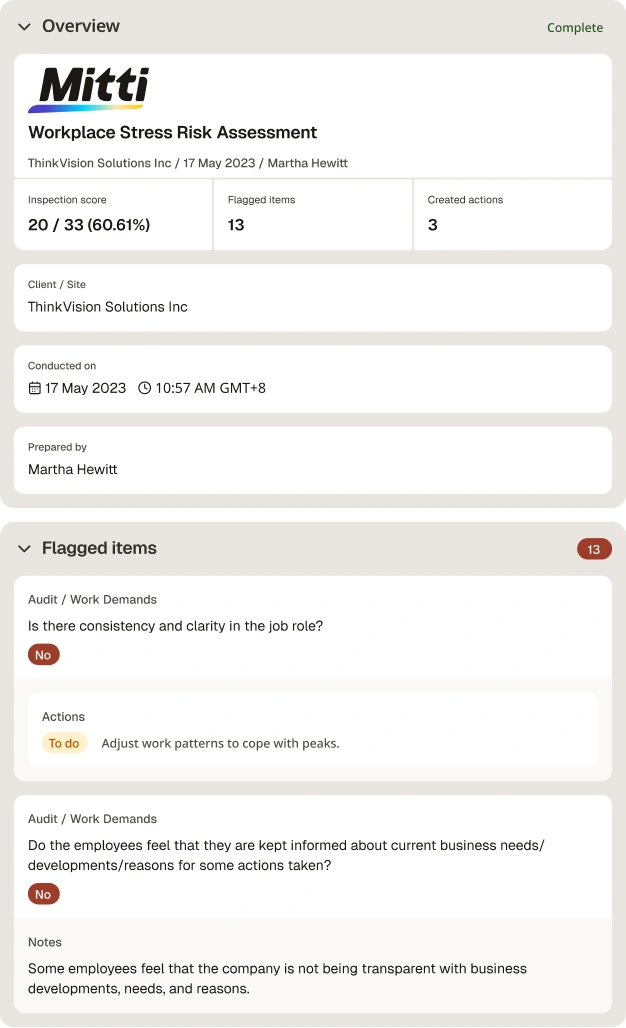
Here is a sample workplace stress risk assessment template report using Mitti.


Still looking for a checklist?
Search, filter, and customize 60,000+ templates across industries and use cases.