What is an ISO 14001 checklist?
An ISO 14001 checklist is a tool for checking an Environmental Management System (EMS) against the requirements of the ISO 14001 standard. It turns each clause into a question you can answer with evidence, so you can see where your EMS conforms and where it falls short.
Teams use it three ways: as a gap analysis before certification, as an internal audit tool, and as a running record of environmental controls. Certification itself is voluntary. Organizations pursue it to prove their environmental credentials, improve their public image, tighten cost control and cut incidents caused by environmental factors.
Importance and benefits
Research cited by ISO found that a 1% increase in ISO 14001 certifications is associated with a 0.14% decrease in greenhouse gas emissions per unit of Gross Domestic Product (GDP). A well-designed ISO 14001 checklist can also help Environmental, Health, and Safety (EHS) managers stay on top of compliance requirements and double down efforts on effective implementation.
However, while a checklist is important, organizations must continue using, modifying, and updating their ISO 14001 template to demonstrate dedication to validating their EMS consistently. When selecting the right ISO 14001 checklist for your business, assess your current EMS to determine which parts of the ISO 14001 standard are most relevant to your organization, since not all aspects may be essential to your systems.
Some of the other benefits using a digital checklist for ISO 14001 compliance include:
Real-time tracking and updates, which allows you to quickly make adjustments as environmental management practices evolve
Improved accuracy by reducing the risk of human error associated with paper-based checklists
Enhanced collaboration and accessibility, ensuring that everyone stays aligned with the latest ISO 14001 requirements
Automated generation of reports that reduces the need to manually compile compliance documentation
Better task prioritization with tasks being assigned and racked more efficiently
Compliance with relevant organizational or industry standards such as the Business Social Compliance Initiative (BSCI) and Good Manufacturing Practices (GMP), among others
Does the 2026 update change ISO 14001 checklists?
ISO 14001 recently underwent an update, changing ISO 14001:2015 to ISO 14001:2026. This change doesn’t mean the standard was overhauled; rather, the 2015 standard was just improved upon.
If you’re currently using a checklist based on the ISO 14001:2015 standard for internal audits and checks, that’s okay, as the standard is still valid for three more years. However, by April 2029, anybody following the 2015 version should have already transitioned to the 2026 version.
An audit checklist in compliance with ISO 14001:2026 won’t be too different from the 2015 one, but it will have difference in Clauses, coverage, and wordings, as the newer version aims to bring more focus on climate change, supply chain impacts, and formal change management. Meanwhile, what has been retained are the following:
The Plan-Do-Check-Act (PDCA) framework as basis for audits
The overall Clause 4–10 structure of checklists
The core requirements around impacts, objectives, monitoring, and corrective action
What to include in an ISO 14001 checklist
Clauses 4 to 10 of ISO 14001 outline the key requirements any business must meet to establish and continually improve its EMS. Your checklist should address each of these areas:
Clause 4: Context of the organization
Identify internal and external issues that affect environmental management.
Understand the needs and expectations of interested parties.
Define the scope of your EMS.
Use explicit questions about climate change, biodiversity, and natural resource availability.
Clause 5: Leadership
Establish and communicate an environmental policy.
Ensure top management demonstrates commitment and provides direction.
Assign clear roles, responsibilities, and authorities.
Clause 6: Planning
Identify environmental aspects, change management aspects, and their impacts.
Determine legal and compliance obligations.
Assess risks and opportunities.
Set measurable environmental objectives and develop plans to achieve them.
Clause 7: Support
Allocate necessary resources.
Ensure employee competence through training.
Promote awareness of environmental responsibilities.
Establish internal and external communication processes.
Manage documented information effectively.
Clause 8: Operations
Implement operational controls for significant environmental aspects.
Manage externally provided processes, products or services with controls in line with their environmental performance and impact.
Prepare for and respond to environmental emergencies.
Clause 9: Performance evaluation
Monitor and measure environmental performance.
Evaluate compliance with legal and other requirements.
Conduct internal audits with based on three sub-clauses: inputs, process, results.
Hold management reviews to assess EMS effectiveness.
Clause 10: Improvement
Address non-conformities with corrective actions.
Drive continual improvement in environmental performance.
Complying to these clauses of ISO 14001 are the most critical to perform a successful audit.
How to use this checklist
Implementing ISO 14001 involves a structured approach to integrating environmental management practices into an organization’s operations. But how do you implement ISO 14001 effectively? Here’s a quick step-by-step guide to help you kickstart your system:
Understand ISO 14001 and its requirements: Review the standard in full to understand its structure and intent, then focus on the PDCA foundation as you use your checklist.
Secure leadership commitment: Ensure top management is fully engaged since they will define policy, allocate resources, and set the EMS direction.
Assess current position: Conduct a gap analysis against ISO 14001 requirements with your checklist to address them immediately.
Plan your EMS: Set specific environmental objectives and develop an implementation plan with timelines, responsibilities, and resources.
Implement EMS procedures: Integrate these procedures and audit findings from your checklist into your operations, linking with existing processes where appropriate.
Perform training and awareness: Train employees about ISO 14001 and their roles to ensure organizational awareness and competence.
Monitor, measure, and evaluate: Track key environmental performance indicators and perform internal audits to check compliance with the requirements.
Create corrective actions: Address any issues found during audits or monitoring to continuously improve.
As mentioned above, during implementation of ISO 14001, adhering to the PDCA can organize EMS processes and help organizations meet the standard in proper order. The PDCA cycle can be simplified into 4 easy-to-follow steps:
Plan: Plan environmental performance evaluation by selecting relevant indicators. Use a comprehensive checklist to ensure that auditors thoroughly investigates during data collection.
Do: Collect and analyze data, assess information, and report results. This step involves implementing the planned EMS and operational controls
Check: Conduct a performance evaluation and management review
Act: Implement and ensure that corrective actions are completed
Sample report
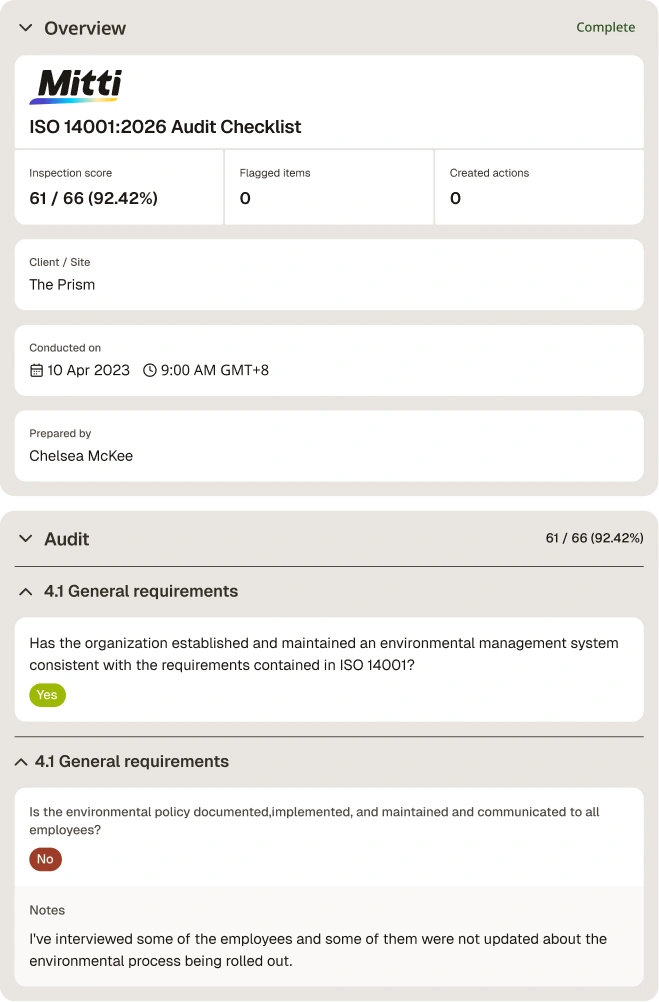
Here is a sample ISO 14001:2026 checklist in use for reference:


To meet customer requirements, they’re certified to multiple standards (ISO 9001, IATF 16949, ISO 14001, ISO 45001, ISO 50001) and use Mitti (by SafetyCulture) to support quality audits at major production sites.


Still looking for a checklist?
Search, filter, and customize 60,000+ templates across industries and use cases.