Who are lone workers?
As people are legally allowed to work alone, lone workers are those whose job entails working in isolation from other employees. They can be those who work outside normal business hours, away from a fixed base, or those who work separately from others.
Anyone who works alone, including contractors, self-employed individuals, and especially employees, is considered a lone worker. Such types of workers are exposed to higher risks of workplace hazards due to a lack of assistance and supervision.
Employers are required by the Welfare at Work Act Section 19 (United Kingdom) to conduct risk assessments. These lone-worker risk assessments determine whether an employee can work alone.
What are the risks of lone working?
The Health and Safety Executive (HSE) has recorded a handful of information concerning lone worker accidents and fatalities. Common workplace accidents involve hazards such as slipping, tripping, falling, electrocution, using faulty machines, not wearing personal protective equipment, and unattended medical conditions. Controlling the risks of lone working is crucial for both employers and employees to make sure that safe work practices and conditions are still top priorities even when working alone.
The Health and Safety Authority (HSA) identified possible hazards a lone worker may be exposed to, such as work accidents, inadequate first aid, diseases, lack of rest, and physical violence from other parties. The lone worker risk assessment determines if it’s safe for one person to do the job. If an activity is found to be high risk, the employer must provide a backup worker. HSA also recommends providing control measures such as available communication using phones or tablets. Another important item is the first aid kit for non-serious injuries or to mitigate the impact of graver accidents.
Ensuring a safe work environment: employer’s duty
Workers rely on their employers to provide a safe working environment while keeping themselves safe by taking necessary precautions. All employers must establish safe working procedures to reduce or eliminate potential hazards and hazardous materials that lone workers may be exposed to. Employees must then cooperate with their employers about these policies. Here are 4 major issues that employers need to address when establishing a safe workplace:
Risk control measures – conduct regular risk assessments to identify and evaluate existing and potential hazards. Assess which hazards can be mitigated, which of them need to be prioritized according to the level of severity, and which of them are uncontrolled to develop more effective engineering and administrative controls.
Worker medical condition – ensure that all lone workers are physically fit before commencing work. Seek medical advice if needed and make sure that emergency equipment and procedures are in place.
Safety and competency training – develop training programs to measure and enhance worker competency level and skills.
Supervision – conduct periodic site visits to check current working conditions and employees’ quality of work and discuss findings with employees. Use reporting tools like Mitti (by SafetyCulture) in your business and get notified of what is happening during lone working hours. Lastly, according to the Occupational Safety and Health Administration’s (OSHA) standard regarding working alone, employers should “account for employees either by sight or verbal communication”.
Ultimately, it is the employer’s responsibility to care for the well-being of their employees. Through a comprehensive safety management system and internal safety programs, they can make sure that work-related health and safety issues are prevented and eliminated as much as possible.
Mobile app solution for more effective lone working risk assessment
An essential part of establishing a safe working system for lone workers is to conduct regular risk assessments. A mobile app solution like Mitti (by SafetyCulture) is an ideal replacement for paper-based risk assessments and can be incorporated into your safe work system:
Lone worker benefits: Due to a lack of assistance and supervision, lone workers should be competent to identify and assess the risks in the workplace and be capable of responding to emergencies. Do paperless reporting on iPhone, iPad, and Android devices. Capture photo evidence of hazards and electronically share them with authorized people anytime.
Employer and manager benefits: Track work progress and the safety of lone workers. Using a lone worker app can help businesses comply with government requirements and get notified when there are new risks for immediate resolution.
Lone working risk assessment example
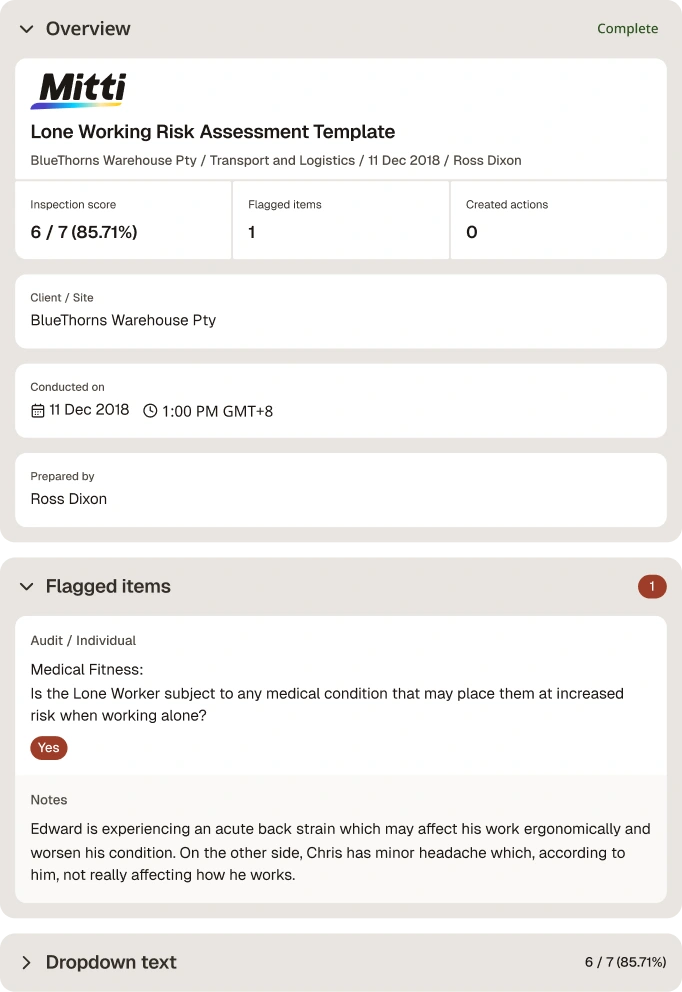
Here is an example safety audit checklist for a construction site for your reference:
Sample lone working risk assessment