Mitti by SafetyCulture
Pricing
Log inSign up for free
  1. Home
  2. Checklist guides
  3. Safety
  1. Home
  2. Checklist guides
  3. Safety
Mitti by SafetyCulture

The way the world works

Follow us

App Store
Google Play

Product

  • Pricing
  • Book a demo
  • Product updates
  • Mitti (by SafetyCulture)

Support

  • Help center
  • Contact us
  • API developer documentation
  • Digitize your checklist

Resources

  • Content library
  • App & software guides
  • Checklist guides
  • Topic guides
  • eBooks
  • Blog

Company

  • About
  • Careers
  • News room
  • Meet the leadership team
  • Events & webinars
Copyright © 2026 Mitti
StatusLegalPrivacyTerms & ConditionsSecurity

SafetyCulture has a new name. Say hello to Mitti. Learn More.

Powered by

Risk-based Inspection Audit Template

Optimize equipment inspection schedules with the aid of digitized RBI templates

Rated 4.6/5 stars on Capterra | 3k+ app store reviews
Use templatePreview template
Featured Template
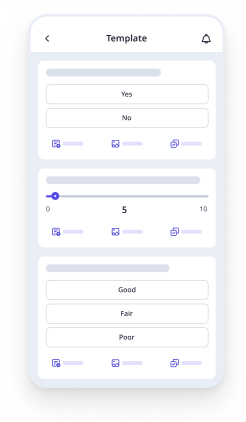
Mobile Preview
See the template in action (opens in new tab)

The risk-based inspection screening assessment form is used to perform qualitative assessments with the aim of identifying, at a higher level, the elements that significantly affect risk levels. This form helps assessors to conduct detailed RBI audits that are focused on these elements. With Mitti (by SafetyCulture), assessors can:

  • Create customizable RBI screening assessment forms for different purposes, such as offshore installations, storage tanks, pressure vessels, and pipelines

  • Document risk identification on a system-by-system or equipment item basis

  • Set scoring metrics to help you easily know the completion status of RBI screenings

  • Assign medium and high-risk items for detailed evaluation to a responsible person

  • Examine gathered inspection data through Mitti (by SafetyCulture) Analytics

Featured Template
Mobile Preview
See the template in action (opens in new tab)

Why Mitti digital checklists?

  • Free to use for up to 10 users

  • Eliminate paperwork with digital checklists

  • Generate reports from completed checklists

Use template
  • What is a Risk-based Inspection (RBI)?
  • How Does It Work?
  • What are the Goals of RBI?
  • How was RBI Conceived?
  • Why use a Risk-Based Inspection Instead of Time-Based?
  • What are the Recommended Practices for Risk-based Inspections?
  • Risk-Based Inspection PDF Example

In this article

  • What is a Risk-based Inspection (RBI)?
  • How Does It Work?
  • What are the Goals of RBI?
  • How was RBI Conceived?
  • Why use a Risk-Based Inspection Instead of Time-Based?
  • What are the Recommended Practices for Risk-based Inspections?
  • Risk-Based Inspection PDF Example

Eliminate paperwork with digital checklists

Skip the setup and get to work in seconds.

Use template

Article by

Jona Tarlengco

|

4 min read

|

8 Mar 2024

What is a Risk-based Inspection (RBI)?

Risk-based inspection (RBI) is a risk assessment and management approach that aims to develop an optimal routine inspection scheme based on risk knowledge associated with equipment and structural items. It serves as an alternative strategy to Class rule-based or time-based inspection regimes.

How Does It Work?

During the risk-based inspection process, engineers conduct a qualitative, quantitative, or semi-quantitative assessment to determine the probability of failure (PoF) and consequence of failure (CoF), then ultimately discern:

  • which components to inspect;

  • what degradation mechanism to use for inspections;

  • when to inspect; and

  • how to inspect.

This asset management methodology is predominant in the engineering field, particularly in the Oil and Gas industries. Some of the most common types of assets that undergo risk-based inspection include pressure vessels, atmospheric storage tanks, underground storage tanks, floating offshore installations, pipeline structures, boilers, and power generation components such as steam generators and turbines.

What are the Goals of RBI?

According to the American Petroleum Institute (API), the official trade association for the oil and natural gas industry of the United States, an RBI program has four key goals:

4 Goals of Risk-Based Inspection (RBI)
  • Identify and measure risk for all covered equipment

  • Impart an accurate understanding of risks and risk drivers

  • Enable effective risk management

  • Reduce risks associated with operating processing facilities

How was RBI Conceived?

Facility and equipment asset maintenance had historically been performed through a time-based inspection (TBI) regime. While the TBI regime proved to be effective in maintaining assets in operational condition over the past decades, its efficiency was challenged by the growing number of equipment and other assets in facilities. This growth needed to be supported by the required inspections, which ballooned expenses due to the related costs and resources needed to conduct the inspections. With this, there was a necessity to rethink TBI schemes and optimize their inspection schedules hence risk-based inspections were conceived.

Why use a Risk-Based Inspection Instead of Time-Based?

The risk-based inspection approach has proven to be a valuable strategy in asset maintenance and regulation compliance, particularly in providing a cost-efficient inspection plan. In a 2018 case study by engineering leads from PinnacleART, four key advantages of RBI over the TBI approach were identified.

Reduced turnaround exposure

With the RBI approach, non-essential checks in the inspection program can be identified and removed from the scope to achieve efficiency. With these exclusions, total inspection times and manpower needs are reduced,  thus helping optimize inspection processes.

Extended Inspection Intervals

In addition to overall risk reduction and promoting a safer work environment, RBI plans also help in cost reductions. Risk-based inspections identify equipment that either does not require servicing or needs only minor evaluations. This way, inspection and maintenance activities become cost-effective and flexible with regard to planning and scheduling. Risk-based inspections result in a significant reduction in the frequency, and duration of each individual inspection. This produces a more concentrated, accurate data set.

Increased Operational Awareness

The risk-based inspection framework can help increase operational knowledge and make collaboration easier. As a result of the continuous interaction between corrosion and inspection engineers, including regular discussions on the effects of operating conditions on equipment damage and susceptibilities, operations personnel become more knowledgeable about the entire process, resulting in a natural increase in accountability.

Optimized Inspection Regimes

An RBI program provides the justification to eliminate ineffective, unnecessary, or excessive inspection techniques. It provides a basis for the reduction or elimination of inspection activities in low-risk assets that are not deemed dangerous enough to negatively impact operations.

What are the Recommended Practices for Risk-based Inspections?

The API published recommended practices for risk-based inspections through API RP 580, Risk-Based Inspection, Third Edition and the API RP 581, Risk-Based Inspection Methodology.

API RP 580, published in 2002, is the cardinal document that provides the fundamentals on how to develop, implement, and maintain a credible RBI program. It serves as the criterion for the level of quality that RBI programs need to comply with. It also answers the questions:

  • What is RBI?

  • What are the key elements of RBI?

  • How do I implement an RBI program?

API RP 581, published in 2016, supplements the minimum provisions of API RP 580 and provides quantitative RBI methods that define risk as the combination of POF and COF.

Risk-Based Inspection PDF Example

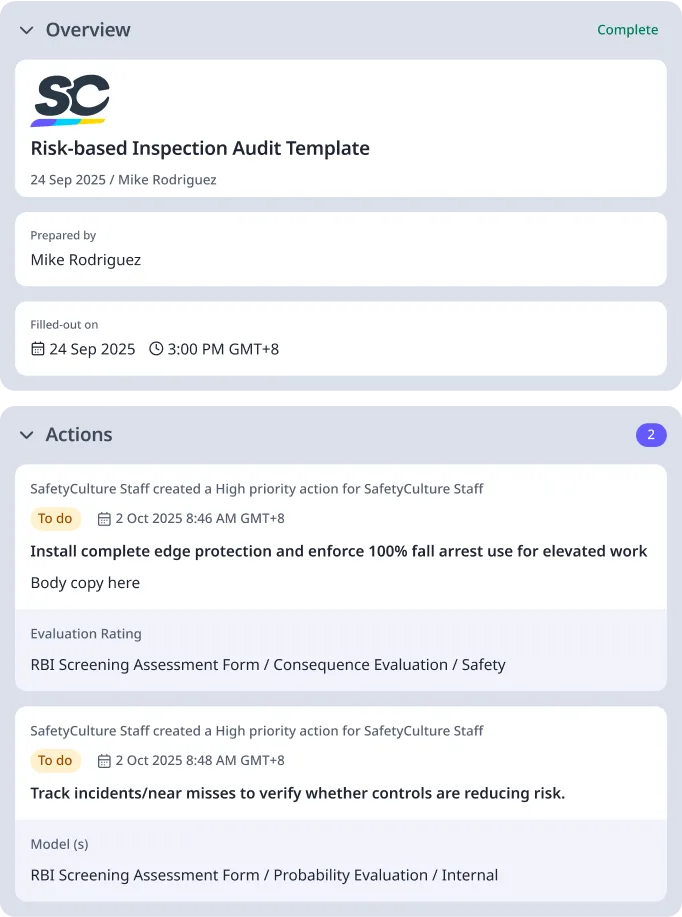
Here’s an example of a completed risk-based inspection audit in PDF format:

Risk-based Inspection Audit Template PDF Report

Preview Risk-Based Inspection PDF Report

Content library templates

Still looking for a checklist?

Search, filter, and customize 60,000+ templates across industries and use cases.

Browse Library
JT

Article by

Jona Tarlengco

Mitti (by SafetyCulture) Content Specialist

View author profile

Related resources you might like

Templates

Powered by

Underground Storage Tank (UST) Inspection Checklist

Operators and owners of UST sites can use this underground storage tank walkthrough inspection checklist to conduct risk-based inspections and capture the following information as required by regulations: exact date and time of inspections, area inspected, inspection results, and description of actions taken. With the Mitti (by SafetyCulture) app, inspectors can:

  • Capture photo evidence of findings during inspections

  • Take immediate action to prevent or mitigate the release

  • Save and submit inspection reports conveniently

  • Assign and schedule inspections within the app

  • Create and edit your underground storage tank inspection checklists as required

View template in library

Powered by

Boiler Inspection Checklist

A boiler inspection checklist is a tool used for the safe and accurate maintenance and routine checks of oil or gas-fired boilers on ships. Normally a part of the Port State Control regime, crew members should use this checklist to inspect the internal, external, and operation of a boiler. Select Safe-At Risk-N/A for crucial components and immediately fix problems to avoid boiler explosions, meltdowns, and scalding or steam burns.

View template in library

Powered by

Pipeline Inspection Checklist

A pipeline inspection checklist is used by pipeline engineers to verify the integrity of a pipeline system and prevent costly shutdowns. Use this checklist to inspect the pipeline’s design, installation, operation, maintenance, and corrosion control procedures, coating and cathodic protection, test stations, remedial measures, and monitoring. With Mitti (by SafetyCulture), you can:

  • Attach pipeline inspection photos or videos as evidence

  • Assign corrective actions and notify the right personnel for the task

  • Sign off with additional observations and digital signatures

View template in library

Powered by

Pressure Vessel Inspection Checklist

A pressure vessel inspection checklist is used by engineers and boiler inspectors to help ensure that pressure vessels are safe to hold liquids and gases under pressure. This Mitti (by SafetyCulture) template is created based on a document on the inspection of unfired pressure vessels. Inspectors can use this to:

  • Conduct external and internal inspections of pressure vessels and inspect safety devices and piping systems.

  • Take photos and make notes on issues found during inspections

  • Assign corrective actions using mobile devices

  • Store reports automatically for easy recordkeeping and utilize the data for future reference.

  • Meet industry standards by customizing the digital template according to the type of boiler or pressure vessel.

View template in library

Articles

Safety Audit Software

Discover the most outstanding safety audit software of 2026 and validate your organization’s safety processes with your number one choice.

Learn more

50+ Safety messages of the day

Discover 50+ safety message of the day examples and tips for offices, construction sites, and labs to help keep your workplace safe daily.

Learn more

5×5 Risk Matrix Template

Download free 5x5 risk matrix templates today. Learn how it works and how it can help systematically assess and plan strategies for workplace risks.

Learn more