What is a risk control matrix template?
A risk control matrix template is a tool auditors and compliance teams use to map each identified risk to the specific control designed to prevent or catch it, then rate how well that control actually works. A completed template captures the risk description, whether the control is preventive or detective, and a score for both control effectiveness and residual risk. Teams working toward SOX compliance or ISO 31000 alignment can adapt the same format for financial reporting, project, or operational risks.
What to include in a risk control matrix template
A risk control matrix template usually captures seven pieces of information for every risk on the list:
Risk description – A specific, named risk rather than a broad category
Likelihood – How probable the risk is, typically on a numbered scale
Impact – The potential consequence if the risk occurs
Control description – Exactly what stops or catches the risk
Control type – Preventive (blocks the risk before it happens) or detective (catches it after)
Control effectiveness – How well the control performs, based on evidence
Residual risk – What's left over once the control is applied
Take unauthorized access to a financial system as an example. The control might be multi-factor authentication, which is preventive, paired with a monthly access log review, which is detective. Rating both controls separately usually shows where the real gap sits. It's rarely the preventive control. It's how consistently the detective one gets carried out. Understanding the difference between control types also helps when deciding which level of the hierarchy of controls a given safeguard actually sits at.
Control effectiveness ratings work best on a three-point scale: effective, partially effective, or ineffective. Tie every rating to evidence, such as a completed review, a system log, or a signed-off checklist, rather than a gut call. That evidence is exactly what auditors ask to see first.
Residual risk is the field teams skip most often, and it's usually the one reviewers ask about. It's the risk that remains once the control has done its job, and it's rarely zero. A control rated “effective” can still leave meaningful residual risk if the underlying exposure is severe enough, so don't treat a high effectiveness score as a reason to close out the row.
How to fill out a risk control matrix template step by step
Step 1: Identify and categorize risks. Group risks by department, process, or project so the matrix stays easy to scan. A financial reporting risk and a site safety risk shouldn't sit in the same unsorted list.
Step 2: Assign and document controls. Name the specific control for each risk and mark whether it's preventive or detective. A risk with no assigned control is a gap, not an oversight to fix later.
Step 3: Rate likelihood, impact, and control effectiveness. Score each risk using a consistent scale across the whole matrix, then rate how effective its control is based on evidence. Multiply likelihood by impact if a numeric residual risk score is useful for reporting.
For reference, here is an example of a filled-out risk control matrix template:
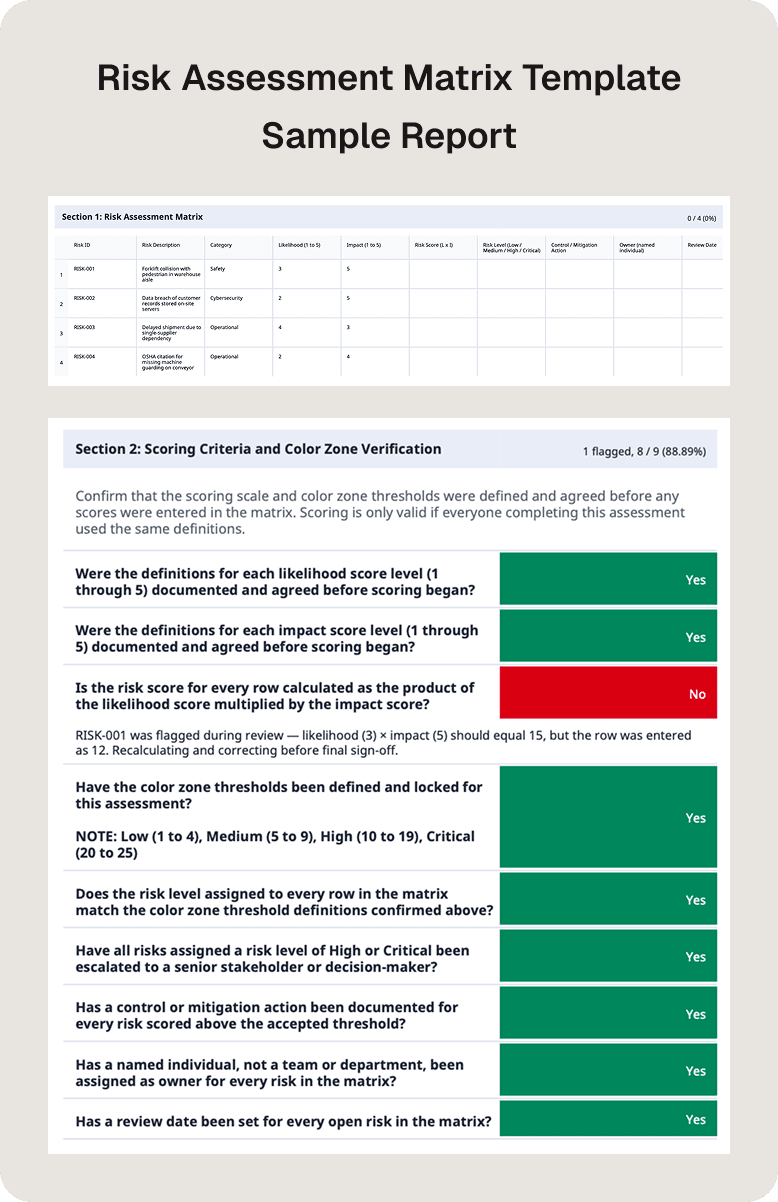
Risk Control Matrix Template PDF Sample Report
Risk control matrix examples for audit and compliance teams
It's important to understand how a risk control matrix, or risk management matrix, can be used. Here are a few key examples: can be used.l Here are a few key examples:
Example for financial reporting and SOX compliance
An internal audit team reviewing revenue recognition might list “unauthorized changes to customer invoices” as the risk. The control is a two-person approval workflow for any invoice edit, rated as effective based on system logs showing no single-user edits in the past quarter. This is the level of specificity SOX Section 404 reviewers expect: a named control, tied to evidence, not a general statement about “strong internal controls.”
Example for a construction project
A site manager tracking fall hazards on a multi-story build might list “workers on unprotected edges” as the risk, with a permit-to-work sign-off and daily edge protection inspection as paired controls. Rating the inspection control weekly, rather than assuming it's covered once and done, is what keeps the matrix useful past the first site audit.
The same logic applies across trades. A crane operation might list “dropped load near personnel” as the risk, with an exclusion zone and a pre-lift equipment check as controls, each rated separately since one failing doesn't mean the other has too. Treating every control as its own line item, rather than bundling several safeguards under one rating, is what makes the matrix genuinely useful when something does go wrong.

Still looking for a checklist?
Search, filter, and customize 60,000+ templates across industries and use cases.