What are slip, trip and fall hazards?
Slip, trip and fall hazards are anything that makes someone lose their footing or balance. A slip happens when there's too little grip between a shoe and the floor, such as on a wet or greasy surface. A trip happens when a foot catches on something in the way, like a loose cable, a curled mat or a raised edge. A fall follows when someone can’t recover, or drops from a step, ramp or ladder, even from a low height.
Most of these hazards are small. They sit in places people walk through every day, so they go unnoticed until someone gets hurt. A hazards checklist makes you look closely at each area and leaves a record of what you found and what still needs fixing.
Slip, trip and fall hazards checklist
Slips, trips and falls are one of the biggest causes of workplace injury across countries. In the US, they caused 479,480 private-sector injury cases involving days away from work across 2023 and 2024, and 844 workers died from them in 2024. In Great Britain, slips, trips and falls on the same level made up 30% of employer-reported non-fatal injuries to employees in 2024/25, the largest single category. In Australia, they led to 32,000 serious workers' compensation claims in 2023-24, and 68% of those were falls on the same level.
That's why this checklist starts at ground level. Walk the site one area at a time, mark each item pass or fail and photograph anything that fails.
Floors and walking surfaces
Floors cause the everyday slips, so check the surface and what's on it.
Are floors clean and dry, with spills cleaned up straight away?
Are floors even, with no cracks, worn patches or loose boards?
Is the flooring slip-resistant where it gets wet or greasy?
Are mats flat and secured, with no curled edges?
Are changes in floor level clearly marked?
Stairs, ramps and ladders
Changes in height are where a missed step turns into a fall. Minimize changes in floor level where you can. Where a change is needed, use a ramp rather than steps.
Are stairs and ramps in good repair, with grip surfaces intact?
Are handrails secure and easy to reach?
Are step edges visible, and are stairs kept clear of stored items?
Are ladders in good condition and set up on stable, level ground?
Lighting, furniture and outdoor areas
Hazards are easy to miss in poor light or bad weather. They also tend to stack up. An outdoor staircase, for example, needs controls for both the steps and the rain.
Is lighting bright enough in corridors, stairwells, storerooms and car parks?
Are blown bulbs and dark spots reported and replaced?
Are chairs, tables and open drawers kept out of walkways?
Are paths, entrances and car parks free of mud, ice, leaves and loose gravel?
Add job demands to the walk-through too. Time pressure and fatigue count as hazards because they leave workers rushed and tempted to cut corners. Note busy periods, long shifts and tight deadlines next to your floor findings.
Workplace area inspections
Run the checklist in the same order every time so nothing gets skipped. A broader look at slips, trips and falls at work covers the causes behind each hazard type. Some areas need a closer look than others.
Indoor workspaces and corridors: Check that walkways stay clear of cables, boxes and cleaning equipment, especially near doors and where traffic peaks.
Wet areas, kitchens and bathrooms: Look for pooled water, grease and blocked drains. Confirm anti-slip flooring and mats are in place and in good condition.
Outdoor areas and entrances: Check paths, ramps and car parks after rain. Entrances matter most, because wet shoes carry slip risk indoors.
Think about where your own weak spots are. In a store, that might be the entrance on a rainy day. In a warehouse, it could be pallet wrap near the dock door. In a care facility, it could be a freshly mopped corridor.
Housekeeping and maintenance controls
Good housekeeping removes many hazards before an inspection has to find them. Work through the hierarchy of controls in order. Remove the hazard first, reduce the risk next and rely on protective equipment last.
Spills and wet surfaces: Clean up spills straight away, put out a wet floor sign and block off the area until it's dry.
Cables, clutter and storage: Run cables along walls or under covers, keep aisles clear and give stock a proper home.
Footwear: Slip-resistant shoes help where floors get wet or greasy, but they sit at the bottom of the hierarchy of controls.
Removing the hazard is more reliable than managing it. Replacing a slippery floor with a slip-resistant surface is a good example, because nobody has to remember to avoid it.
Corrective actions and documentation
Every hazard the checklist flags needs a fix, an owner and a due date. Record the details below for each one, then close the item when the work is done. These corrective actions also give you a record of what you found and when you fixed it.
Location and description: Say exactly where the hazard is and what it looks like.
Photo: Attach one so the person fixing it sees what you saw.
Risk rating: Note how likely the hazard is to cause harm and how serious the injury could be.
Owner and due date: Name one person and set a deadline.
Review the findings every few weeks. If the same door keeps flooding or the same cable keeps tripping people, the layout needs fixing.
Regulatory standards for slip, trip and fall prevention
Rules differ by country, but most share three expectations: inspect surfaces, fix hazards and keep records.
OSHA (US): 29 CFR 1910.22 requires employers to keep walking-working surfaces clean, orderly and free of hazards such as spills, ice and loose boards. Employers must inspect these surfaces regularly and as necessary, and correct hazardous conditions before anyone uses the surface again.
Australia: Under the model WHS laws, businesses must eliminate risks so far as is reasonably practicable and minimize them if they can't. Safe Work Australia's 2026 guide isn't law, but it marks legal requirements with “must” and recommended practice with “should”.
ISO 45001: The international standard for occupational health and safety management expects organizations to identify hazards and assess risks. This ISO 45001 audit checklist covers hazard identification and emergency preparedness.
OSHA doesn't set a fixed interval. It requires employers to inspect surfaces regularly and as necessary, so match your frequency to your risk and inspect again after any incident or change to the layout.
Slip, trip and fall hazards checklist example
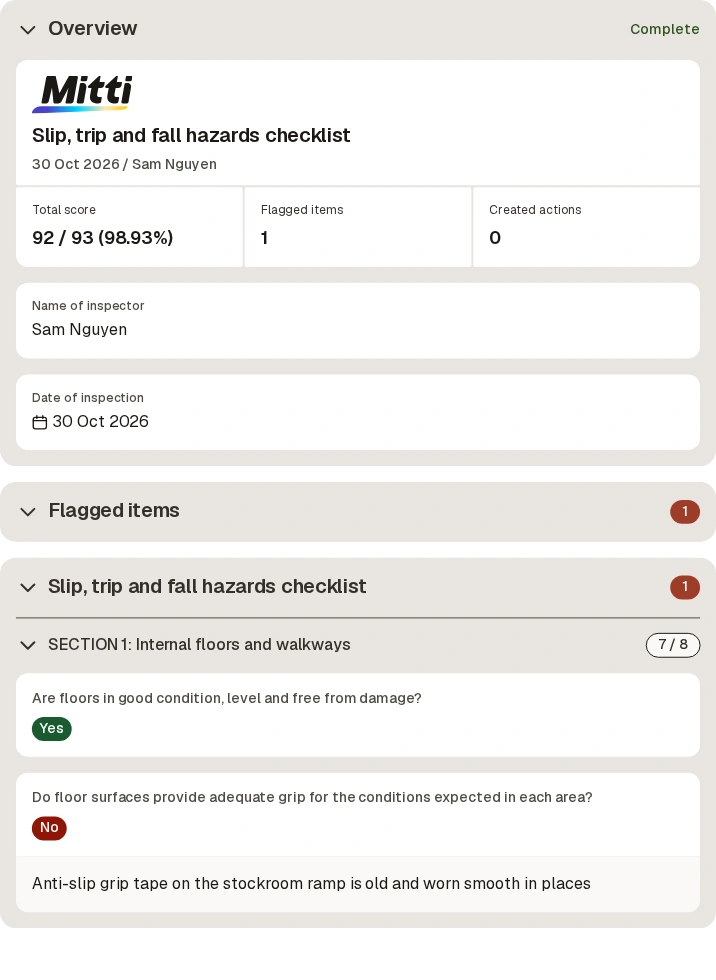
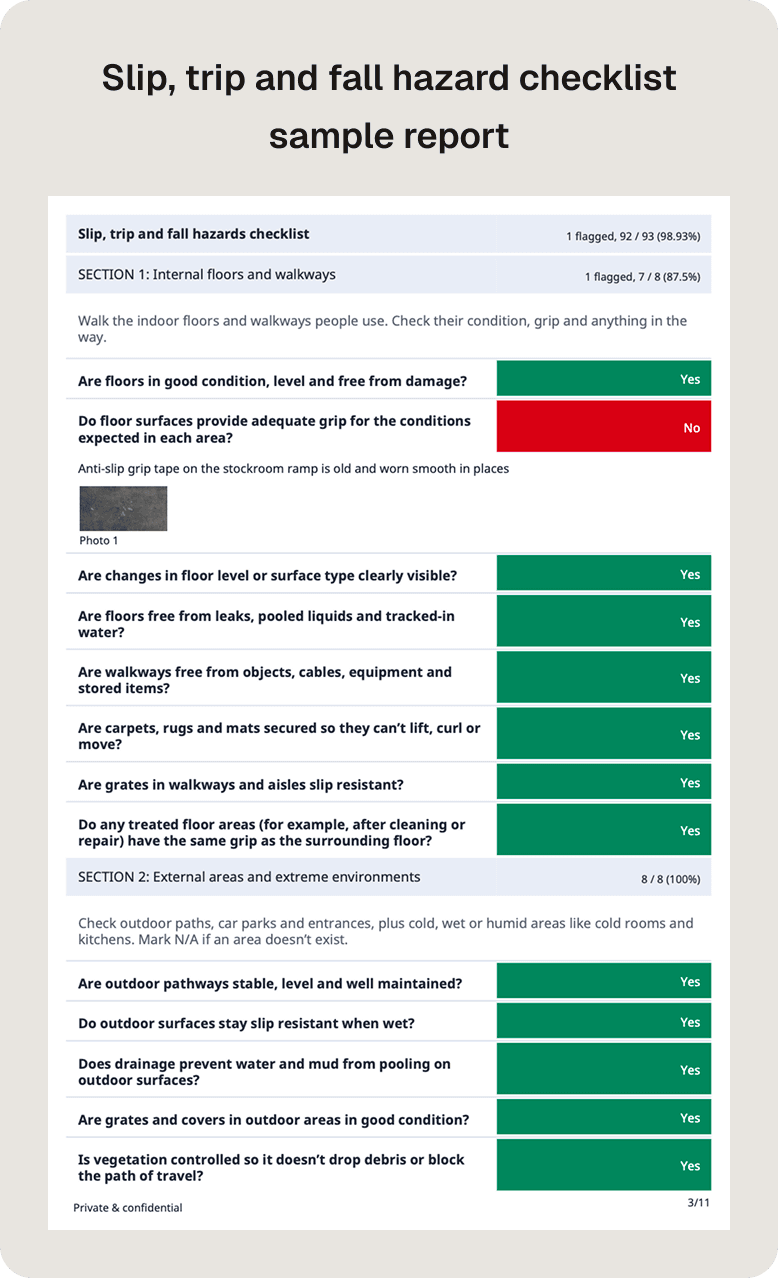
Here is an example slip, trip and fall hazards checklist report for your reference.
Mitti (by SafetyCulture) adapted this checklist from Safe Work Australia's free Guide to managing the risks of slips, trips and falls (September 2026) and used it as the basis for the hazard areas and inspection questions. We converted it into a digital inspection template. The guide is © Commonwealth of Australia and licensed under CC BY 4.0.

Still looking for a checklist?
Search, filter, and customize 60,000+ templates across industries and use cases.
FAQs about slip, trip and fall hazards
Article by
Mitti (by SafetyCulture) Content Team
Mitti (by SafetyCulture) Content Contributor
View author profile