
Mitti by SafetyCulture
Pricing
Log inSign up for free
  1. Home
  2. Checklist guides
  3. Safety
  1. Home
  2. Checklist guides
  3. Safety
Mitti by SafetyCulture

The way the world works

Follow us

App Store
Google Play

Product

  • Pricing
  • Book a demo
  • Product updates
  • Mitti (by SafetyCulture)

Support

  • Help center
  • Contact us
  • API developer documentation
  • Digitize your checklist

Resources

  • Content library
  • App & software guides
  • Checklist guides
  • Topic guides
  • eBooks
  • Blog

Company

  • About
  • Careers
  • News room
  • Meet the leadership team
  • Events & webinars
Copyright © 2026 Mitti
StatusLegalPrivacyTerms & ConditionsSecurity

SafetyCulture has a new name. Say hello to Mitti. Learn More.

Powered by

TACCP risk assessment template

Streamline TACCP risk assessments processes and proactively address food threat using digital TACCP templates. Also learn more about HACCP and VACCP.
Rated 4.6/5 stars on Capterra | 3k+ app store reviews
Use templatePreview template
TACCP Risk Assessment Template
Mobile Preview
See the template in action (opens in new tab)

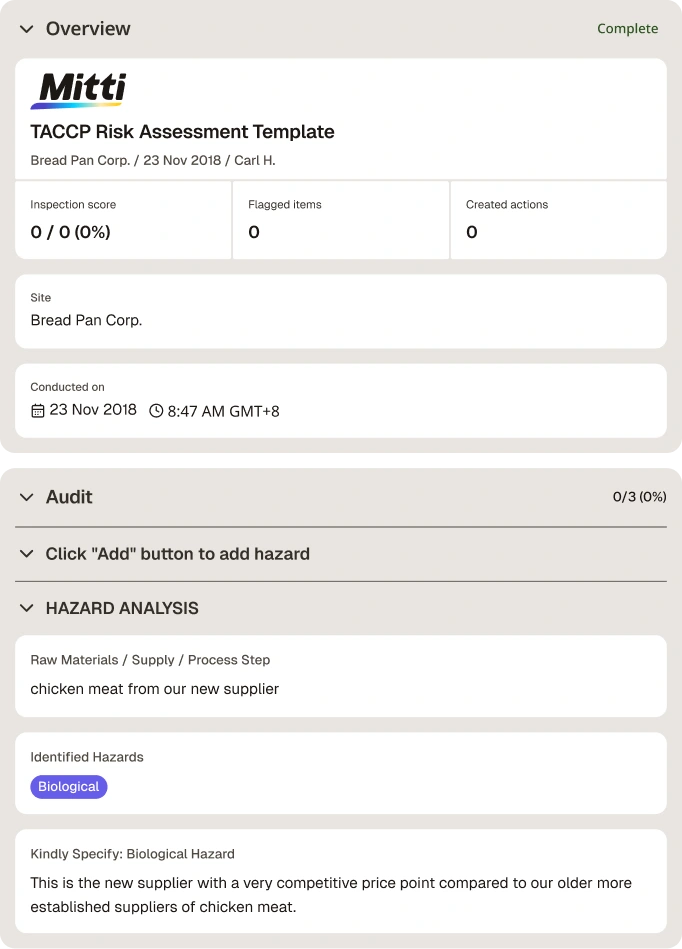
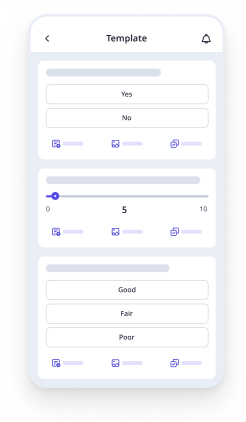
This TACCP Risk Assessment Template can be used to identify critical points in food production that are at risk to threats. Managers can use this digital template to proactively assess which effective risk control and prerequisite programs are to be used. Use this template as a guide for the following:

  1. Evaluate the process, analyze the hazard, and identify the risk rating.

  2. Identify if Biological, Chemical, Physical, or Radiological hazard (in addition to hazards usually considered for HACCP).

  3. Proactively guard against threats and make sure that corrective actions are assigned to appropriate team members.

  4. Submit reports like these TACCP risk assessment examples in digital and PDF formats.

TACCP Risk Assessment Template
Mobile Preview
See the template in action (opens in new tab)

Why Mitti digital checklists?

  • Free to use for up to 10 users

  • Eliminate paperwork with digital checklists

  • Generate reports from completed checklists

Use template
  • What is TACCP?
  • What does it protect against?
  • Similarities and differences between HACCP, VACCP, and TACCP
  • TACCP Implementation
  • TACCP Risk Assessment Example

In this article

  • What is TACCP?
  • What does it protect against?
  • Similarities and differences between HACCP, VACCP, and TACCP
  • TACCP Implementation
  • TACCP Risk Assessment Example

Eliminate paperwork with digital checklists

Skip the setup and get to work in seconds.

Use template

Article by

Mitti (by SafetyCulture) Content Team

|

2 min read

|

19 Feb 2025

What is TACCP?

TACCP, which stands for Threat Assessment and Critical Control Points, is a management process that aims to protect food products from deliberate contamination intending to cause harm. Also called food defense, TACCP helps proactively identify and manage control points in the supply chain that can be at risk of intentional contamination.

What does it protect against?

In the context of TACCP, threats are acts that can harm consumers or businesses through the contamination of food products. Some examples for TACCP include exposing food production to allergens such as peanuts, contaminating produce with needles or other physical contaminants, or causing a salmonella outbreak via contaminated self-service food. Such malicious acts can be costly for businesses and can be very harmful to consumers if not addressed immediately.

Similarities and differences between HACCP, VACCP, and TACCP

HACCP

VACCP

TACCP

Hazard Analysis Critical Control Point is designed to identify and mitigate hazards during food production and ensure that food product is safe for consumption.

Vulnerability Assessment Critical Control Point helps identify and control vulnerabilities in the food supply chain that can be exposed to (economically motivated) food fraud.

It aims to protect food products from deliberate contamination to cause harm (behaviorally or ideologically motivated). TACCP builds upon existing processes of HACCP in ensuring the safety of food products

TACCP Implementation

Businesses can properly mitigate risks by proactively anticipating threats and knowing which points in the food supply chain are at risk of deliberate contamination. To implement TACCP, businesses should:

  1. Create a multi-disciplinary team with members from HR, procurement, security, etc., who can contribute in developing a TACCP plan.

  2. Identify points in the food supply chain where threats are possible against staff, operations, and products.

  3. Conduct assessments of the critical points to identify risks.

  4. Analyze the risks and put in place appropriate threat controls and continue to monitor the control points.

  5. Create action plans in anticipation of possible breach of controls.

  6. Train employees and continue to improve the TACCP process by reviewing documentation and anticipating new threats.

TACCP Risk Assessment Example

Check this sample PDF report to see what information can be included in a TACCP risk assessment.

TACCP Risk Assessment Example

TACCP Risk Assessment Example

Content library templates

Still looking for a checklist?

Search, filter, and customize 60,000+ templates across industries and use cases.

Browse Library
MT

Article by

Mitti (by SafetyCulture) Content Team

Mitti (by SafetyCulture) Content Contributor

View author profile

Related resources you might like

Templates

Powered by

TACCP - food manufacturing audit (GMP)

This food manufacturing audit template follows GMP based on 21 CFR Part 110 and can be used as a guide when conducting food manufacturing audits. Operations Managers can use this as a guide to:

  1. Ensure that workers are trained on proper sanitary procedures and that equipment and process & controls follow GMP.

  2. Securely save your completed reports in the cloud and track overall audit score performance

View template in library

Powered by

TACCP - general food safety checklist

This food safety checklist can help ensure that food is properly prepared and protected from contamination. Managers can use this as an aid to look for possible risks in food safety. Use this as a guide to:

  1. Check staff hygienic practices and food preparation.

  2. Assess the status of the freezer, storage, utensils, equipment, garbage disposal, and pest control.

  3. Use Mitti (by SafetyCulture) to capture photo evidence of health risks and immediately assign corrective actions.

View template in library

Powered by

VACCP template

TACCP and VACCP can be used hand-in-hand with VACCP to promote a strong food defence by going through critical control points that could expose both threats and food fraud vulnerabilities. QA officers can use this to check ingredients or raw materials, product, production line, supplier/s, and nature of business. With other stakeholders to identify risks. Use this checklist as guide for the following:

  1. Assess the possibility of food fraud.

  2. Determine which point in the supply chain fraud can be an incentive.

  3. Check control measures in place against food fraud.

  4. Mitti (by SafetyCulture) templates can be edited according to your business needs – no programming skills needed!

View template in library

Articles

Project Risk Register Software

Compare the best project risk register software for 2026. See features, pricing and integrations to manage project risks with confidence.

Learn more

Risk prioritization: how to rank and act on risks that matter most

Learn how to score, rank and act on risks using proven prioritization methods and a step-by-step matrix you can apply today.

Learn more

ISO 14001 Checklist

Use this free ISO 14001 checklist to perform a streamlined internal audit for Environmental Management System (EMS).

Learn more