
Qu'est-ce que le Lean Six Sigma (6S lean) ?
Découvrez l’importance de la mise en œuvre de la méthode Lean Six Sigma 6S sur le lieu de travail.
Découvrez l’importance de la mise en œuvre de la méthode Lean Six Sigma 6S sur le lieu de travail.
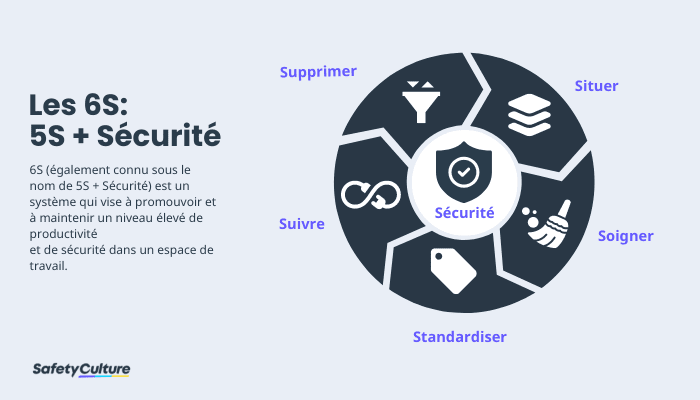
6S (également connu sous le nom de 5S + Sécurité) est un système qui vise à promouvoir et à maintenir un niveau élevé de productivité et de sécurité dans un espace de travail. Tout en respectant le principe des 5S (Sélectionner, Situer, Scintiller, Standardiser et Suivre), la méthode 6S ajoute le concept de sécurité. Le lean 6 S aide non seulement les organisations à promouvoir des environnements de travail efficaces, mais aussi à établir une culture durable de la sécurité.
6S lean gives your manufacturing and warehouse team a structured way to cut waste, prevent injuries and keep operations running smoothly. Here’s what teams typically gain:
Fewer workplace injuries. Sorting out workplace hazards and standardizing safety checks means fewer trip hazards, cluttered walkways and unsecured tools on the floor.
Less wasted time. Workers spend less time searching for tools, materials or paperwork when everything has a labeled, logical home.
Lower operating costs. Less waste, fewer equipment breakdowns and less rework add up to real savings over time.
Better audit and compliance readiness. A consistent 6S routine makes it easier to pass OSHA inspections and internal audits. OSHA’s housekeeping rule requires work areas to be kept clean and orderly and walking-working surfaces to be inspected regularly, so hazards get caught and fixed before they become findings.
Stronger team accountability. Assigning 6S ownership to shift leads and operators makes safety and organization everyone’s job, not just management’s.
Keep raising the bar. Regular audits show where standards slip, so your team can fix the cause and improve a little every shift.
6S sits within the wider lean philosophy, which the House of Lean framework maps out through its pillars and foundations. Manufacturing teams that run 6S audits with digital checklists, like those built with Mitti (by SafetyCulture), also get a clear record of what’s been checked, what needs fixing, and who’s responsible, so nothing falls through the cracks between audits.
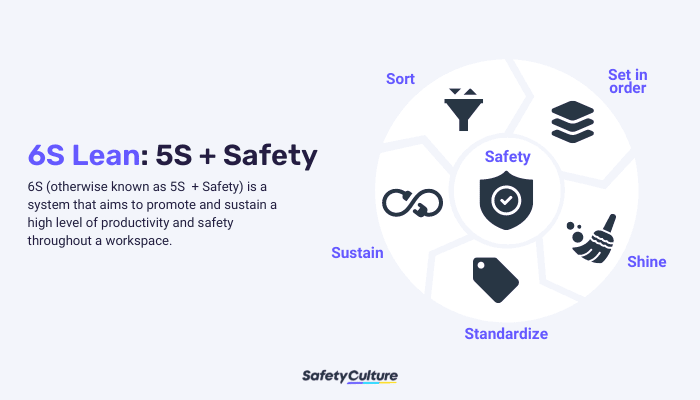
What are the components of 6S and why do they matter? Start with this quick reference:
Step | Japanese term | What it means |
|---|---|---|
1. Sort | Seiri | Remove what you don’t need. |
2. Set in order | Seiton | Give every item a labeled, logical home |
3. Shine | Seiso | Clean and inspect the work area |
4. Standardize | Seiketsu | Set consistent procedures and visual controls |
5. Sustain | Shitsuke | Make the routine a habit through regular audits |
6. Safety | Anzen | Identify hazards and set preventive controls |
Sorting is the first step. It cuts clutter so essential items are easy to find. Use red tags to mark unnecessary items for disposal and yellow tags for items you can store off-site for later.
Tag the items, equipment and materials you need, then place them in the most logical spots. The goal of set in order (also called “straighten”) is a system for storing and retrieving items that makes the most of your access and space.
Once you’ve removed what you don’t need and organized what’s left, clean the workplace and take steps to keep it that way. The goal is a space that prevents injuries and keeps products from getting stained by dirt.
Standardize sets the new norm. Capture best practices and write consistent procedures for the first three steps so everyone follows the same routine. Visual reminders, clear responsibilities and regular site checks help. Use one digital checklist so every shift sets up the same way.
Sustain is the hardest step. The goal is to apply your standards every day until they become second nature. Schedule recurring audits and give each finding an owner and a deadline, so standards don’t slip.
Safety is the final step. It focuses on identifying hazards and setting preventive controls to keep workers safe and to meet required safety standards. Log hazards from any phone so the next shift sees them straight away.
Private employers reported 2.5 million nonfatal workplace injuries and illnesses in 2024, a rate of 2.3 cases per 100 full-time workers, and the rate in manufacturing fell that year. Adding safety as a sixth step helps teams catch hazards before they become incidents. A safe, clean work environment helps you:
Improve productivity and quality
Create a healthy, stress-free atmosphere where workers feel safe
Spot potential hazards and add safety controls faster
Meet or exceed environmental performance and waste reduction goals, an approach the EPA’s Lean and Environment program also recognizes as core to a 6S rollout
6S in manufacturing applies the 5S principles (sort, set in order, shine, standardize and sustain) to production, with safety added. In manufacturing, a safer floor is a more productive one. Running regular 6S audits helps you cut waste, reduce machine breakdowns and protect your people and equipment. Done well, a 6S lean program helps you:
Manage waste and cut costs
Reduce machine breakdowns
Deliver high-quality products
Onboard employees faster with clear 6S training
6S isn’t only for factories. Warehouses use it to keep aisles and packing stations clear and safe. Construction teams apply the same lean construction thinking on site. Healthcare teams use it to organize workspaces and reduce errors.
To fully implement 6S lean in your workplace, you’ll need:
A solid understanding of (or experience with) 5S
A system for identifying and reporting hazards
Safety awareness training for your industry
A commitment to hold toolbox talks about 5S and 6S with your workers
Approval from upper management, with dedicated resources and support
You can roll out 6S in seven steps. Start with one area, prove it works and then expand:
Get leadership buy-in and pick a pilot area – Choose an area with visible clutter or hazards so results show fast. Get a sponsor and set aside time and resources.
Train the team – Cover the six steps, your red tag rules and how to report hazards. Hold short toolbox talks to keep it fresh.
Sort – Red-tag items you don’t need, then remove or relocate them.
Set in order – Give every item a labeled home within reach of where it’s used.
Shine – Clean the area and inspect equipment as you go. Use cleaning checklists to make it routine, or see janitorial inspection software for recurring checks.
Standardize – Post visual standards and use one digital checklist so every shift follows the same routine. To compare tools, see these lean six sigma software options.
Sustain – Schedule recurring audits, give each finding an owner and a deadline and review results with your team.
Keep safety checks running through every step, and log hazards as you find them.
The first step to safety is identifying existing hazards. Follow the systematic approach in OSHA’s recommendations for safety and health programs. If your site follows ISO 45001, the international standard for occupational health and safety management systems, the safety step is a practical way to put hazard identification into practice. Everyone on site should know the types of workplace hazards and evaluate them with risk assessments or a job safety analysis (JSA). These methods set the standard safety procedures and controls that reduce or eliminate hazards.
Workers should also wear the right personal protective equipment (PPE) for hazards that are hard to control or can’t be eliminated. PPE includes hard hats, safety goggles, face masks, insulated gloves, slip-resistant boots and more. Check PPE use and share other safety protocols with all workers through training and toolbox meetings.
No site reaches perfect safety. But adding safety to 5S, and pairing it with kaizen, helps your team improve working conditions a little every day. Workers stop focusing only on the day’s tasks and start contributing to overall workplace safety as a habit.
This example combines the 5S audit checklist and the 6S lean safety checklist from Mitti (by SafetyCulture) at a single warehouse packing station:
Sort: Clear the station of duplicate tools, expired labels and anything not used during the current shift.
Set in order: Store scanners, tape guns and packing materials in labeled bins within arm’s reach of the operator.
Shine: Wipe down work surfaces at the end of each shift and check conveyor rollers for buildup that could cause slips.
Standardize: Post a visual layout of the station so every shift sets it up the same way, with tools and materials in the same spots.
Sustain: Assign a rotating team member to confirm the station meets the standard at the start of each shift.
Safety: Flag and report any exposed wiring, blocked exits or unsecured pallets before work begins, following the NIOSH hierarchy of controls to decide how each hazard gets fixed.
A 6S audit checks how well each step is holding up. Use a checklist that covers:
A section for each S, with specific items to check (for example, no unused items in the work area under sort)
A scoring scale so you can compare areas and track progress over time
An owner for each area
A frequency that matches the step
A corrective action for every item that fails, with an owner and a deadline
Each system builds on the last. 5S focuses on organization, 6S adds safety and 7S adds one more element:
5S | 6S | 7S | |
|---|---|---|---|
Steps | Sort, set in order, shine, standardize, sustain | The five steps plus safety | The six steps plus one more |
Focus | Organization and waste reduction | Organization plus proactive hazard prevention | Organization, safety and a wider focus |
The added S | None | Safety | Security or spirit, depending on the source |
Best for | Workplaces with few significant safety risks | Workplaces with significant safety risks | Sites that handle sensitive data or want to build team culture |
When you choose between 6S and 5S, pick the one that fits your risks. In more hazardous workplaces, the extra step makes sense. It puts safety at the center and gives you specific safety KPIs to measure improvement. Where there are few significant safety risks, the sixth S can be unnecessary. Whichever you choose, keep safety a priority and pick the lean management approach that fits your site.
Parcourez notre collection de listes de vérification 6S prêtes à l’emploi que vous pouvez utiliser gratuitement !
Listes de contrôle pour les chariots élévateurs à fourche
Article par
Mitti Content Team
Mitti Content Contributor


