
Heat stroke vs heat exhaustion: symptoms, differences and when to get help
Know the signs of each, how to tell them apart in seconds and what to do until help arrives.

Know the signs of each, how to tell them apart in seconds and what to do until help arrives.
Heat exhaustion happens when the body loses too much water and salt, usually through heavy sweating. Heat stroke is the more dangerous stage, when the body can no longer control its temperature and it keeps climbing.
The clearest difference is how the person is thinking. Someone with heat exhaustion feels sick but still thinks clearly. Someone with heat stroke is confused, slurring words or passing out, and needs an ambulance.
Both are heat-related illnesses that start with heat stress. Heat exhaustion can turn into heat stroke if nothing is done, so knowing the signs of each helps you act before a rough afternoon turns into an emergency.
Most signs come from OSHA's heat illness guidance and CDC's heat-related illness chart.
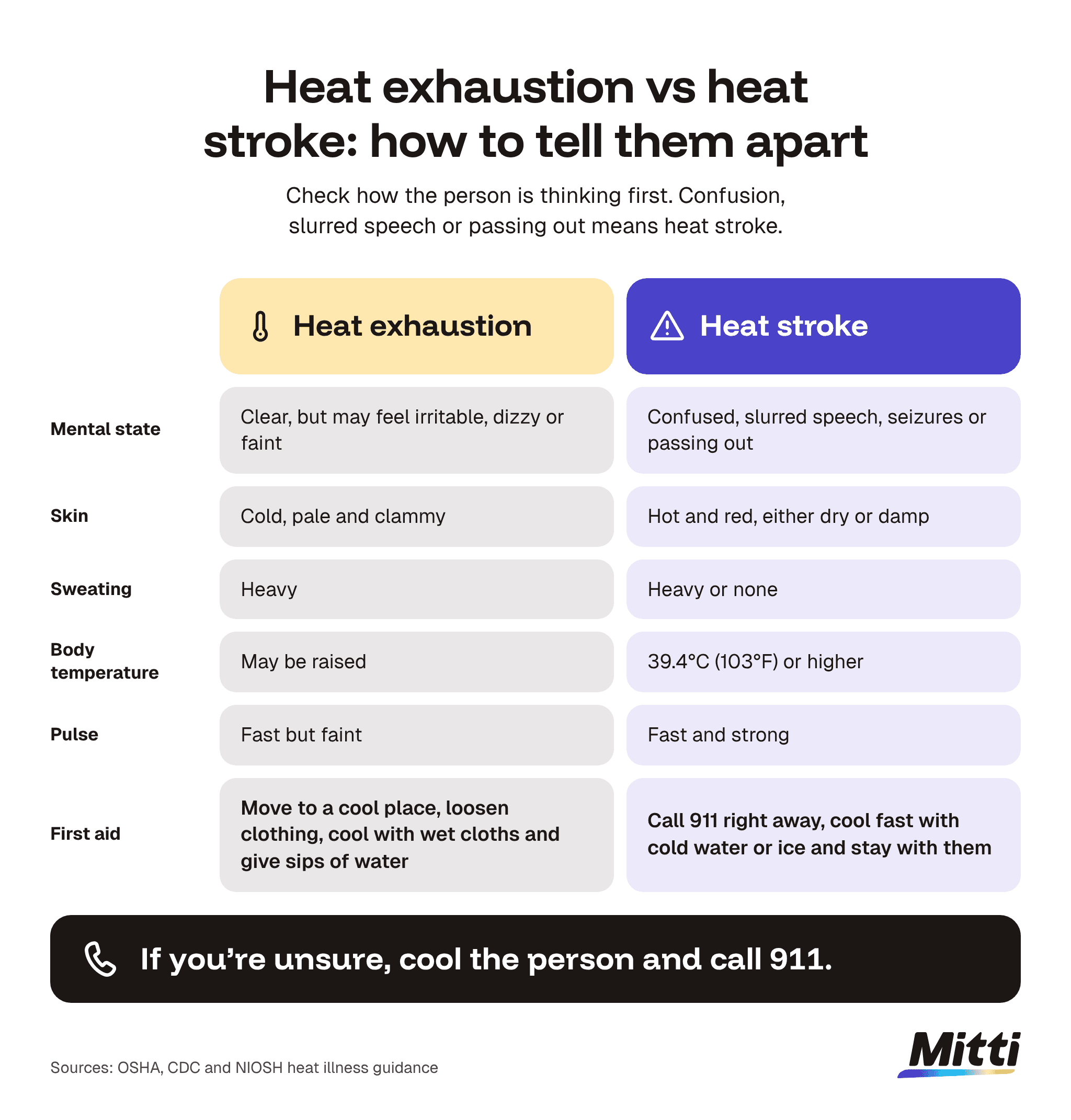
Heat exhaustion vs heat stroke: how to tell them apart
Sweat alone doesn't settle it. OSHA lists both heavy sweating and hot, dry skin as signs of heat stroke, so don't rule it out because someone is still sweating.
You don't need a diagnosis to act. OSHA says diagnosis is often difficult because several heat illnesses can show up together, so its rule is simple: when in doubt, call 911. Three quick checks still point you in the right direction.
Ask a simple question. Ask for their name, the date or where they are. Confusion or slurred speech means heat stroke.
Check the skin and pulse. Cold, clammy skin and a fast, faint pulse point to heat exhaustion. Hot, red skin and a fast, strong pulse point to heat stroke.
Take their temperature if you can. A reading above 41°C (106°F) points to heat stroke, but a lower reading doesn't rule it out, so don't wait for a thermometer before you act.
Cleveland Clinic names signs of brain dysfunction as the key difference. Heat stroke has them and heat exhaustion doesn't.
Picture a laborer on the second hot afternoon of a heat wave. He's pale, soaked in sweat and says he feels sick. That's likely heat exhaustion, so get him into shade and start cooling him. If he starts slurring his words or can't tell you where he is, treat it as heat stroke and call 911.
OSHA's first aid standards require employers to keep first aid personnel and equipment ready. The steps below follow guidance from OSHA, NIOSH and CDC. Stay with the person the whole time, because heat illness can get worse fast.
Move the person to a cool place, like shade or air conditioning.
Loosen or remove extra clothing, including shoes and socks.
Cool them with cold wet cloths, or have them wash their head, face and neck with cold water.
Give frequent sips of cool water.
Stay with them until they feel better.
Get medical help right away if the person is vomiting, gets worse or doesn't feel better within an hour, says CDC. For workers, NIOSH advises a medical evaluation, and a 911 call if care isn't available.
Call 911 right away.
Stay with the person until help arrives.
Move them to shade or a cool room and remove outer clothing.
Cool them fast. An ice bath or cold water immersion is, per OSHA, the best way to cool workers rapidly in an emergency. If you can't, wet their skin and put cold wet cloths or ice on the head, neck, armpits and groin.
Fan them to speed up cooling.
Don't give them anything to drink, CDC advises.
Heat cramps and heat syncope are all part of heat-related illnesses. They are milder, but they can be early warnings. Heat cramps are painful muscle spasms in the legs, arms or stomach after heavy sweating, and they can also be a symptom of heat exhaustion. Heat syncope is a short fainting spell or dizziness, often after standing too long or getting up suddenly.
Don't wait for the first case to work out a plan. NIOSH says workers and supervisors should be trained on heat-related illnesses, their symptoms and first aid. Before a hot spell:
Keep cooling supplies where the crew works. OSHA says to make an ice bath by putting all the available ice into a large container of water.
Set up a shaded or air-conditioned spot to cool people down.
Name who calls 911 and who stays with the person.
Post the site address and gate directions where everyone can see them.
Brief new workers on the warning signs during their first few days.
A heat action plan helps you write all of this down in one place.

Use this free template to plan shade, water, rest breaks and emergency steps before the next hot spell.
This guide covers spotting and treating each illness. For full heat stress prevention steps, read our guide to heat illness prevention. The short version is OSHA's formula of water, rest and shade.
New workers are at higher risk, so OSHA says all symptoms should be taken seriously in the first few days on the job. Employers can see what's expected of them in our guide to OSHA heat regulations, and our heat stress guide explains how heat builds up on site.
You can also brief your crew with a heat stress toolbox talk before the next hot spell.
Mitti (by SafetyCulture) is the operations system for every site, shift and standard. Trusted by over 80,000 organizations, Mitti brings your people, operational data and workflows into one operating picture.
Your frontline teams get real-time visibility across every site, worker and task. They catch risks earlier, close out corrective actions and build a digital audit trail as the work happens, so you stay audit-ready without the paperwork.
Catch hazards and near-misses the moment they happen
Turn every issue into a clear next step with an owner and a deadline
Stay audit-ready with a digital audit trail that builds itself
Get workers trained and site-ready before they start
Spot trends across sites, shifts and teams
Improve safety every day with evidence from the people doing the work
Article by
Mitti (by SafetyCulture) Content Team
Mitti (by SafetyCulture) Content Contributor
View author profile