
Industry Insights
How one unwashed hand can cause a six-figure problem
By Rafael Villamor31 Jul 20265 min read
Rushed handwashing and skipped glove changes cause a huge share of food handling mistakes.
Rinsing raw chicken doesn't kill bacteria, only cooking to a safe temperature does.
One foodborne illness outbreak can cost a restaurant anywhere from $4,000 to $2.6 million.
Important notice
The information contained in this article is general in nature and you should consider whether the information is appropriate to your specific needs. Legal and other matters referred to in this article are based on our interpretation of laws existing at the time and should not be relied on in place of professional advice. We are not responsible for the content of any site owned by a third party that may be linked to this article. Mitti disclaims all liability (except for any liability which by law cannot be excluded) for any error, inaccuracy, or omission from the information contained in this article, any site linked to this article, and any loss or damage suffered by any person directly or indirectly through relying on this information.
This is how easily food poisoning spreads:
All it takes is one employee, like at this restaurant in Port Chester, New York. That employee was infected with hepatitis A and skipped basic kitchen hand hygiene, including touching ready-to-eat food with bare hands.
After, more than 2,900 people needed post-exposure treatment. The virus kept moving too, passed from a dine-in customer to another employee at a nearby country club's kitchen.
The restaurant closed for a few days to sanitize, then reopened. That's all it takes to put an entire county on alert. One small, human error cost Westchester County taxpayers up to $210,000 to operate vaccination clinics for the more than 3,000 people who were exposed.
It’s scary how simply washing your hands too quickly can create a ripple effect that can infect millions of people. So much so that the Centers for Disease Control and Prevention (CDC) estimates that 48 million people get sick from foodborne illness in the US every year. Even worse, is that 128,000 of those end up hospitalized and 3,000 die.
The costs also don't lie. One outbreak can run a restaurant anywhere from $4,000 for a handful of cases with no lawsuits, up to $2.6 million once legal fees and lost revenue get involved, according to a Johns Hopkins Bloomberg School of Public Health model. That's how much one unwashed hand can cost you. Now, think about how many hands touch food in your kitchen on a single shift.
When serving food is your job, you have to think about every point of contact your food has touched, because that's what you'd be serving to your customers. So, here are the most common mistakes to watch out for and build proper habits around:
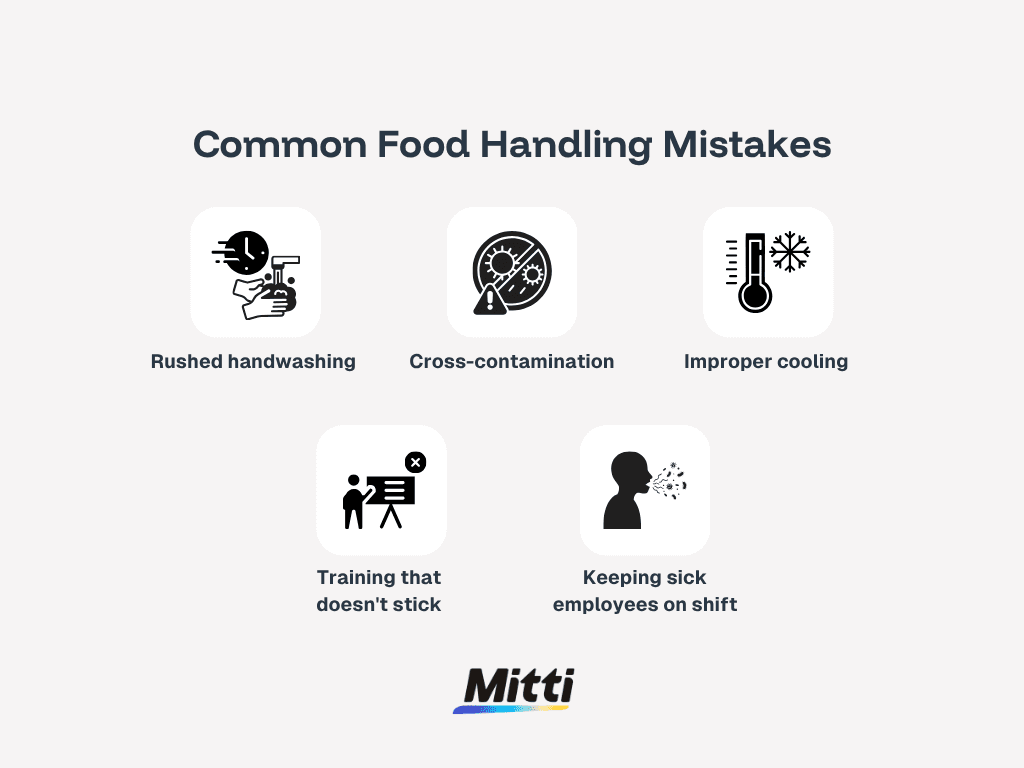
Common Food Handling Mistakes
Arguably the simplest, but also the most common mistake. The CDC mentions that in an 8-hour shift, restaurant staff wash their hands around 15.7 times, but between touching raw meat, poultry, and ready-to-eat food, about 1 in 4 workers don't always wash their hands, and 1 in 3 didn't always change gloves. There's no easy fix for this one, but to just remind your team to properly wash their hands.
A lot of kitchens still rinse raw chicken before cooking it, assuming water removes bacteria. It doesn't. A US Department of Agriculture (USDA) study found 1 in 7 people who washed chicken still had bacteria in the sink afterward, because rinsing just splashes contaminated water around the kitchen instead of removing it. Cooking meat to a safe internal temperature is the safest way to eliminate a food safety hazard.
Did you know hot food shouldn't sit in containers deeper than 3 inches? 4 in 10 restaurants do it anyway. The deeper the container, the longer the center stays warm, and the US Food and Drug Administration (FDA) only allows 6 hours to bring hot food down to a safe temperature. Shallower containers and smaller portions fix that, and a temperature sensor catches a slow cool-down before it becomes a problem.
Restaurants should also be stricter on their sick policies. Employees are required to notify their manager and stay home if they have symptoms like vomiting, diarrhea, or jaundice, according to the FDA Food Code. A digital log sheet makes this easier to catch, since it gives every shift a quick, trackable record of who reported what, instead of relying on a manager who might miss it.
The restaurant industry has one of the highest turnover rates in the general job market, averaging around 75%, with quick-service restaurants often exceeding 100%. That kind of churn means food handling training may get missed when new hires start, or quietly falls off once a manager stops tracking it. Checklists and digital courses fix this because they don't rely on one person remembering to follow up; they keep running no matter who's on shift.
Every food handling mistake is avoidable, and none of them require a bigger budget or a fancier kitchen. Restaurants have to move fast and get people in and out, that's the nature of the business, but that doesn't mean the basics get to slide. A kitchen that gets this right protects its customers, its staff, and its reputation, all at once.
Take the SSP Group, for example. They run food and beverage outlets across more than 100 airport locations in Australia and New Zealand. A lot can go wrong when you’re handling that many customers, but after digitizing inspections and temperature monitoring, their compliance rates climbed from 60% to nearly 100%, with an 82% jump in staff understanding of food safety practices.
I just want to make things safer for our people and safer for our customers. It’s simple. With Mitti (by SafetyCulture), we can focus on our people going home safe and our customers leaving happy.


