
Industry Insights
Why waiting to fix things in hospitality businesses always costs you more
By Rafael Villamor31 Jul 20266 min read
Preventive maintenance saves 12% to 18% compared to reactive.
Low-cost, easily replaceable equipment can stay on reactive maintenance.
Match your maintenance strategy to what matters most to guests and safety.
Important notice
The information contained in this article is general in nature and you should consider whether the information is appropriate to your specific needs. Legal and other matters referred to in this article are based on our interpretation of laws existing at the time and should not be relied on in place of professional advice. We are not responsible for the content of any site owned by a third party that may be linked to this article. Mitti disclaims all liability (except for any liability which by law cannot be excluded) for any error, inaccuracy, or omission from the information contained in this article, any site linked to this article, and any loss or damage suffered by any person directly or indirectly through relying on this information.
Something strange happened in July 2019, at a hotel deep in Atlanta. People randomly started feeling sick, so much so that one person died. As it turns out, this was from a special type of pneumonia called Legionnaires' disease.
Where did it come from? One of the places was the decorative fountain at the center of the hotel. Once water gets stagnant and unchanged without any sort of maintenance, it starts spreading tiny droplets of Legionella bacteria.
The hotel was later closed for weeks, all because nobody was watching the cooling tower that just ran quietly for years. It was all reactionary.
This could've easily been prevented, but no one was paying attention, in a place where guests expect to be taken care of.
Preventive maintenance is scheduled servicing done before something fails, whether that schedule is based on time, usage, or the equipment's actual condition. Reactive maintenance is the opposite: nothing happens until something breaks, and then someone scrambles to fix or replace it.
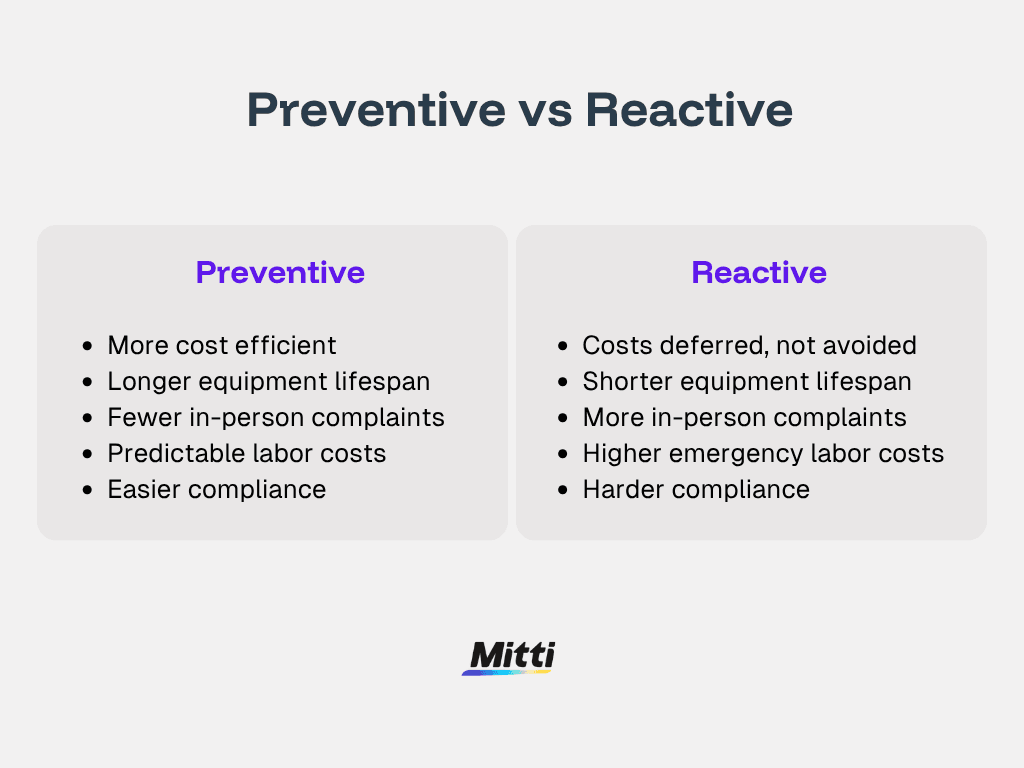
Preventive vs Reactive Maintenance
On top of that, preventive maintenance is usually cheaper overall. Preventive programs save an estimated 12% to 18% compared to a purely reactive one, since reactive maintenance shortens equipment lifespan and drives up labor and capital costs down the line.
So for the hospitality industry, preventive maintenance isn't just the safer bet. It's the cheaper one too.
This doesn’t mean that you should just ditch reactive maintenance completely. There is still a time and place for this, like:
Working with low-cost, easily replaceable equipment where scheduling a preventive visit costs more than just fixing it when it fails
Working with equipment already flagged for replacement or nearing the end of its life, where sinking more service dollars into it doesn't make financial sense
Working with equipment whose failures don't follow a predictable pattern, since a scheduled inspection wouldn't have caught it anyway
Especially if you're a smaller business, a preventive program's labor and scheduling costs can run higher than what you'd spend just fixing things as they break.
When a guest books a 5-star hotel or restaurant, they expect 5-star treatment. You give what you advertise, and when you don't deliver it, they have every right to complain.
Here are some common maintenance problems guests notice first:
Heating, Ventilation, and Air Conditioning (HVAC) units, elevators, hot water systems, hotel room TVs, and amenities like the gym and pool are the equipment hotel guests actually notice the most. When one of those fails, you're not just facing the consequences of the repair bill, but also a hit to your online reputation. And hotels live and die by repeat bookings and review-driven demand. Something like a room's hairdryer or alarm clock, low-cost and easy to swap, can stay reactive without any real downside.
Walk-ins, fryers, refrigeration units, and ventilation units are important to how fragile food can be where even the slightest temperature change can spoil it. The Food and Drug Administration (FDA) has strict rules here, and for good reason. If equipment fails, you're not just looking at a bad inspection. You're looking at fines, or worse, a foodborne illness case that puts people in the hospital. Dining room furniture or a countertop blender behind the bar, on the other hand, is cheap enough to just replace when it goes.
When developing the templates, I always try to make it as intuitive as possible. We don’t need our team to have a degree in engineering to be able to run a daily report.
Theme parks, casinos, stadiums, and cinemas carry high stakes when it comes to customer safety. Mechanical rides, electrical systems, and outdoor structural systems like lighting towers and rigging are strictly regulated, since a single mistake can shut the whole venue down. Decorative signage or a vending machine in the lobby is a different story, since they’re low stakes enough to fix when it breaks.
HVAC, plumbing, elevators, and life-safety systems carry more weight at sea. Calling vendors or repairmen can be difficult once you're days from the nearest port. A minor issue on land becomes a multi-thousand-guest problem with nowhere to go, which is why cruise ships are held to the International Maritime Organization's International Safety Management (ISM) Code. A stateroom's mini fridge or in-cabin entertainment system is low-stakes enough to run reactive without putting anyone at risk.
The common thread is simple: the longer you wait, the more it costs, and that cost scales with how visible the failure is to guests and how critical the equipment is to safety.
As previously stated preventive maintenance is just the more cost-effective option, because reactive maintenance is just a deferred cost that you will pay in the future. After all, why pay for something that can be easily prevented?
Skip a scheduled maintenance check, and you eventually pay emergency labor rates instead. Skip a $200 HVAC capacitor, and you eventually pay more once it fails. Skip proper upkeep, and a compressor that should've lasted 15 years gets replaced at year 12. The bill still comes, it's just bigger, and it arrives at, possibly, the worst possible time.
And it's already showing up in the numbers. 49% of restaurant operators experienced downtime due to equipment failure or unplanned maintenance according to MachineQ's 2026 Restaurant Readiness report, and 24% of respondents estimate revenue loss between $1,001–$5,000 per hour of disruption.
That's why proper asset management of your equipment saves you money, and the stress of arguing with a guest over something that shouldn't have happened.
Start with a criticality assessment. Sort your equipment by what matters to your guests most. Map preventive schedules to the equipment that needs it most, and let the low-stakes ones run reactively on purpose for maximum cost efficiency.
One good example of a maintenance strategy done right is that of Sydney Festival’s. The event runs 60 venues, 150 events, and 334 performances across a single festival season, and instead of chasing maintenance and safety checks separately for each site, the team put pre-event checks, incident reporting, and daily reports all in one system. Having everything in one place makes things clearer for your team, and makes sure the right people get pinged the moment something needs attention.
That consistency is the actual goal. Not a specific ratio of preventive to reactive work, but a program where every piece of equipment is running a strategy that best fits.