
Industry Insights
What AI is actually doing on the frontline in 2026
By Rafael Villamor9 Oct 20266 min read
AI agents are growing fast, but most businesses haven’t scaled them yet.
The frontline AI that’s working right now still needs a person in the loop.
Judge a tool by whether it fits your workflow, not by how big its claims are.
Important notice
The information contained in this article is general in nature and you should consider whether the information is appropriate to your specific needs. Legal and other matters referred to in this article are based on our interpretation of laws existing at the time and should not be relied on in place of professional advice. We are not responsible for the content of any site owned by a third party that may be linked to this article. Mitti disclaims all liability (except for any liability which by law cannot be excluded) for any error, inaccuracy, or omission from the information contained in this article, any site linked to this article, and any loss or damage suffered by any person directly or indirectly through relying on this information.
Every week there’s another headline about AI running the frontline on its own. Agents making big decisions. Robots replacing shift supervisors. But how much of that is really happening?
That story is ahead of the data. McKinsey’s newest global survey found that even at large enterprises, only 40% report scaling AI agents across the business, up from 27% a year ago. That’s real growth, but still under half.
Meanwhile, the robots doing parkour and dancing on your feed are a different story entirely while impressive, that’s not something you want running your frontline unsupervised. It’s probably going to happen eventually. That’s just not the reality yet.
What’s actually happening is smaller and a lot more useful. A checklist built just by talking, ready in real time. A problem fixed before anyone even sees it. Or an AI agent quietly working a problem nobody assigned it.
That’s frontline AI in 2026, without the hype.
A lot of it. “Agentic AI” is the term you’ve probably heard, used to describe a system that does everything for you. It plans, acts, and adjusts, all without a person telling it what to do.
And that part’s true. AI agents do exist, and they’re already part of the workforce. From that same McKinsey report, 62% of companies have started using them in some form. But most companies are still deciding where an AI agent is allowed to act at all. It’s like picturing your agentic AI frontline system writing up an email to an angry customer.
There still needs to be some supervision, and a way for frontline teams to actually work alongside the AI instead of handing it the whole job. That’s not just a caveat, it's the whole point. The tools worth paying attention to are built with a person still in the loop, not working around one.
Mitti AI sits on top of the data frontline teams are already collecting. It’s meant to work alongside managers to spot problems early so things get fixed before they cost anyone any real time.
Four things Mitti does best are:
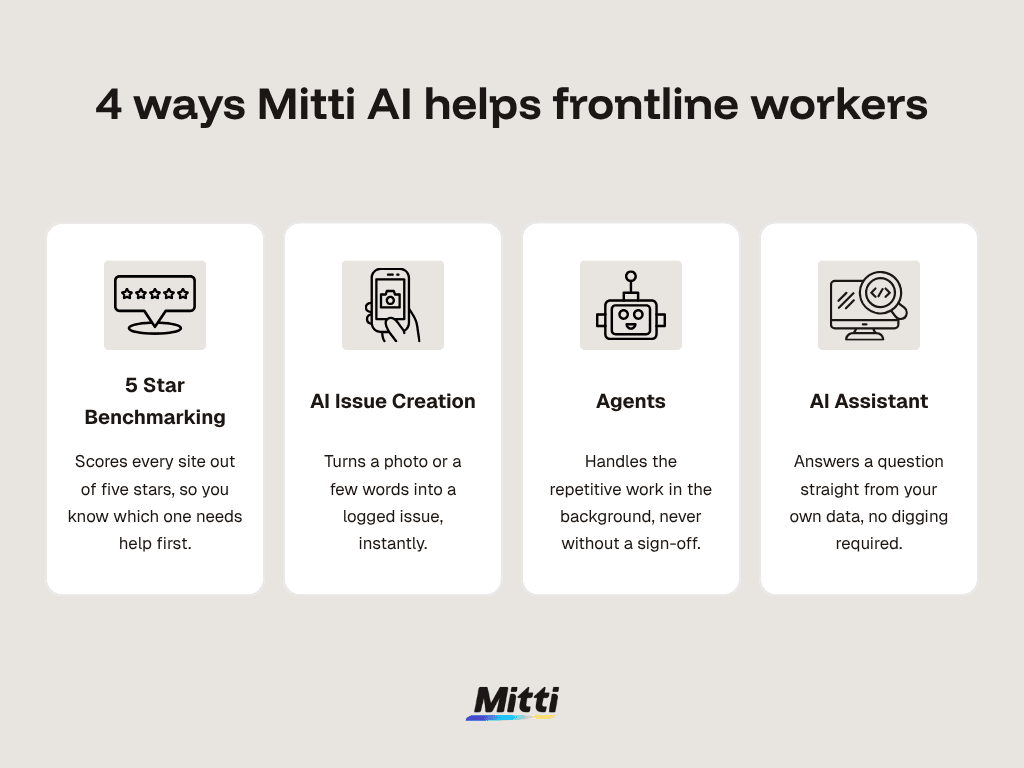
A feature that scores every job site out of five stars, like a report card for each location. It looks at things like how well standards are being followed: site visits, safety walks, inspections. Instead of a regional manager having to visit every site themselves, the tool compares them automatically and flags which ones need attention before a small problem turns into a bigger one.
A feature that turns a photo or a few spoken words into a logged, written-up issue right away. So when you spot a loose wire on-site or a spill on the floor, you can snap a picture and say what’s wrong. It automatically gets reported to whoever’s in charge to fix, instead of sitting forgotten until someone remembers.
A feature that quietly handles the repetitive work that normally eats into a manager’s day, running continuously, but never acting without someone in charge signing off first. So instead of someone manually pulling together the same report every week or chasing down the same update across different sites, an agent’s already done it, and all you have to do is review it.
A feature that answers a question directly, pulling from a team’s own operational data, instead of having someone dig through reports to find it themselves. So instead of sorting through issues by hand to spot a trend, someone can just ask what’s going on and get the answer straight away.
Here’s what this all looks like when spread across different industries.
“We carry out almost 5,000 audits a year, and we also expect to report 8,000 hazardous situations or actions by 2022. This represents a huge workload for our managers. We had to find a solution to make their job easier and save them time.”
The real story isn’t one big artificial intelligence system running the whole thing. It’s AI slotting quietly into the places people already work, each tool doing one job well.
That’s exactly what Mitti AI is already doing in 2026, since launching these AI features. Here’s what it actually looks like, up close in different industries.
Each restaurant and retail chain could run hundreds of locations around the world, so it’s hard to know which ones are slipping. The 5 Star Benchmarking feature can score every branch against food safety standards, catching a site that needs help before food ever leaves the kitchen. Delivery companies like Marley Spoon use AI Issue Creation to create hazard reports on the spot.
A construction site generates a lot of data, inspections, certifications, permits or incident reports, all split across different subcontractors and projects. That’s exactly the kind of visibility gap Agents were built for. At Thermosash, regional and general managers suddenly had full visibility into their portfolios, and nobody had to build a single new report to get it.
Incident and compliance reports pile up fast in most public, community and health service organizations. So an organization like St Vincent de Paul Society Victoria can simply answer any question directly with an AI Assistant, pulling from that data, instead of digging through all of it one by one, saving a lot of time and resources.
Heavy industry sites run a constant stream of safety audits, often thousands a year across dozens of locations, and manually tracking all of it is its own full-time job. Take a steel and mining group like ArcelorMittal. They run close to 4,848 safety audits a year across Europe, and moving all those audits to an operations system like Mitti saved them about 5,000 hours.
None of this comes without any tension. There’s some real talk to be had here about worker anxiety and job security mixed in with the enthusiasm about AI, and that anxiety isn’t unfounded if a business is using AI to replace its frontline rather than support it. That’s not where things stand right now, and treating it that way is a risk in itself.
There’s also the accountability angle. When an AI tool misses something or flags the wrong thing, someone still has to be held responsible. That means knowing who ran it and who the AI answers to.
But none of these are reasons to avoid AI altogether. They’re reasons to be specific about what you’re using AI for in your business.
Just look again at ArcelorMittal Construction as proof of that. The company already cut reporting time from 10 minutes down to 1, just by moving its audits onto Mitti. It’s exactly why a team that already knows how to use a tool well is the team AI ends up helping most.
That’s how frontline AI should work right now. Not as one big system replacing how a business runs, but as something built to fit into the systems already there.


