
Best Practices
Are you registered yet? NDIS mandatory registration and what's coming
By Rafael Villamor27 Nov 20265 min read
Share article
Supported Independent Living (SIL) and digital platform providers had to apply for NDIS registration by 1 October 2026 or stop delivering.
Registration expands to higher-risk supports from 1 July 2027, and more kickback bans start on 27 November.
You need proof to stay registered, so keep your standards evidence, incident reports and worker clearances up to date.
Important notice
The information contained in this article is general in nature and you should consider whether the information is appropriate to your specific needs. Legal and other matters referred to in this article are based on our interpretation of laws existing at the time and should not be relied on in place of professional advice. We are not responsible for the content of any site owned by a third party that may be linked to this article. Mitti disclaims all liability (except for any liability which by law cannot be excluded) for any error, inaccuracy, or omission from the information contained in this article, any site linked to this article, and any loss or damage suffered by any person directly or indirectly through relying on this information.
On 1 October, the deadline passed for supported independent living (SIL) providers and NDIS digital platform providers to apply for NDIS registration.
If you missed it and are still operating, please stop delivering those services right now. That means stopping things like helping someone get ready for the day, cook dinner or take their medication.
Delivering those supports without registering is a serious offence under the NDIS Act, with a maximum penalty of up to two years in jail, a fine, or both.
The NDIS changed it because of the huge number of unregistered providers, with more than 150,000 reported. These providers could operate with little to no visibility of what they delivered.
Imagine someone who charges you less than the going rate for daily personal care, but cuts corners along the way because no one is checking. That's too risky, especially for people with disability.
The NDIS provider mandatory registration removes the option to stay unregistered.
Registered providers have to meet the NDIS Practice Standards, follow the Code of Conduct, and report certain incidents on set timeframes. Meaning, the NDIS Commission can now ask you to prove how you work, not just say how you work.
Registration is rolling out in stages, so what you need to do depends on the type of support you deliver.
SIL providers and NDIS digital platform providers are first on the priority list. Mandatory registration for both started on 1 July 2026, and the deadline to apply was 1 October 2026. If that's you and you're reading this now, you should be registered already.
New rules took effect after the NDIS Amendment (Securing the NDIS for Future Generations) Act 2026 passed in August. Providers now have to keep their records for seven years. And there are new offences for lying on purpose to the NDIS, getting NDIS funds by deception or destroying records on purpose.
A ban on providers offering kickbacks and inducements begins on 27 November 2026. In plain terms, providers can't give participants money, gifts or other rewards to get them to sign up, stay or use more services. Even if you’re not a SIL provider or NDIS digital platform provider, this still applies to you either way.
From 1 July 2027, mandatory registration will start rolling out to every provider of higher-risk supports, meaning supports for people most at risk of abuse or exploitation. The plan is for every in-scope provider to be registered by December 2030.
Getting your compliance in order now makes registration smoother. Use this checklist to see where you stand against the NDIS Practice Standards before you apply.
Here's what the NDIS registration requirements look like in everyday terms. This applies if you're applying right now or getting ready for your registration date. There are four things to get right:
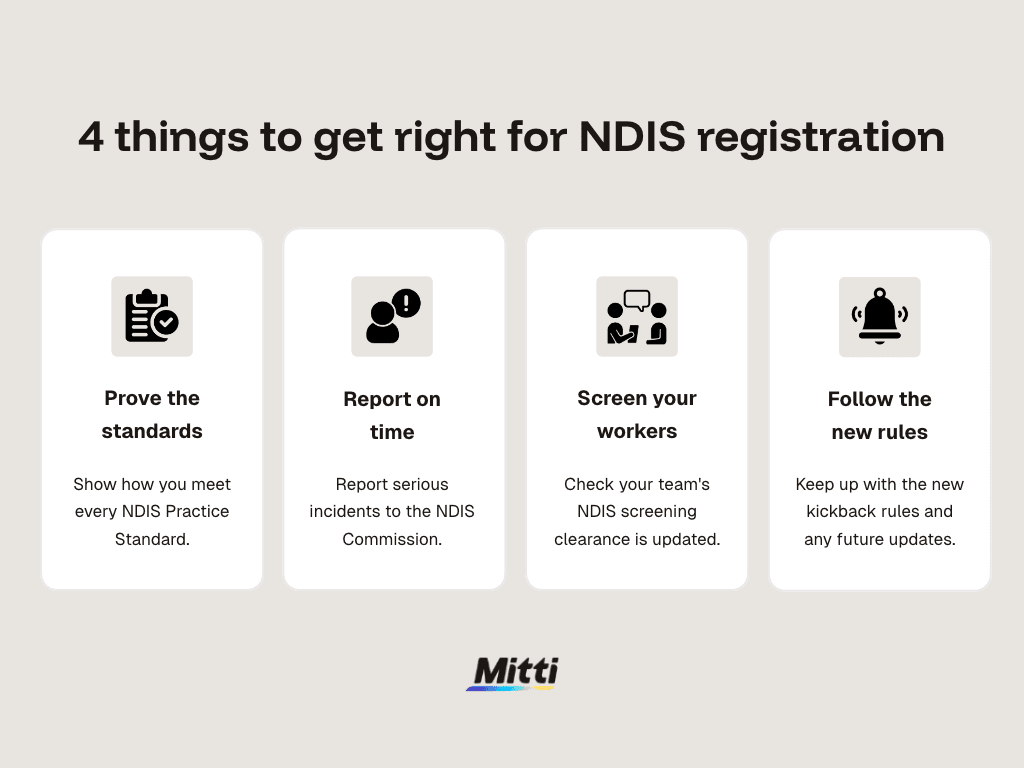
4 things to get right for NDIS registration
Prove the standards: Show how each NDIS Practice Standard is met, with evidence from regular compliance audits.
Report on time: Serious reportable incidents, like a death, serious injury or abuse, must be reported within 24 hours.
Screen your workers: Make sure every worker has a valid NDIS worker screening clearance, and track when each one expires.
Follow the new rules: Don't break the new kickback rules, in place from 27 November 2026.
You can't catch up on these the week before an audit. Proof has to build up as you go, with a record of what happened, who did it and when.
It helps to keep your records where the work happens. NDIS software like Mitti (by SafetyCulture) lets you log inspections and incidents as they occur, with photos and timestamps attached.
As of right now, only SIL and digital platform providers are required to register. So if you're a personal care provider or a support coordinator, you still have some time. Is it worth registering early? Here's how they compare.
Registered | Unregistered | |
Approved by the NDIS Commission | Yes | No |
Audited by an approved quality auditor | Yes, as part of registering | No |
Self-assessed against the NDIS Practice Standards | Yes | No |
Must notify the Commission of reportable incidents | Yes | No |
Must follow the NDIS Code of Conduct | Yes | Yes |
Can deliver SIL | Yes | No |
Can run an NDIS digital platform | Yes | No |
Can deliver higher-risk supports from 2027 | Yes | No, once the rollout reaches them |
It's your call. But waiting until the rules reach you means doing the preparation in a rush. And whenever you start, the hard part is keeping the proof as you go.
Thrive House, an NDIS provider with 30 homes across Queensland, used to run its reporting on email chains and paper forms. A support worker had to call the house manager, who then created the ticket, so every issue was handled twice.
Now, with Mitti, workers scan a QR code at the site and raise the issue in seconds. Reports went up, because issues that used to slip through unlogged are now visible. The data also revealed recurring problems, so the team could fix the root cause.

This general NDIS quality audit checklist covers the practice standards in one place.
"It comes down to trust," says Bernadette Burns, Director of Thrive House. "Families and regulators expect us to always be on top of things. So even small things, if ignored, can turn into bigger risks quickly. If something gets missed, it can affect the safety of a service user or staff member, with flow-on effects for compliance, audit outcomes and organisational risk."