
Best Practices
Australia’s acetone exposure limit is being cut in half. What else changes on December 1?
By Rafael Villamor5 Nov 20266 min read
Share article
On December 1, Australia’s workplace exposure limits change: 31 new limits, lower numbers for many chemicals and no limits for 33 carcinogens.
Limits are averaged over a shift, so overtime and longer shifts can mean a lower limit applies.
Check your chemical register, risk assessments and air monitoring results now, and tell your team about anything that changed.
Important notice
The information contained in this article is general in nature and you should consider whether the information is appropriate to your specific needs. Legal and other matters referred to in this article are based on our interpretation of laws existing at the time and should not be relied on in place of professional advice. We are not responsible for the content of any site owned by a third party that may be linked to this article. Mitti disclaims all liability (except for any liability which by law cannot be excluded) for any error, inaccuracy, or omission from the information contained in this article, any site linked to this article, and any loss or damage suffered by any person directly or indirectly through relying on this information.
Acetone is the smell of nail polish remover. It’s also what wipes oil off steel before it goes to the paint booth or what rinses glassware in a lab.
You might be used to 500 ppm being fine, but on December 1, Safe Work Australia’s (SWA) updated Workplace Exposure Limits (WEL) list cuts the legal limit to 250 ppm.
That’s the most acetone vapor allowed in the air you breathe, averaged over a single shift. So if you work overtime or with stronger chemicals, you or someone on your team needs to keep track of how much you’re actually taking in.
And if your business falls short, it could face up to $827,000 for failing to meet a safety duty.
Keep in mind, acetone is only one of many changes in the 2026 update. So here’s the rundown on what’s changing and what you can do to stay compliant now.
Until November 30, Australia’s rules on airborne chemicals run off a list called the Workplace Exposure Standards (WES). But starting December 1, a revised list called the Workplace Exposure Limits (WEL) takes over.
These limits matter because airborne contaminants can be invisible, and some even have no smell. They can still cause serious respiratory diseases, including asthma, COPD, cancers of the respiratory system, mesothelioma and silicosis.
The last full review of the national exposure list was in 2003. That’s more than two decades ago.
So SWA started a review in 2018 to check whether the limits still held up against today’s health research and gave workers the best protection. Some parts were outdated. Others were missing altogether, which is why this update was needed.
The name changed too. Work Health and Safety (WHS) ministers wanted the list to say plainly that the numbers are limits that can’t be exceeded, and to match the language used internationally.
Besides the name change, there were four big changes:
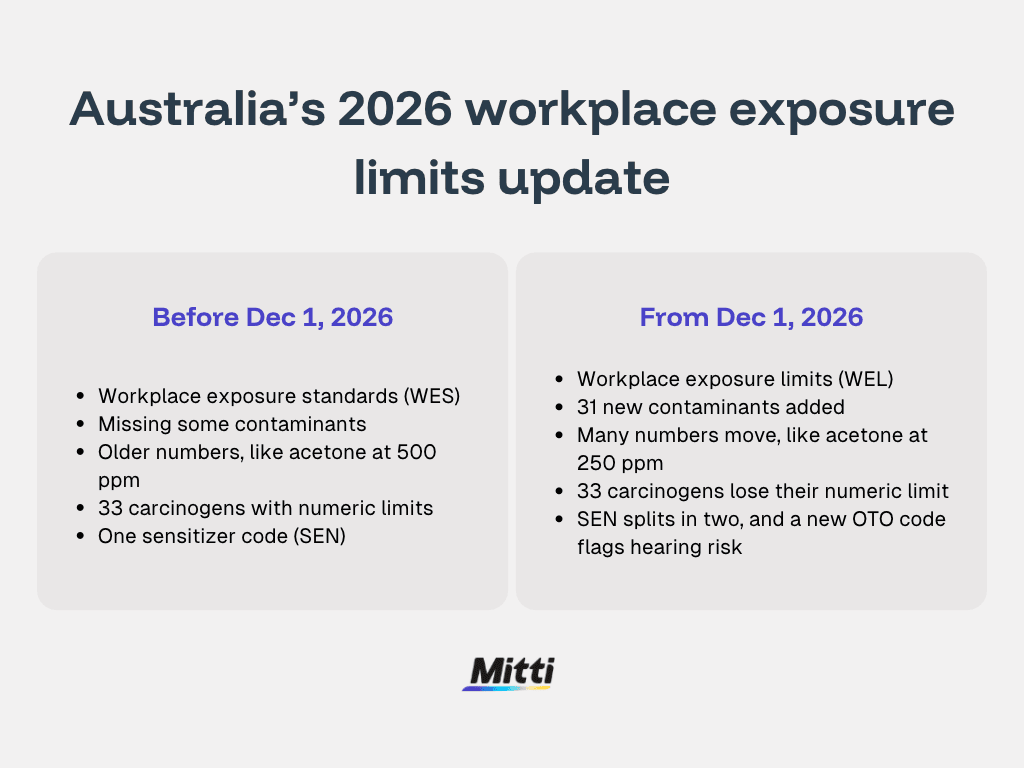
Australia's 2026 workplace exposure limits update
31 airborne contaminants that had no limit now have one. Some you might recognize are diesel particulate matter (the soot in diesel exhaust), flour dust, peracetic acid (a common disinfectant) and bisphenol-A, better known as BPA, which is mostly used in plastics and resins.
Most of the new limits are also averages over a work shift. A few add a shorter-term limit, like diacetyl’s 15-minute limit, and some like peracetic acid have a hard cap that should never be crossed. So if you run a diesel plant or a bakery, make sure to follow the full list provided by SWA here.
For substances that already had a limit, most of the changes go down and a few go up. Toluene, most commonly used as a solvent in paints, thinners and adhesives, drops from 50 to 20 ppm. Softwood dust from sawing and sanding timber drops from 5 to 2 mg/m³, while n-hexane, a solvent in glues and degreasers, goes the other way, from 20 to 50 ppm. For everything that’s moving, see SWA’s comparison table.
Short-term limits shift too. So check both numbers for every substance on your register.
33 chemicals that can damage genes and may lead to cancer like ethylene oxide and chromium VI compounds no longer get an exposure limit. SWA says that there’s just no practical safe level to set for them without further research.
Losing a limit isn’t the same as being banned, though some of these chemicals are prohibited or restricted under separate rules, like benzidine (prohibited) and vinyl chloride (restricted).
So if you work with any of them, you have to get rid of them first. If you can’t, swap them for something safer. If that isn’t possible either, cut the risk as far as reasonably practicable.
Some chemicals carry a short code, called a notation, that flags a risk the exposure number doesn’t cover, like harm through skin contact. SWA listed three changes:
SEN splits in two: The old sensitiser tag becomes DSEN (skin) and RSEN (breathing), so you know which route to protect.
OTO is new: It marks ototoxic chemicals, which can damage hearing, and the risk rises when workers also face noise.
Carcinogen tags are gone: To check whether a chemical can cause cancer, look at its safety data sheet or the Hazardous Chemical Information System (HCIS).
These are a lot of changes to take note of, which is why Mitti (by SafetyCulture) created a digital checklist based on the 2026 updates. However, it doesn’t include all contaminants, only the most common ones.
You don’t need to read the whole list. You just need to find the entries that affect you. It’s best to start by:
• Checking your chemical register: Take note and list everything that can become airborne, and flag them with their new changes.
• Reviewing your risk assessments: With so many changes, some of your risk assessments may already be out of date, so a digital checklist can help you redo them.
• Recheck your air monitoring results: Compare your last results with the new limits. A reading that passed under the old number can fail under the new one,
• Telling your team and writing it down: Update procedures and training for the substances that changed.
Most of that is tracking, not thinking. Mitti (by SafetyCulture) pulls it into one place: teams catch hazards as they happen, turn every gap into an action with an owner and a deadline, and build a digital audit trail as the work gets done.
Roma Food Products, Australia’s largest gluten and allergen free manufacturer, is a good example. Their old software setup was impractical, and inspections and follow-up actions took too long. After moving to Mitti, starting with good manufacturing practice (GMP) audits, the team raised over 550 actions in five months and closed 96% of them.
“One of the great things about Mitti (by SafetyCulture) is that the initial tool was free, allowing us to ensure it was fit for purpose and met our needs before we made any significant financial commitment. From a leadership perspective, this assisted uptake of the Mitti Platform within the organisation because the tool had already proved its value and we were confident with the product we were investing in.”


