
Best Practices
Seven places a slip, trip or fall is hiding in your workplace, according to Safe Work Australia
By Rafael Villamor30 Oct 20264 min read
Share article
Slips, trips and falls led to 32,000 serious workers’ compensation claims across Australia in 2023-24.
Safe Work Australia’s free guide covers seven hazard areas and it applies to any industry.
A safety checklist only helps if every hazard it finds gets an owner and a fix.
Important notice
The information contained in this article is general in nature and you should consider whether the information is appropriate to your specific needs. Legal and other matters referred to in this article are based on our interpretation of laws existing at the time and should not be relied on in place of professional advice. We are not responsible for the content of any site owned by a third party that may be linked to this article. Mitti disclaims all liability (except for any liability which by law cannot be excluded) for any error, inaccuracy, or omission from the information contained in this article, any site linked to this article, and any loss or damage suffered by any person directly or indirectly through relying on this information.
Black Friday is on 27 November, and for anyone managing a store it marks the start of the busiest stretch of the year. Customers will be looking at the shelves, not the floor.
Across Australia, slips, trips and falls led to 32,000 serious workers’ compensation claims in 2023-24, roughly 88 every day.
In response, on 29 September 2026, Safe Work Australia released a free guide on how to manage the risks of slips, trips and falls, with a downloadable checklist.
The guide also doesn’t just tackle the retail industry. Just about any industry could use it for reference, and with the rush weeks away, these are all reasonably practicable.
Employers have a duty under WHS laws to eliminate risks to health and safety or, where that isn’t possible, minimise them so far as is reasonably practicable. That phrase is hard to turn into a Monday morning task.
In practice, it means weighing up five things:
Likelihood: How likely the hazard is to cause harm.
Degree of harm: How serious that harm could be.
Knowledge: What you know (or should know) about the hazard and how to control it.
Available controls: Whether those controls are available and suitable.
Cost: Considered last, and it only counts as a reason not to act if it’s grossly disproportionate to the risk.
For a warehouse supervisor, that could mean asking how likely a trip is over pallet wrap near the dock door. For an aged care manager, it could mean deciding how to manage a freshly mopped corridor.
The guide covers seven hazard areas. It also sticks to falls from two metres or less, so ladders are in but anything higher, like roof work, falls under working at heights rules. Here’s each area in a line, with where you’ll often come across it.
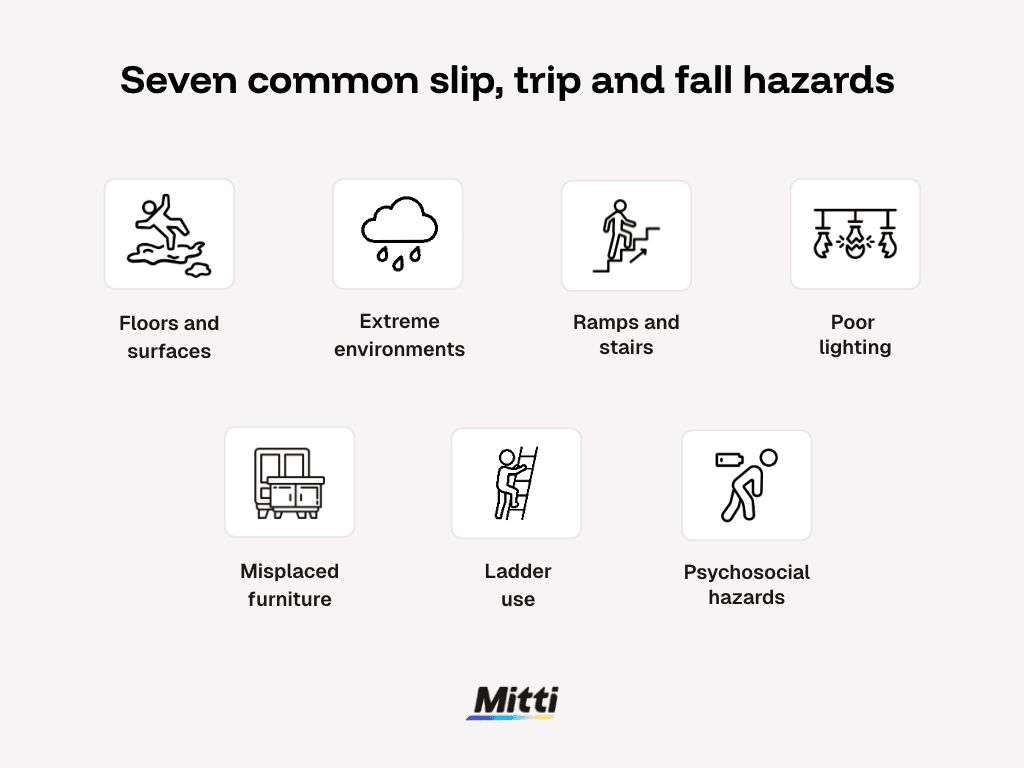
Floors and surfaces: Spills, wet mopping, worn flooring and uneven surfaces cause everyday slips and trips. Often seen in: hospitality, retail and healthcare.
Outdoor and extreme environments: Rain, mud, loose gravel and heat add slip risk to any work done outside. Often seen in: construction, agriculture and landscaping.
Ramps and stairs: Changes in level are where missteps happen, especially when people are carrying loads or rushing. Often seen in: warehousing, aged care and back-of-house retail.
Lighting: Poor lighting hides hazards on floors and steps until it’s too late. Often seen in: warehouses, car parks and storerooms.
Furniture: Chairs, tables and open drawers in the wrong place become trip and fall hazards. Often seen in: offices, aged care and schools.
Ladders: Falls from ladders are in scope up to two metres, and a rushed climb makes them more likely. Often seen in: construction, maintenance and retail stockrooms.
High job demands and psychosocial hazards: Time pressure and fatigue push workers to rush and cut corners. Often seen in: any fast-paced workplace, including retail in peak season, hospitality and logistics.
A downloaded checklist only helps if someone completes it regularly and follows up on what it finds. That’s where a platform like Mitti (by SafetyCulture) works as a companion to the guide. We’ve turned the guide’s checklist into a digital template, so every inspection is saved automatically. If something’s wrong, it’s flagged and sent to whoever is responsible for fixing it.
Butlins, the UK holiday resort operator with 1,700 accommodation units, ran into the same problem with paper checks. Problems spotted on the move were forgotten before anyone wrote them down. After moving its daily housekeeping checks to Mitti, staff could attach a photo to a check or raise an issue on the spot and assign it to someone to fix.


