
Best Practices
WorkSafe inspectors are on NZ building sites and farms until December. Are you ready?
By Rafael Villamor22 Oct 20265 min read
Share article
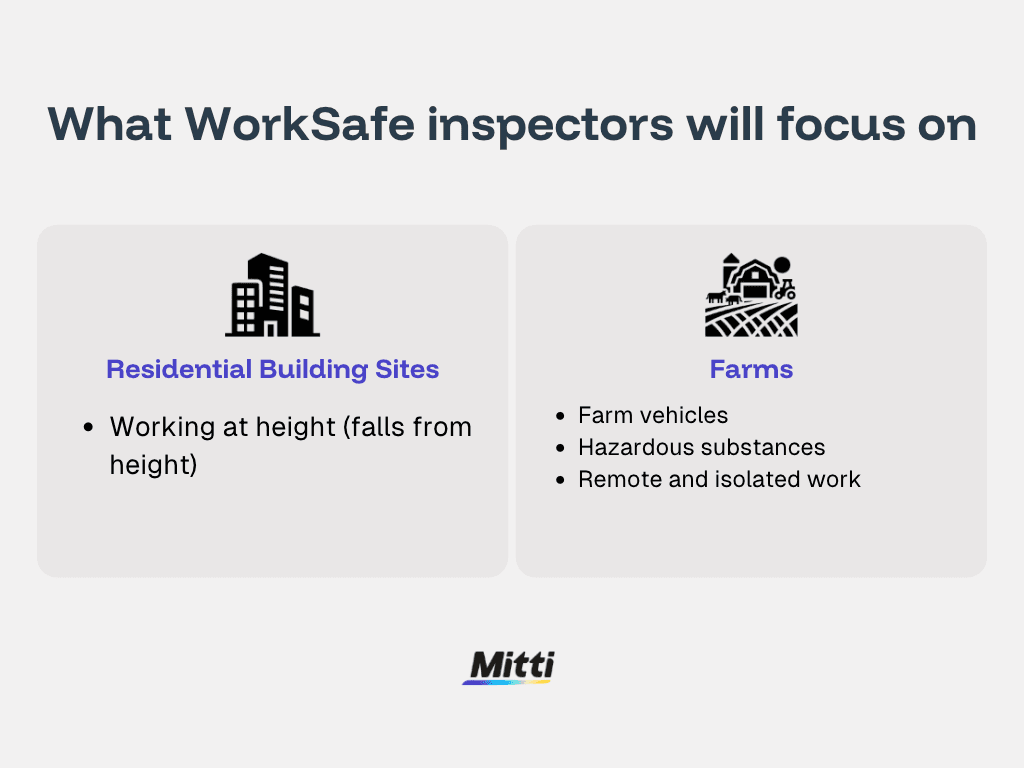
From October to December 2026, WorkSafe inspectors are visiting residential building sites and beef and lamb farms across New Zealand.
For inspections on building sites, the focus is on falls from height. On farms, it’s vehicles, hazardous substances and remote work.
Inspectors check that what you say matches what’s on site, so keep your plan and records ready.
Important notice
The information contained in this article is general in nature and you should consider whether the information is appropriate to your specific needs. Legal and other matters referred to in this article are based on our interpretation of laws existing at the time and should not be relied on in place of professional advice. We are not responsible for the content of any site owned by a third party that may be linked to this article. Mitti disclaims all liability (except for any liability which by law cannot be excluded) for any error, inaccuracy, or omission from the information contained in this article, any site linked to this article, and any loss or damage suffered by any person directly or indirectly through relying on this information.
Did you know a WorkSafe inspection can happen at any time, especially in high-risk industries? Because they do. Completely unplanned.
So here’s the heads-up: between October and December 2026, inspectors will turn up at residential building sites and beef and lamb farms across the country.
Why those two? WorkSafe says both have high numbers of deaths and serious injuries, so it would rather check in now than after an incident.
So here’s all you need to know to ace the inspection.
On the day, it follows a pattern. The inspector chats with you about your business and the risks you’ve identified, then walks the site to see if what they’ve heard matches what they see. They might also ask for your health and safety documents. If something looks off, they dig deeper and may even ask a worker to demonstrate a task.
So your paperwork must match your story. If they don’t, that’s where things get complicated.
WorkSafe’s announcement on 15 September confirms proactive assessment visits to beef and lamb farms and residential construction sites across New Zealand. Again, these sectors were picked because of the high numbers of deaths and serious injuries in agriculture and construction.
“These proactive visits to workplaces in high-risk industries help ensure businesses and workers understand their health and safety responsibilities,” says WorkSafe’s Head of Inspectorate Rob Pope.
It’s worth noting, the announcement doesn’t add any new requirements either. It’s a closer look at how critical risks are already being managed.
WorkSafe also hasn’t said whether inspectors will check anything beyond these focus areas, so just to be safe, review your other critical risks too.
More injuries happen on residential building sites than any other workplace in construction. More specifically, WorkSafe says falls from height cause an average of four deaths, 100 serious injuries and around 1,000 injuries each year.
Part of those falls are also ladder accidents. They are involved in about 40% of fall-from-height injuries in construction. Think of a ladder against the gutter and the roof edge on a single-storey house. That’s roughly under three metres, but it still counts as working at height, and it doesn’t take a tall building to cause a serious injury. A ladder and a gutter will do.
WorkSafe’s guidance says too many falls come from a failure to plan and organise the work properly. So expect an inspector’s questions to start there. Have you identified everywhere someone could fall? Could the hazard be eliminated or isolated? And what’s physically stopping a slip from becoming a fall?
So it’s best to plan what could go wrong beforehand. Follow these six checks before the inspector does:
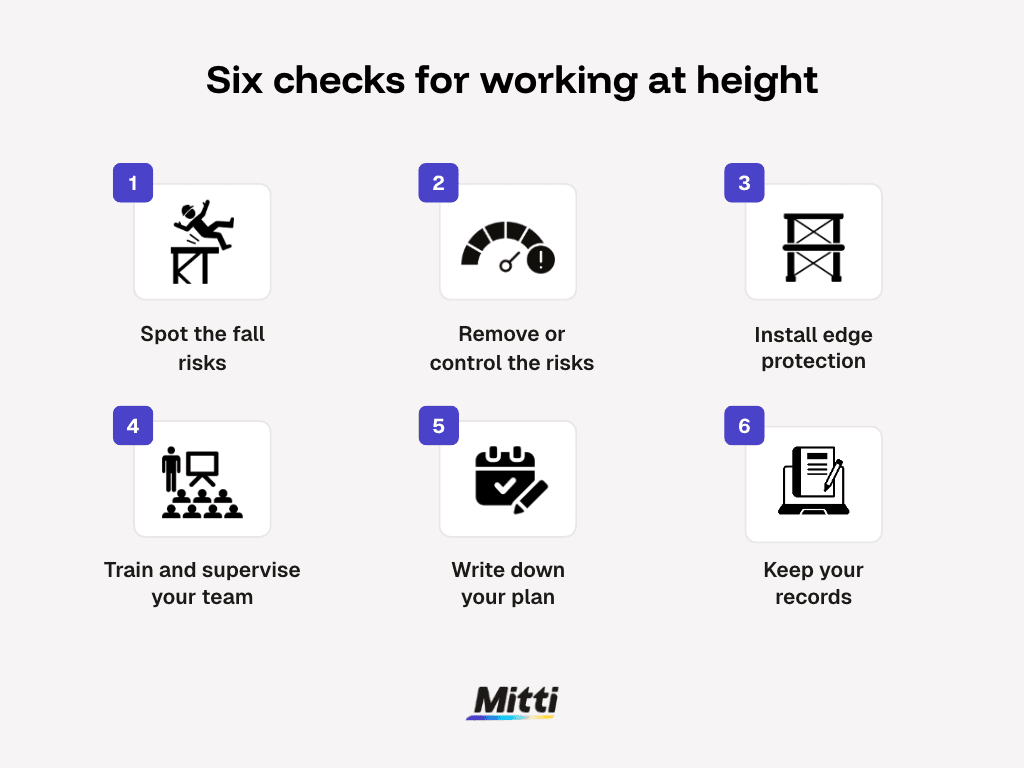
Six checks for working at height
Spot the fall risks: Do a safety walk and note every place someone could fall, no matter how high or low it is.
Remove or control the risks: Take the fall risk away if you can. If you can’t, control it with precautions.
Install edge protection or scaffolding: Put a physical barrier in place before the work starts, so a slip doesn’t turn into a fall.
Train and supervise your team: Make sure everyone knows how to do the job safely, and someone competent keeps an eye on it.
Write down your plan: Keep a record of the hazards and how you’re controlling them, specific to the job
Keep your records: Keep your records and documents somewhere you can easily find them, better if digital. Mitti (by SafetyCulture) keeps your checks, photos and fixes in one place with digital inspections.
WorkSafe has also said the best fall protection doesn’t depend on people being careful. So even before the inspector shows up, put the barrier in first and finish installing the railing.
Back in 2025, visits to sheep, beef and dairy farms covered some of the same ground: vehicles and hazardous substances. WorkSafe found big gaps in both. The biggest was hazardous substances, where 39% of assessments needed improvement. It also found that 94% of improvement notices related to missing safety data sheets (SDS) or chemical inventories.
Based on last year’s findings, expect inspectors to want to see an SDS for every chemical and an up-to-date inventory of what’s on the farm. For vehicles, that covers tractors and side-by-sides (SxS), also called utility vehicles (UTVs). It also covers quad bikes, or all-terrain vehicles (ATVs).
Expect questions along these lines:
Do you have a full, updated record of all your hazardous substances on your farm?
Are vehicles serviced regularly? This includes tyres, brakes or lights and steering.
Are power take-off (PTO) shafts on your tractors and machinery properly guarded?
Do workers wear the right protective gear, like seatbelts and helmets on vehicles and gloves and eye protection when handling chemicals?
Remote work is new. It wasn’t on last year’s focus list, and WorkSafe hasn’t specifically said what inspectors will look for. Its farm guidance, though, mentions that farm work often happens in difficult and sometimes remote environments. So be ready to explain how you’d reach someone who needs help.
Documentation is a big part of the inspection process. So you can be as safe as houses, but if you’re missing your files, inspectors can still flag it. This is why Mitti (by SafetyCulture) works well for this job. It helps you see what’s happening on site, act on it and keep the proof.
When a worker spots a hazard, they can flag it right away and alert the person in charge to take action, all in real time. Mitti (by SafetyCulture) also covers toolbox talks and height safety training courses, so everyone shares responsibility for a safe work environment.
“Mitti (by SafetyCulture) is the best app I have ever downloaded. It saves a heap of time on site and then when I am at home, the task is already done; no more sitting at the computer writing out reports.”


