
Best Practices
Hacked Fridges? The cyber risk that can spoil your stock
By Rafael Villamor15 Oct 20264 min read
Hackers tampered with fridge controls at hundreds of French supermarkets, and any kitchen with networked fridges could be next.
AI is making it faster and cheaper to turn a known flaw into an attack.
Don’t rely on the screen alone. Confirm with a thermometer or a separate sensor when temperatures change.
Important notice
The information contained in this article is general in nature and you should consider whether the information is appropriate to your specific needs. Legal and other matters referred to in this article are based on our interpretation of laws existing at the time and should not be relied on in place of professional advice. We are not responsible for the content of any site owned by a third party that may be linked to this article. Mitti disclaims all liability (except for any liability which by law cannot be excluded) for any error, inaccuracy, or omission from the information contained in this article, any site linked to this article, and any loss or damage suffered by any person directly or indirectly through relying on this information.
When you think about hackers, you think about phishing emails. Stolen passwords. Ransomware.
Refrigerators?
Yes, really. On the night of October 11 to 12, attackers hacked the refrigeration systems at hundreds of French supermarkets like Intermarché and Netto. Some fridges reportedly reached 50°C (122°F), the temperature of an extra hot bath. That’s way past the 4°C (39°F) limit French rules generally set for chilled food.
This resulted in spoiled food, stores short on stock and even some reports of fires.
Les Mousquetaires, the group behind Intermarché and Netto, estimated its losses at several million euros.
And this probably won’t be the last time hackers go after operational technology (OT) or the systems that run physical equipment like fridges, ovens and air conditioning.
So this was never only a supermarket problem. If your fridges and freezers are connected to a network, any kitchen or hotel could be a target.
Here’s a little more background on the refrigerators and freezers companies are using these days. Many of the affected stores ran Danfoss controls, and French authorities say other makers’ systems were hit too.
Plenty of commercial fridges and freezers are run by a refrigeration management system. It’s the controller that sets temperatures, schedules defrost cycles and triggers alarms. You can manage many of them from anywhere. Handy, but it also puts the controller on the internet.
And if it’s on the internet, there’s always a possibility it could be hacked.
What didn’t help was that Danfoss told AFP most of the affected units were older models that no longer get software or security updates, which is an easy way to leave yourself open to a cybersecurity breach.
Then there’s AI. Researchers at Claroty tested how fast an AI coding agent could rebuild an attack on a Danfoss controller using public information. In a lab, it took about 28 minutes and roughly $6. That’s how quickly a known flaw can turn into an attack, especially on systems that haven’t been updated.
AI is already speeding up some parts of an attack, from days to seconds. Less time, less cost and less work for the hacker. And whatever the cause, a single cold room failure can mean thousands of euros in lost stock, before you count lost sales. That’s why the first hour matters.
For a restaurant or hotel, the scale is smaller but the stakes feel the same. Picture a walk-in full of stock, tomorrow’s service prepped and everything at the right temperature, according to the screen. Trouble is, that number doesn’t always match what’s happening inside your fridge, freezer or walk-in.
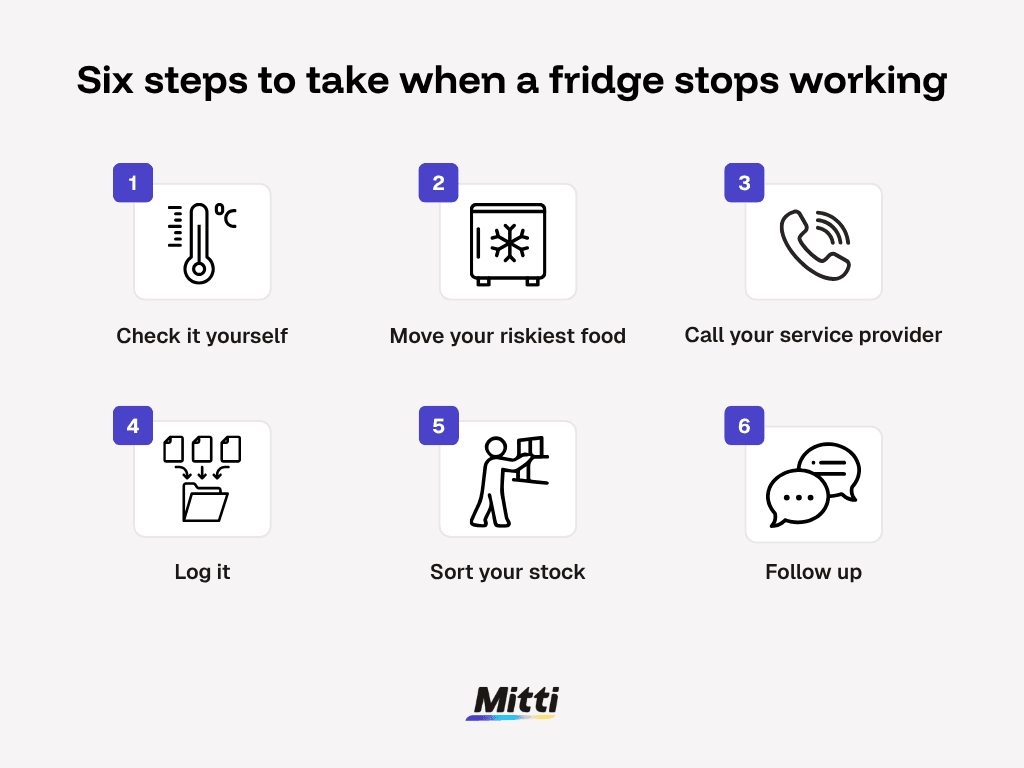
Six steps to take when a fridge stops working
So here’s what to do:
Check it yourself: Put a handheld probe thermometer in the warmest part of the unit.
Move your riskiest food: Raw meat, seafood, dairy and prepared food go into a unit you know is working.
Call your service provider: If your system can be accessed remotely, ask them to restrict or cut that access. Otherwise, just ask them to check the unit.
Log it: Record what you found, when you found it and who you told in your refrigerator temperature log.
Sort your stock: If you can’t tell how long food sat above its safe temperature, it’s best to discard it.
Follow up: Once you know the cause, record it along with the fix. Then book any repairs or upgrades so it doesn’t happen again.
Most of that only works if you know early. That’s the hard part when the problem starts in the middle of the night, which is where automatic temperature alerts earn their keep.
That’s where sensors come in. Mitti (by SafetyCulture) sensors sit outside your fridge’s controller, so they give you a second reading that doesn’t depend on the screen.
When a temperature leaves its range, Mitti alerts the right person in charge, wherever they are. And if you run more than one location, managers can see and get alerts from every site. That alert becomes an action that’s tracked until it’s closed, and stays on record for all your audits.
Brooklyn Donut & Coffee Co learned this the hard way. Before rolling out Mitti sensors, their stores relied on manual temperature checks twice a day, which left overnight failures unaccounted for. When a power supply problem hit a new store, one franchise partner lost a lot of stock. Now with Mitti, the team has 24/7 remote visibility.
Phishing emails, stolen passwords, ransomware and refrigerators. It’s odd, but it’s a legit cyber risk. So it’s worth checking how your fridges are run and who’s keeping an eye on them.
Mitti (by SafetyCulture) Sensors were really easy to implement. I was concerned it would be more complicated – especially in the coolroom fridges. Easy to set up on mobile and the implementation was self-explanatory on the app.


