
Best Practices
“Made in USA” claims aren’t enough: what BABA’s 2026 change means for suppliers
By Rafael Villamor30 Oct 20265 min read
Share article
“Made in USA” doesn’t mean BABA-compliant.
On new federal highway and bridge projects, manufactured products now need more than 55% US-made parts by cost.
Suppliers need the proof ready before anyone asks.
Important notice
The information contained in this article is general in nature and you should consider whether the information is appropriate to your specific needs. Legal and other matters referred to in this article are based on our interpretation of laws existing at the time and should not be relied on in place of professional advice. We are not responsible for the content of any site owned by a third party that may be linked to this article. Mitti disclaims all liability (except for any liability which by law cannot be excluded) for any error, inaccuracy, or omission from the information contained in this article, any site linked to this article, and any loss or damage suffered by any person directly or indirectly through relying on this information.
Say you’re installing new light fixtures on a bridge whose federal funding was committed after October 1, 2026. The crate arrives with “Assembled in USA” on the label, and the spec sheet backs it up. The fixtures were indeed put together in the US.
But as you cut the strapping and lift out the foam, you flip one over and spot a country name printed on the power supply. It isn’t the US. The LED modules carry the same mark. Together, they make up 60% of each fixture’s parts cost.
On a project funded before October 1, 2026, this wouldn’t seem like an issue. Then the last phase of a highway rule tied to the Build America, Buy America Act (BABA) took effect. A manufactured product on a federally funded highway or bridge project now needs US-made parts that make up more than 55% of its total parts cost.
These light fixtures only hit 40%. In the end, they wouldn’t be compliant, and you could be stuck paying to replace them yourself.
To quickly recap, the Build America, Buy America Act (BABA) is a federal law passed in 2021. It says the iron, steel, manufactured products and construction materials used in federally funded infrastructure projects have to be made in the US.
In other words, if federal money pays for even part of a project, the whole project has to follow the rule, according to HUD’s guidance. Contractors and suppliers then sign certifications, and the agency can ask to see the records behind them.
No. They answer completely different questions, and vague wording like “Made in USA” is what can get you caught.
The Federal Trade Commission (FTC) sets the rules for the label. To say “Made in USA” with no caveats, a product’s final assembly and all major processing must happen in the US, and all or nearly all of its parts must be made and sourced here.
While the FTC sets the rules, it doesn’t check every product’s label. So the seller has to be able to prove the claim on its own. Looser wording like “assembled in USA” can be true and still say very little about where the parts came from.
BABA compliance has its own set of rules, and they go beyond a “Made in USA” label. According to guidance from the U.S. Department of Housing and Urban Development (HUD), each item gets sorted into one of three categories:
Iron and steel (steel pipes, beams)
Manufactured products (light fixtures, HVAC units)
Construction materials (lumber, drywall)
Together, those make up BABA’s three-category test. Then comes the paperwork like the manufacturer’s certificate, product specs and a signed certification.
Mistakes are common. The Bipartisan Policy Center reports that many products marketed as American-made don’t actually comply. Whether you buy these products or make them, the proof has to exist. If you’re the supplier, it’s good practice to audit your own parts and paperwork for things like:
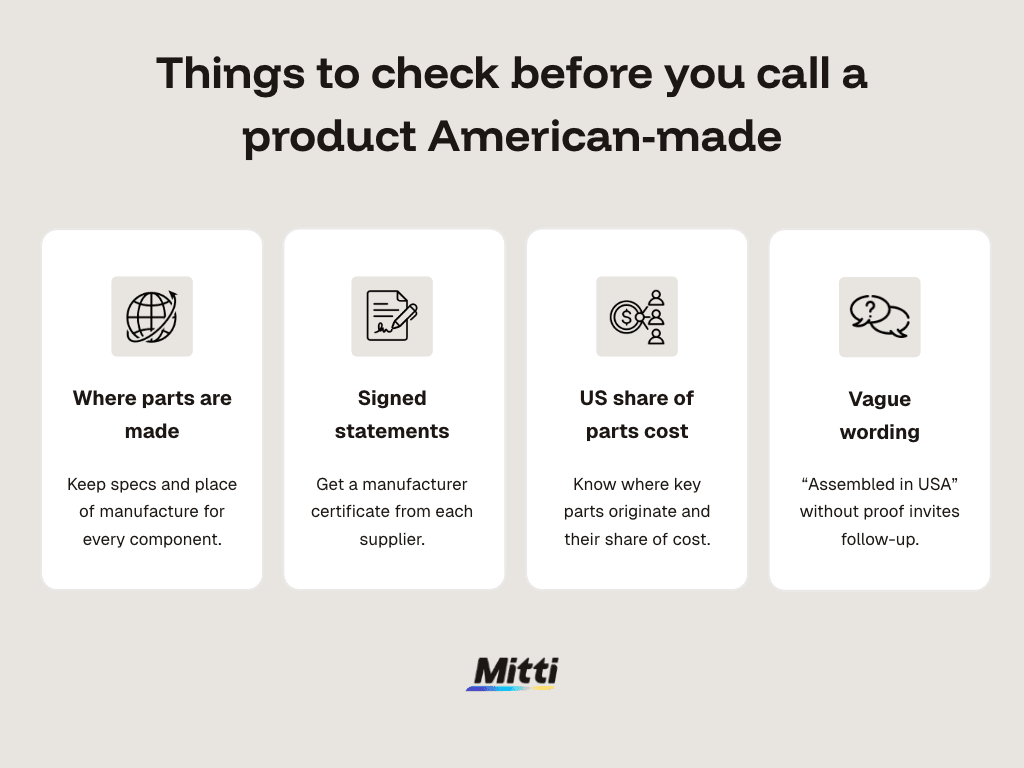
• Where each part is made: Keep the product specs and place of manufacture for every component, not just a line saying it complies.
• A signed statement: Collect a manufacturer certificate or compliance statement from your own suppliers, the kind of document HUD lists as proof.
• Where the big parts come from: For manufactured products, know where your main components originate and what share of the cost they represent. If you can’t say, a buyer’s compliance check stops with you.
• Wording that dodges: “Assembled in USA” or “American-made” on your label or spec sheet with nothing behind it invites a follow-up.
A BABA certification checklist walks through each document to collect.
The risk lands on whoever signs. Certification forms like HUD’s are signed under penalty of perjury. That knowingly putting false statements can result in criminal and civil penalties.
As the supplier? A false domestic-origin certification can end in a False Claims Act settlement, like this $625,000 Colorado case. That one fell under the older Buy American Act, but BABA works on the same idea: say it’s domestic, and you have to be able to prove it.
As the buyer? Expect to pay to replace noncompliant items or lose federal reimbursement for them.
That’s why staying on top of inspections matters. The proof has to exist before anyone asks for it.
Audits eat time, and most of it is because of paperwork. Platforms like Mitti (by SafetyCulture) let whoever receives your incoming parts run a digital inspection on every shipment from a phone.
If something doesn’t match, they raise an issue with a photo and assign it to the right person. When an agency or a buyer asks for records, everything’s already saved and ready to pull up.
What it won’t do is run the three-category test for you. Someone on your team still makes that call. The point is that the evidence exists when the question comes.


