What is Buy America certification?
Buy America certification is a signed statement that the iron, steel, manufactured products and construction materials on a federally funded infrastructure project meet US domestic content rules. It's a document you sign, not a certificate an agency issues.
The rules come from the Build America, Buy America Act (BABA), which became law in 2021 as part of the Infrastructure Investment and Jobs Act. Contractors, subcontractors and suppliers sign the statement when a funding agency asks for it. A Buy America certification checklist walks your team through the evidence behind that signature: what the project is, what each material is, where it was made and who vouches for it.
What does BABA require for each type of material?
BABA sorts each item into one category based on its status when it reaches the work site, and each item goes in only one. Each category has a different domestic test.
The tests come from the Office of Management and Budget's rule at 2 CFR Part 184, as summarized in the U.S. Department of Housing and Urban Development (HUD's) guidance. BABA compliance sets out each category and its test in full. Classification can surprise you. A precast concrete panel, for example, counts as a manufactured product, even though concrete mixed on site falls outside the rule.
What changed for FHWA-funded projects on October 1, 2026?
For projects that use Federal Highway Administration (FHWA) money, manufactured products now face a stricter test. Final assembly in the US applies to projects obligated on or after October 1, 2025. For projects obligated on or after October 1, 2026, those products must also pass the 55% cost-of-components test, according to the Federal Register notice.
Agencies phase in BABA on their own schedules. HUD, for example, tied its start dates to each program's obligation date and the type of material, as its notice explains. Confirm the dates that apply to your funding source before you sign.
How do you complete a Buy America certification checklist?
Work through these steps in order. Each one produces a record you'll want if an agency monitors the project.
Confirm the project is covered: List every funding source. If federal assistance pays for building, altering, maintaining or repairing public infrastructure, BABA applies unless a waiver or exemption says otherwise. HUD treats housing projects with one to four units as private and projects with five or more units as public infrastructure. You can't split a project into smaller contracts to avoid the rule.
Classify every material: Assign each item to iron or steel, a manufactured product or a construction material. Classify it by what it is when it arrives on site.
Check for general waivers: Look at your agency's general waivers before you buy. HUD's de minimis waiver, for example, lets you use foreign or unknown-origin materials up to 5% of total covered-material cost, capped at $1 million. Its small grants waiver exempts projects costing $250,000 or less in total. Both run through November 23, 2027, unless HUD ends them sooner. Record which items used a waiver.
Ask suppliers for proof before you order: Request the product's specification sheet, a manufacturer certificate or a signed statement of compliance, plus the place of manufacture. A Made in USA label is a starting point, not proof. The Federal Trade Commission's standard for that label generally means US assembly from US-origin parts, while BABA's manufactured products test also asks whether US components cost more than 55% of the total.
Verify each delivery: Match every delivery to the approved submittal and purchase order. Photograph product markings and labels, attach the supplier's document and log the manufacturer. If something doesn't match, raise an issue with an owner and a due date, and hold the item until it clears.
Sign the certification: Sign only after the first five steps are complete. HUD's optional certification asks the signer to certify under penalty of perjury and warns that knowingly false statements bring criminal and civil penalties. Attach a list of the covered materials you procured.
Keep the records: Store everything in hard copy or electronic form, and be ready to hand it over when the agency asks. HUD tells grantees to keep records for monitoring, in line with the retention rules for their program.
This BABA certification sample report shows a completed checklist.
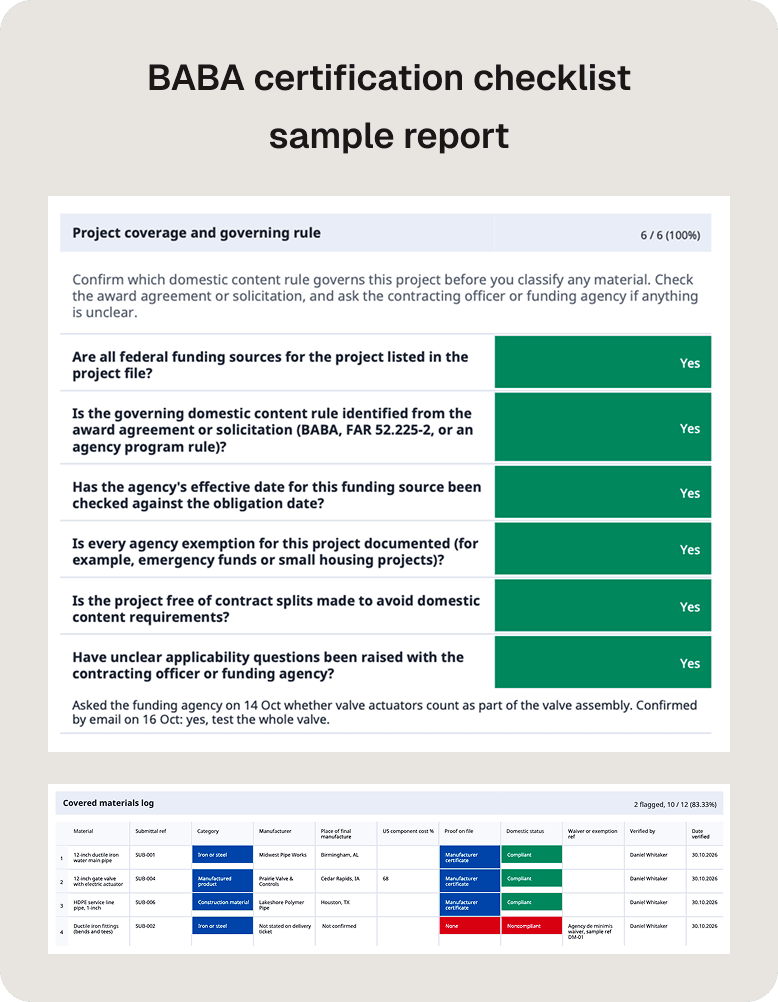
Sample BABA certification checklist report
What proof should you keep for each delivery?
HUD's FAQ says no official label or certifying body exists for BABA-compliant products, so the proof sits with you (see the HUD BABA FAQ). HUD's guidance lists examples of documentation that show covered materials were made in the US. Your agency may ask for different items, but this is a solid starting set:
A copy of the label showing the product was made in the US
The product description or technical specifications, detailed enough to show compliance
A certificate or other document from the manufacturer showing compliance
A signed certification from the contractor
A signed certification from the manufacturer
Market research records, if you're seeking a waiver
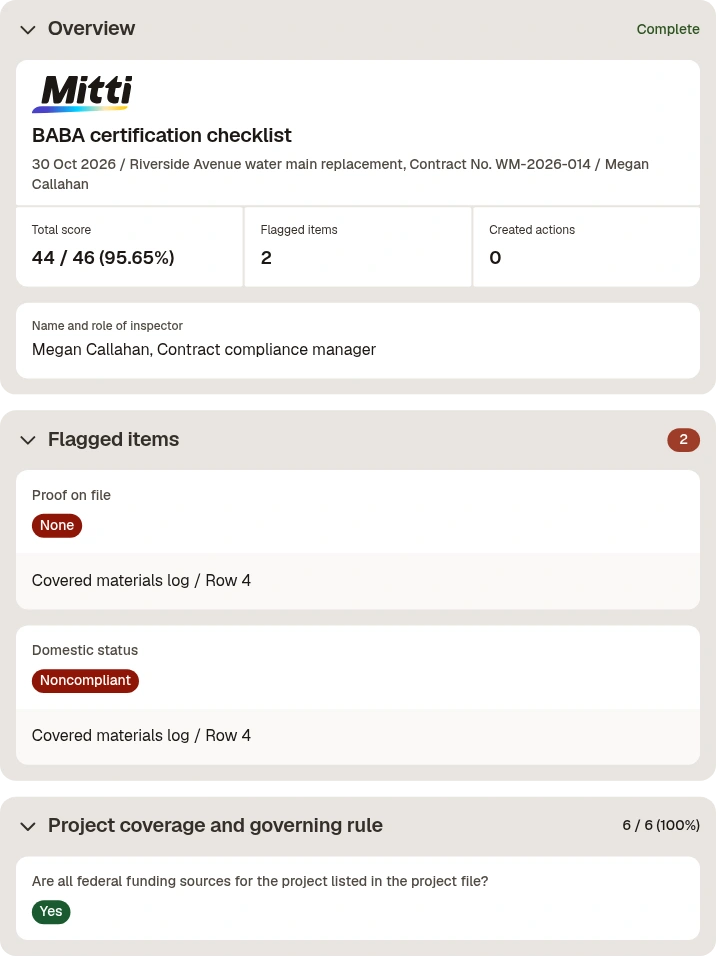
On a job with hundreds of line items, this paperwork piles up fast. Platforms like Mitti (by SafetyCulture) let a receiving inspector run the same checklist on every delivery from a phone, attach photos of product markings and raise an issue with an owner and due date when something doesn't match. Level 10 Construction uses Mitti to capture, assign and resolve issues from inspections before they affect schedules or quality.
Review your records before an agency does. A compliance audit checklist helps you spot gaps in your files, and regular compliance monitoring catches missing certificates before they become audit findings. Compliance software can run those reviews on a schedule.
When can you ask for a Buy America waiver?
BABA allows waivers in three situations, according to the EPA. A public interest waiver applies when the preference would go against the public interest. A nonavailability waiver applies when a product isn't made in the US in sufficient quantity or quality. An unreasonable cost waiver applies when US-made products would raise the total project cost by more than 25%.
Under HUD's process, only the direct recipient can file a request. Subrecipients and subcontractors can't, and approvals can't cover items you already bought. Before you file, document your market research. HUD accepts supplier scouting results from a NIST Manufacturing Extension Partnership center, or proof that you contacted at least three manufacturers or suppliers, with dates, contacts and notes. Tell your prime contractor or grantee early if you think an item needs a waiver.

Still looking for a checklist?
Search, filter, and customize 60,000+ templates across industries and use cases.
FAQs about Buy America certification
Article by
Mitti (by SafetyCulture) Content Team
Mitti (by SafetyCulture) Content Contributor
View author profile