What is the single-use plastic ban in Australia?
Every state and territory in Australia now bans some single-use plastic items. None of them ban the same things, on the same date, under the same law. A cafe in Perth can serve a plastic-lined coffee cup that's illegal in Melbourne. A retailer in Adelaide can be fined for a product that's still legal in Hobart.
The single-use plastic ban Australia enforces isn't one law. It's eight separate ones, each moving through its own phases, each with its own banned items list and its own penalties. For a business operating in more than one state, or sourcing packaging nationally, that patchwork is the real compliance problem, not any single ban on its own.
Single-use plastic ban Australia: state and territory rules
South Australia moved first, banning plastic straws, stirrers, and cutlery on 1 March 2021, then adding polystyrene food and drink containers and oxo-degradable plastics a year later, under the state's Replace the Waste program. The Australian Capital Territory followed in 2022, and Queensland, Western Australia, New South Wales, and Victoria all had first-wave bans running by early 2023.
Victoria's ban, enforced by the EPA, took effect on 1 February 2023 and covers plastic cutlery, plates, stirrers, cotton buds, and polystyrene food service items, whether they're made from conventional, degradable, or compostable plastic. Queensland's Waste Reduction and Recycling Act 2011 covers a similar list, administered through Business Queensland.
Western Australia and South Australia have gone further than most. WA extended its produce bag ban to dry goods and confectionery from 1 October 2025, and will extend its plastic barrier bag ban to meat, fish, and dairy packaging in 2026. Tasmania and the Northern Territory are the outliers. Tasmania is still consulting on a statewide ban, with only the City of Hobart currently enforcing one under a local by-law, and the NT's Circular Economy Strategy targets some bans by 2025 but hasn't matched the other jurisdictions' scope yet.
That's also why a compliance checklist beats a static PDF here. State rules shift mid-year, exemptions get added or removed, and a list printed even a year ago is already out of date in at least two jurisdictions. Treat this as a working reference to recheck, not a one-off download.
For a recent example of that shift,type: entry-hyperlink id: 5bOyjASqz7rakF1BwoxFDpcovers three separate changes that took effect in a single year, with more already flagged for 2027 and 2028.
If your business operates across state lines, or ships to customers in more than one jurisdiction, running a waste management system that tracks which items are banned where saves you from designing one packaging spec and finding out it's non-compliant three states over.
What single-use plastic items are banned in Australia?
Despite the patchwork, some items are banned almost everywhere. If you supply food, retail, or hospitality, check current stock against this common list first:
Plastic cutlery, including knives, forks, spoons, sporks, and chopsticks
Drinking straws and stirrers made from plastic
Plastic plates and bowls, including compostable and biodegradable versions
Expanded polystyrene cups, trays, and takeaway containers
Cotton buds with plastic shafts
Lightweight plastic shopping bags under 35 microns
Oxo-degradable plastics, in states that specifically ban them, including SA and WA
Two details catch most businesses out. First, compostable and biodegradable plastics are banned right alongside conventional ones in Victoria, Queensland, and South Australia. If it's still plastic at a molecular level, the ban doesn't care what it eventually breaks down into. Second, items built into another product, like a spoon molded into a yoghurt lid, lose their exemption in Victoria from 1 January 2026, so audit anything bought pre-packaged, not just what's stocked loose. If a supplier can't confirm the exact plastic composition of a product on request, treat that as a warning sign rather than a formality.
Australia single-use plastic ban compliance checklist
Run this checklist against current operations before your next stocktake.
Step 1: Audit what you currently stock and use
List every disposable item supplied to customers or used in food prep, from cutlery to produce bags
Note the material of each item, whether conventional plastic, oxo-degradable, biodegradable, PLA, paper, or fibre
Flag anything sourced through more than one supplier, since specs can vary between batches
Step 2: Match your list against your state's ban
Confirm your state or territory's current banned items list and effective dates, since several states are still mid-rollout
If operating in more than one jurisdiction, apply the strictest list across every site rather than tracking separate rules per state
Check whether an item qualifies for a health, disability, or correctional-facility exemption before assuming it's banned outright
Step 3: Source and trial compliant alternatives
Confirm any compostable replacement is certified to AS 4736 or AS 5810, not just labeled as eco-friendly
Test alternatives with front-of-house or production staff before switching stock entirely, since paper straws and bagasse containers behave differently under heat and moisture
Confirm supplier pricing and lead times, since compliant stock can sell out fast near a ban's start date
Step 4: Train staff and update procurement
Brief staff on what's banned and why, especially for takeaway and delivery packaging handed out daily
Update your procurement checklist so new suppliers are checked against the ban before an order goes through, not after
Set a recheck date, since most states are still adding items in stages through 2026 and beyond
Fishbowl, an Australian restaurant group, digitized its brand standards checklists with Mitti (by SafetyCulture) to keep health, safety, and quality consistent across its busiest sites, a shift that also cut $70,000 in annual stock loss. The same approach, one digital checklist instead of a folder of PDFs, is what keeps a multi-site plastics audit from becoming a once-a-year scramble.
Exemptions and exceptions to the ban
Every state carves out exemptions, though the details differ:
Medical and disability needs: plastic straws remain legal in every state for people who need them for a disability or medical reason, and businesses can supply them on request
Healthcare and correctional settings: hospitals, aged care, and correctional facilities can keep plastic cutlery where a rigid alternative poses a safety risk
Pre-ban stock: some states, including Victoria, don't require destroying stock purchased before a ban's start date, though selling it afterward isn't allowed
Scientific and forensic use: cotton buds with plastic shafts stay legal for lab, medical, or law enforcement testing
None of these exemptions apply automatically. Queensland's Waste Reduction and Recycling Act, for instance, only protects a supplier who reasonably believed they were selling to an exempt business, not one who assumed it. Get exemption claims in writing from the business being supplied, not just a verbal assurance.

Still looking for a checklist?
Search, filter, and customize 60,000+ templates across industries and use cases.
Compliant alternatives to single-use plastics
Once you know what's banned, the harder question is what actually works as a replacement:
Cutlery and stirrers: bamboo, wood, or metal for reusable settings
Straws: paper, stainless steel, or silicone, depending on whether it's single-use or reusable service
Cups and containers: bagasse, uncoated kraft paper, or PLA-lined paper where local composting facilities exist
Bags: certified reusable bags rated for 125-plus uses, since a thicker plastic bag alone doesn't meet most states' reusability tests
Cost is the usual objection, and it's a fair one. Bagasse and kraft paper alternatives typically run higher per unit than the plastic they replace, though the gap has narrowed as more manufacturers compete in the space. Buying in bulk once a supplier's certification is confirmed, rather than testing small orders from several suppliers at once, tends to close most of that price gap within a few months.
The catch with bioplastics is certification, not intention. A container labeled compostable only counts if it's certified to AS 4736:2006 for industrial composting or AS 5810:2010 for home composting. Without that certification, an inspector treats it the same as conventional plastic, because from a landfill's perspective, it behaves the same way when there's no facility to process it. Businesses building out a broader environmental sustainability program usually fold this certification check into supplier onboarding, not just packaging orders.
Penalties for non-compliance
Fines vary sharply by state, and they're not hypothetical. Victoria's EPA issued an early infringement to a Melbourne bubble tea chain, fining the business $2,035 for supplying banned plastic straws with takeaway drinks. Under the Environment Protection Act 2017, that's just the infringement-notice tier. A matter that goes to court can carry a maximum penalty of $55,476 for a corporate body.
Queensland runs a lower cap, up to 50 penalty units, or roughly $6,900 per offence, under the Waste Reduction and Recycling Act 2011, but applies it per offence, so repeated non-compliance compounds fast. Most states currently favor an education-first approach over court action for a first offence, though every regulator makes clear that penalties apply once a business has been notified of its obligations.
Timeline and key dates for the ban
1 March 2021: South Australia bans straws, stirrers, and cutlery, the first state to act
2021 to mid-2022: Queensland and Western Australia roll out first-wave bans
1 July 2022: ACT's first-wave ban takes effect
1 November 2022: New South Wales bans straws, stirrers, cutlery, plates, and bowls
1 February 2023: Victoria's ban takes effect, covering cutlery, plates, stirrers, and polystyrene
1 October 2025: WA extends its produce bag ban to dry goods and confectionery
1 January 2026: Victoria removes the exemption for plastic items integrated into packaging by machine, such as a spoon molded into a yoghurt lid
2026: WA extends its barrier bag ban to meat, fish, and dairy packaging
Ongoing: Tasmania and the Northern Territory remain in consultation or partial rollout, so check local by-laws, such as the City of Hobart's, in the meantime
None of these dates are final. Every state government has said publicly it intends to keep expanding its list, and several already have, twice or more. Build a recheck into your compliance calendar every six months rather than waiting for a supplier or a customer to flag a problem first.
Sample report
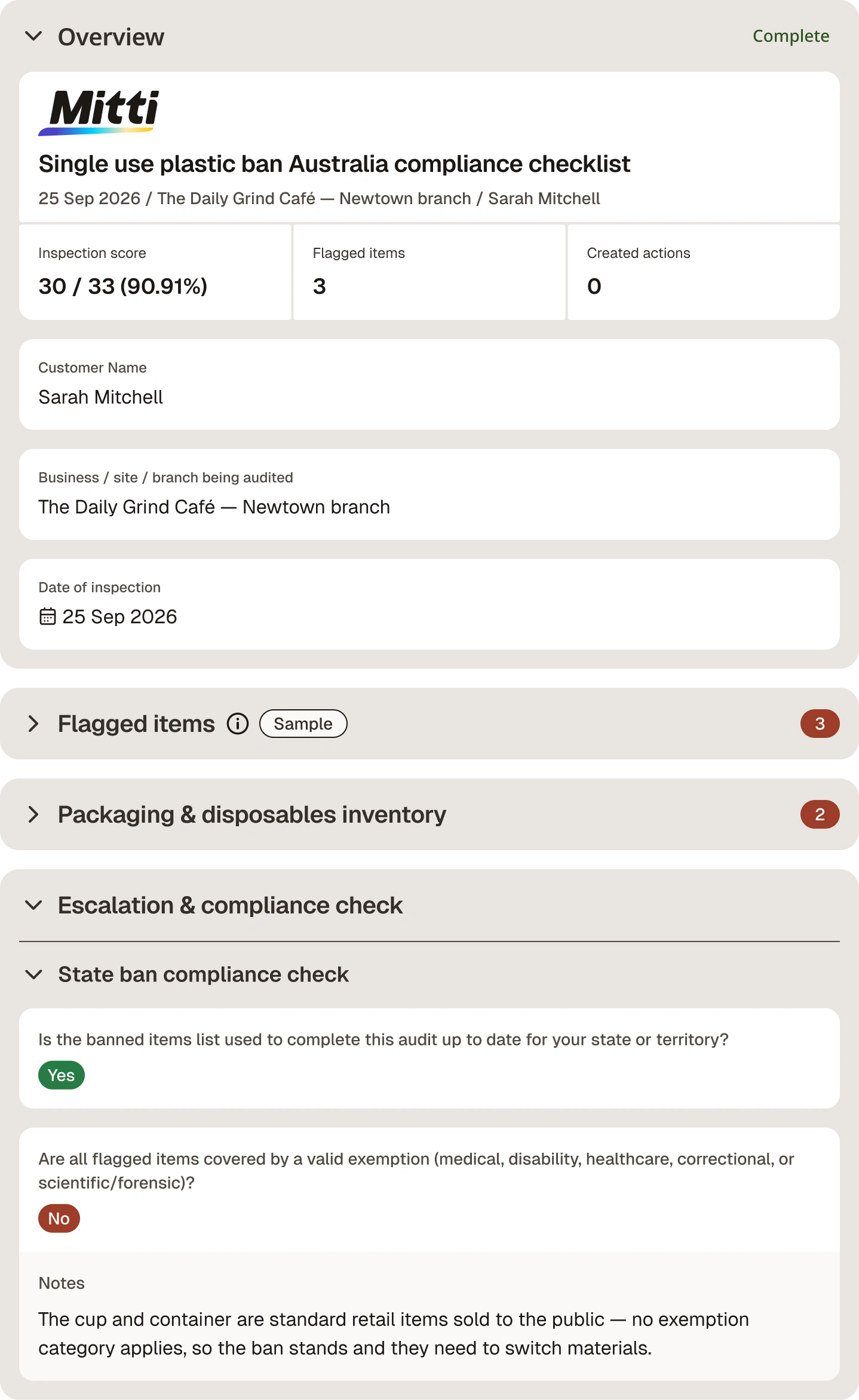
Here is a sample PDF report of a finished single-use plastic ban checklist:
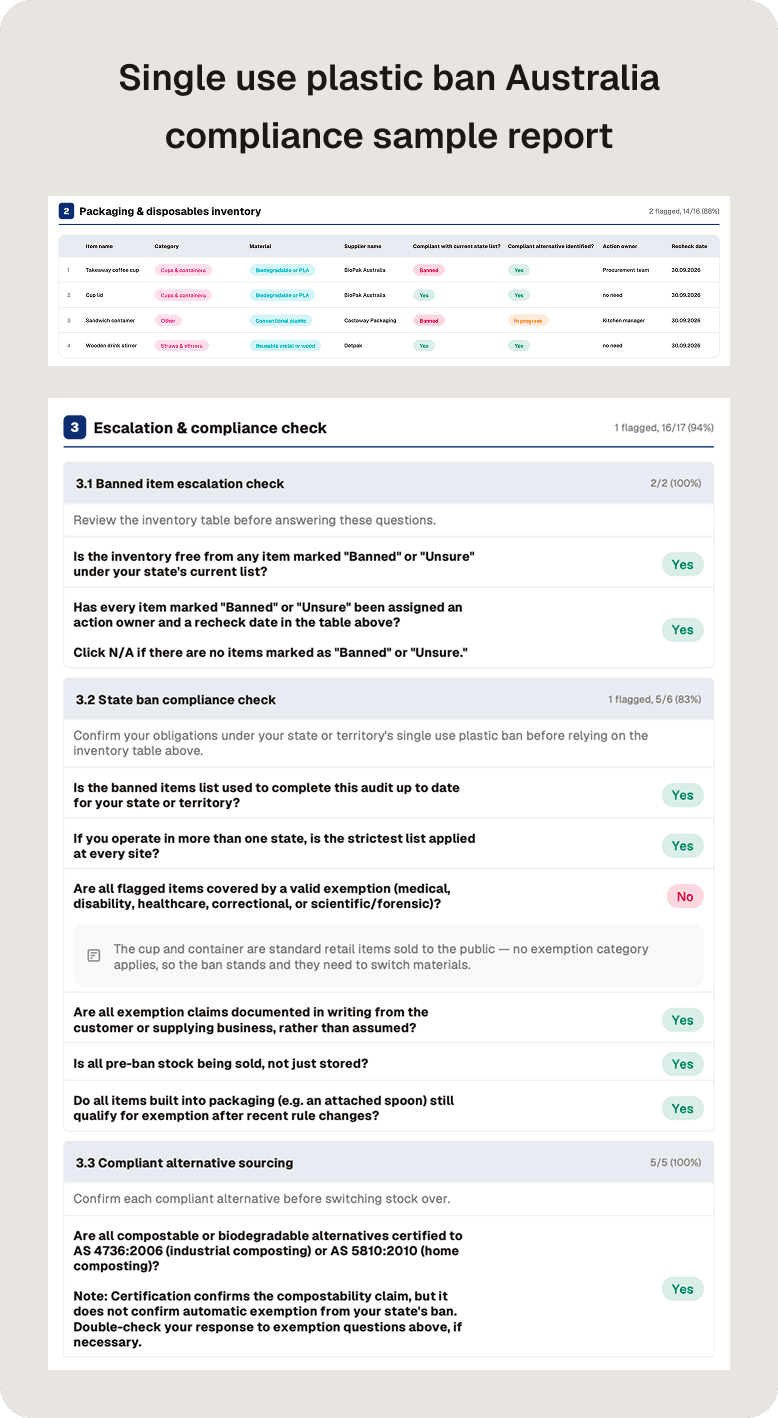
Single-use plastic ban Australia compliance checklist sample report