Permit to work (PTW): the complete guide
Learn what a permit to work is, which permit types you need, how the process works and what the rules require for high-risk jobs.

Learn what a permit to work is, which permit types you need, how the process works and what the rules require for high-risk jobs.
A permit to work (PTW) system is a formal process that authorizes hazardous or non-routine tasks. Each permit outlines the scope of work, identifies risks and sets the safety precautions workers must follow.
On sites like construction projects and manufacturing plants, a PTW system gives your team one clear way to control high-risk jobs. It keeps people safe because everyone knows the hazards and has the controls in place before work starts.
This guide covers PTW as a workplace safety system, not immigration work permits.
These jobs usually need a work permit:
Hot work
Cold work
Confined spaces
Electrical work
Working at heights
Lockout tagout (LOTO)
Work in industrial settings carries different levels of risk. Construction is among the sectors with the most fatal work injuries in the European Union and the United States. In 2024, BLS recorded 1,032 fatal injuries among US construction and extraction workers.
A PTW system works as a safety net for your workers, but a permit isn’t a shortcut to safety. The UK’s Health and Safety Executive says issuing one “does not, by itself, make a job safe,” and that it doesn’t replace a risk assessment. It carries the assessment onto the job itself. With a PTW system in place, your organization can:
Prevent accidents and injuries on-site – Your team identifies and controls every hazard before work begins.
Communicate risks clearly – Everyone understands the job and the precautions, so misunderstandings don’t turn into dangerous situations.
Show you comply – Permits act as documented evidence that you follow your risk assessment and safety procedures.
Cut delays on high-risk tasks – A clear permit process means fewer holdups before work can start.
Workers get a separate permit for each specific task. These are the permits organizations issue most often:
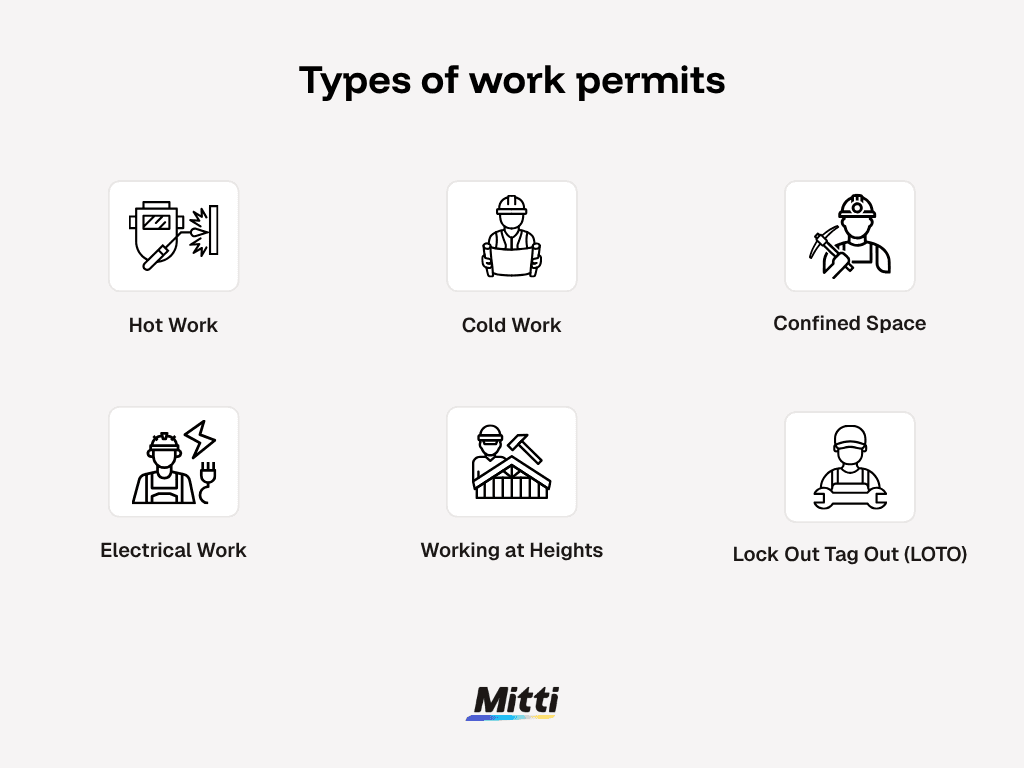
Types of work permits
A hot work permit authorizes people to work with fire or anything that can start one. You need one for welding, cutting, grinding and similar jobs. Workers also need training and a briefing on safe practices before they get one.
A hot work permit should make sure that you:
Inspect the area and clear or cover anything that can burn
Station a trained fire watch with extinguishing equipment
Keep the fire watch in place after the work stops, for the time your rules require
OSHA covers hot work in 29 CFR 1910.252 for general industry. Construction sites follow 29 CFR 1926.352.
A cold work permit is a blanket permit for processes that don’t involve fire or ignition sources. Teams commonly use it for chemical cleanups, scaffolding, heavy lifting and similar tasks. Confirm that nothing on the job can create an ignition source before work starts.
You need one before anyone enters confined spaces such as tanks, vessels and canals. This permit only authorizes entry and investigation. To do the work itself, you need additional permits.
A confined space permit should make sure that you:
Test the atmosphere before anyone enters
Name an attendant who stays outside the space
Have a rescue plan ready
In general industry, OSHA requires employers to check for permit-required confined spaces and, if workers will enter them, to run a written permit space program. Construction sites follow a separate rule, 29 CFR 1926 Subpart AA.
An electrical work permit makes sure everyone working on or near electrical equipment does so safely. Working with electrical components carries a risk you can’t avoid, so the permit controls the major hazards before the job begins.
An electrical work permit should make sure that you:
Isolate the equipment and confirm it’s dead before work starts
Limit the job to qualified people
Specify the PPE for the task
You need one for any job where someone could fall. Working at heights is common in construction and one of the biggest causes of occupational injuries and fatalities worldwide. The permit helps you, your workers and your contractors document the hazards before the job begins.
A working at heights permit should make sure that you:
Check anchor points and fall protection before the job
Confirm workers are trained for the equipment
Control the area below so nobody walks under the work
A lockout tagout permit to work is a key part of your LOTO program. It makes sure teams inspect, maintain and operate equipment safely. These activities are complex and dangerous, so a PTW system helps prevent injuries when equipment starts up by accident.
A LOTO permit should make sure that you:
List every energy source and isolation point for each asset
Apply locks and tags, then test that the equipment can’t start
Remove locks only after the job is closed out and the permit is signed off
A permit to work and LOTO work together, but they aren’t the same thing:
Permit to work | Lockout tagout (LOTO) | |
|---|---|---|
What it is | A formal authorization for a high-risk job | A procedure that keeps equipment from starting during service |
What it controls | The whole job: hazards, people, timing, sign-off | Hazardous energy sources |
Who signs off | An authorized issuer and the workers | Authorized employees who apply the locks |
How they connect | A permit can require LOTO as a control | LOTO is often one step inside a permit |
A PTW system often sits inside a wider control of work system. Whichever setup you use, a good system covers these nine elements:
Hazard identification – Define the hazardous areas and activities where work will be performed.
Risk assessment – Determine the level of risk associated with the hazards identified and establish necessary control measures.
Scope of work – Outline the scope, purpose, location, and duration of the work to be carried out.
Roles and responsibilities – Assign specific roles for individuals involved in the PTW process.
Authorization process – Obtain necessary approval from designated personnel before starting work.
Communication protocol – List the emergency steps to follow and who to call. Say who’s responsible for managing an emergency.
Monitoring and compliance – Check that the permit conditions hold for the whole job, for example with regular supervisor checks.
Documentation – Keep a written or digital record of every permit. Note the work done and confirm the site was left safe.
Closure of permit – Ensure that permits are formally closed after the completion or suspension of work.
Every job follows the same flow, whatever the permit type:
Request – The person doing the work asks for a permit and describes the job, the location and how long it will take.
Assess – The permit issuer checks the site, identifies the hazards and sets the controls.
Authorize – A trained manager or supervisor signs the permit.
Brief – Everyone on the job reads the permit and signs to confirm they understand the risks and precautions.
Work – The team does the job within the permit’s limits while a supervisor checks conditions.
Close – The team reports the work done, the issuer confirms the area is safe, and the permit is signed off.
If a job runs past one shift, leave the site safe and give the next team clear instructions.
A good permit puts everything a worker needs on one page. Include:
Permit number and date
Job description, location and expected duration
Tools and equipment in use
Hazards and the control for each one
Isolation points, PPE and emergency steps
Issuer authorization and worker acceptance, with signatures
Validity period
Hand back and cancellation, signed when the work ends and the area is safe
In the US, there’s no single standard for permit to work systems. Instead, specific rules require permits or permit-style controls for specific jobs:
Confined spaces – 29 CFR 1910.146 requires a written permit space program if workers enter permit-required confined spaces. Construction sites follow 29 CFR 1926 Subpart AA, which includes entry permits.
Hot work – 29 CFR 1910.252 sets fire prevention rules for welding, cutting and brazing in general industry. Construction sites follow 29 CFR 1926.352.
UK HSE guidance – The HSG250 guidance covers permit to work systems in any industry that uses them.
ISO 45001 – It isn’t a law, but it’s the international framework for managing health and safety. Permits are one of the main ways organizations control high-risk work under it. See our guide to ISO 45001.
States and countries can add their own requirements, so check the rules where you work.
Permit systems rarely fail on paper. They fail in practice. The HSE points to competence, procedures and communication as the human factors that decide whether a system works. Watch for these six problems:
Resistance to change – Employees and leaders may push back on a new system, and that can lead to noncompliance. Build a strong safety culture and explain how the PTW system protects workers and keeps operations moving.
Communication issues – Mixed messages and poor coordination between departments cause confusion about who does what. Set clear communication channels and hold regular cross-department meetings so everyone knows the process.
Training gaps – Workers who don’t get enough training can’t apply the safety measures properly. Train everyone on how the system works, why it matters and how to follow it, including who signs off and what to do if conditions change.
System inefficiencies – Complicated procedures and gaps in hazard coverage discourage compliance and lead to missed risks. An electronic permit to work solution simplifies the steps and lets you update templates quickly when regulations change. If you’re moving from paper, the HSE’s HSG250 guidance advises assessing the risks of the changeover and training people in the permit process itself, not just the software.
Unsafe shift handovers – If a job runs past one shift, the site has to be left safe and the next team needs clear instructions. Add a handover step to every permit.
Permit overload – A rush of permits at the start of a shift pushes people to cut corners. Spread the work across the day or add more authorizers at busy times.

Build from scratch or choose from our collection of free, ready-to-download, and customizable templates.
Mitti is the operations system for every site, shift and standard. It helps your team:
See what's happening across every site and shift, as it happens
Turn every issue into a clear next step with an owner and a deadline
Stay on top of standards with digital checklists and an audit trail that builds itself
Improve every day with evidence from the people doing the work
With Mitti, your team can request, approve and close permits from any device, and check that each permit is valid before the job starts. Every permit stays on record, so you can show who signed off and when.
Article by
Mitti (by SafetyCulture) Content Team
Mitti (by SafetyCulture) Content Contributor
View author profile