
Best Practices
"Dairy-free" on the label, milk in the tub: why PEAL is now mandatory
By Rafael Villamor27 Nov 20264 min read
Share article
PEAL has been fully mandatory in Australia and New Zealand since late February 2026, and the stock-in-trade period has ended.
Use the exact allergen name, bold it in the ingredient list and add a bold "Contains" line next to it.
Most label errors come from old packaging, missed recipe changes and wrong labels, so check labels often and keep records.
Important notice
The information contained in this article is general in nature and you should consider whether the information is appropriate to your specific needs. Legal and other matters referred to in this article are based on our interpretation of laws existing at the time and should not be relied on in place of professional advice. We are not responsible for the content of any site owned by a third party that may be linked to this article. Mitti disclaims all liability (except for any liability which by law cannot be excluded) for any error, inaccuracy, or omission from the information contained in this article, any site linked to this article, and any loss or damage suffered by any person directly or indirectly through relying on this information.
In August 2025, a dairy-free coconut yoghurt was recalled from Australian shelves. It started small, with a few batches, then before long it grew to every flavour and size. Why? Surprisingly enough, milk was found in the product.
Up to 10 people reported allergic reactions before the problem reached Food Standards Australia New Zealand (FSANZ), and the company pulled the whole yoghurt range off shelves.
The people who bought that yoghurt had no way of knowing, because the label said "dairy-free".
That's like a label saying "contains tree nuts" without saying which kind. Is it cashew or almond?
That kind of guessing is why Plain English Allergen Labelling (PEAL) was built. And since late February 2026, it applies to every product on the shelf.
PEAL sits in Standard 1.2.3 of the Australia New Zealand Food Standards Code, and Schedule 9 holds the list of required names. And this list is the rule. If an allergen is on the list, the label has to use the listed word, not a close cousin of it.
FSANZ's guidance for food businesses boils it down to a few things:
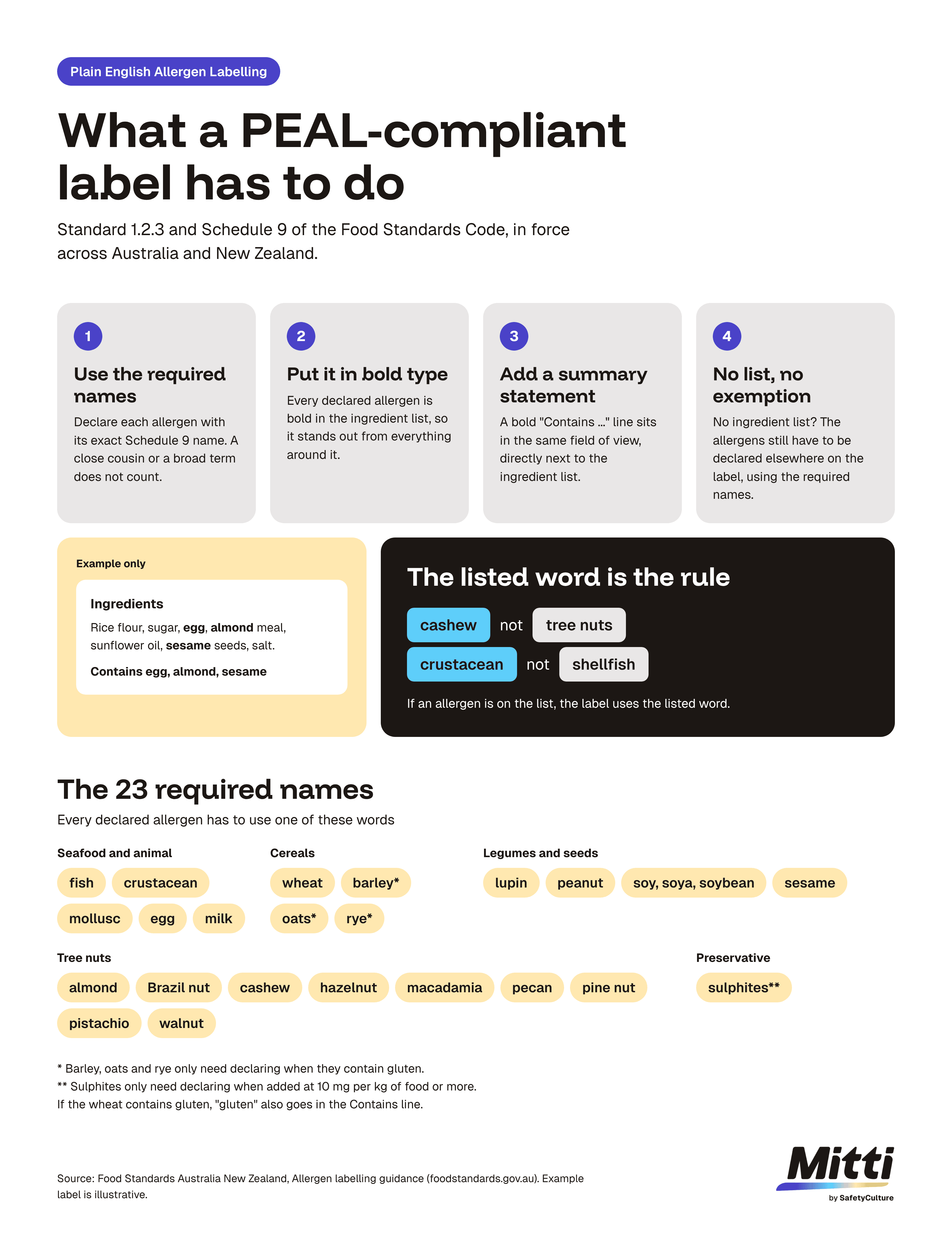
What a PEAL-compliant label has to do
Swap umbrella terms for the exact word:"Tree nuts" and "seafood" aren't on the list. "Cashew" and "crustacean" are.
Bold the allergen, and keep it the same size: In the ingredient list, the allergen goes in bold at the same font size as the other ingredients or larger, never smaller.
Add a bold "Contains" line: Put it next to the ingredient list so both are visible at the same time, for example "Contains egg".
No ingredient list doesn't mean no declaration: Those foods still have to name their allergens somewhere on the label.
In plain terms, a shopper shouldn't have to read the whole ingredient list to find out what could hurt them. It needs to catch their attention as soon as they read the ingredients.
This is happening because food allergies are just so common. They affect about 1 in 10 babies, 1 in 20 teens and 1 in 50 adults in Australia, and while some allergies fade in childhood, many, like peanut, tree nut and sesame, usually last forever.
Sort of. PEAL became law in 2021, and businesses had three years to change their labels. That transition ended on 25 February 2024. Products packaged and labelled before then could stay on shelves for two more years, until that stock-in-trade period ended in late February 2026. This basically means no product can use the old allergen wording anymore.
The rule covers every food and beverage that has to carry a label in Australia and New Zealand, imports included. So if a product on the shelf still says "nuts" or "seafood", it's out of step with the Code.
The hard part now is proving your labels measure up. Regular label checks, with records to back them up, are what keep you ready when an inspector asks.
FSANZ says the biggest reason for food recalls in Australia is still failing to declare allergens on the label. Between 2021 and 2025, that added up to 197 recalls, roughly one every nine days. To add to that, packaging errors, label errors and accidental cross-contamination are the most common root causes.
Why these allergens usually go missing:
Old packaging printed before the rule, still in a storeroom
A recipe or supplier change that never made it onto the label file
The wrong label loaded at the start of a packing run
If you notice where errors usually happen, it’s because of human slips. That's why a thorough inspection is needed before a product leaves the building.
Start with the free PEAL allergen labelling checklist from Mitti (by SafetyCulture), then add the label-specific questions that apply to your products.
Here's how Mitti can support your allergen management and catch these risks early:
Label risk | How Mitti helps |
Old stock with pre-PEAL wording | Inspect with photo evidence and raise issues on the spot |
Generic allergen names | Check each label against the proper names, attach a photo of the ingredient list and flag any that don't match |
Summary statement missing or misplaced | Run a pass/fail check with a photo |
Recipe or supplier change | Schedule reviews and assign actions to an owner with a due date |
Staff unsure of the rules | Assign allergen training courses by role or site and track completion |
Audit questions | Get timestamped reports and analytics across sites |

Use this free checklist to confirm each allergen is named, bolded and summarised the way Standard 1.2.3 requires.


