What is a PEAL allergen labelling checklist?
A PEAL allergen labelling checklist is a set of questions that confirms a food label meets the Plain English Allergen Labelling (PEAL) rules in Standard 1.2.3 of the Australia New Zealand Food Standards Code. You run it on any label, any time something changes.
PEAL is about wording and layout. Each allergen needs its required name, in bold, with a "Contains" summary statement beside the ingredient list. The checklist walks someone through those points in order, so a missed detail doesn't depend on who's on shift.
It suits quality teams, packing leads and anyone who signs off labels, including small producers without a dedicated compliance person.
What should a PEAL allergen labelling checklist cover?
Why use a checklist at all? Label errors are rarely dramatic. A name gets shortened, bold type gets lost in a redesign, or an old roll of packaging turns up in a storeroom. Experienced people still miss these because they read what they expect to see. A fixed set of questions makes you read what's actually printed, and a dated record of completed checks gives auditors and regulators something to look at.
A good checklist follows the label from recipe to pack. The checks below sit inside wider allergen management, and each one maps to a rule in the Code.
Ingredients and required names
Start with the recipe, not the label. List the allergens in every ingredient, including additives and processing aids, then confirm each one appears under its required name. Schedule 9 of the Code sets those names, so a group term like "tree nuts" or "shellfish" doesn't count. The label needs "cashew" or "crustacean" instead. Our guide to food allergens shows where each one tends to hide, and our plain English allergen labelling guide lists all 23 names.
Every allergen in the recipe has a matching required name on the label
Allergens in additives, processing aids and compound ingredients are included
Barley, oats and rye are declared when they contain gluten
Sulphites are declared at 10 mg per kg of food or more
Any exemption you rely on has the supplier's specification on file
Bold type and the summary statement
This is where well-meant labels slip. The required name has to be bold in the ingredient list, at the same size as the other ingredients or larger. A bold "Contains" line then repeats the allergens and sits directly next to the list, so a shopper sees both in one glance. If wheat contains gluten, the summary statement also needs the word "gluten".
Required names are bold in the ingredient list
Bold type is the same size as the surrounding ingredients or larger
The "Contains" line is bold and sits next to the ingredient list
The "Contains" line matches the ingredient list, with "gluten" added where wheat contains it
Foods with no ingredient list declare allergens elsewhere on the label, using the required names
Packaging and label control
A correct label file doesn't help if the wrong roll goes on the line. Most label errors start with a change nobody linked back to the artwork. The FSANZ transition period for older labels has ended and plain English allergen labelling is now mandatory, so any packaging printed to the old rules should be out of circulation.
The right label is loaded for the right product at the start of each run
Old packaging is removed from storerooms and packing areas
Label changes are approved and recorded before printing
A recipe or supplier change triggers a fresh label check
Any precautionary "may contain" statement is reviewed on its own, because the Code doesn't regulate it
A worked example
Say a bakery makes an almond and wheat slice. The recipe holds wheat flour, almond meal, egg, honey, sunflower oil and salt. The draft label reads:
Ingredients: Wheat flour, almond meal, egg, honey, sunflower oil, salt.
CONTAINS: tree nuts, egg, wheat
One pass through the checklist finds three fails:
"Tree nuts" isn't a required name, so the label needs "almond" instead
The ingredient list has no bold allergen names
Wheat contains gluten here, so the summary statement is missing "gluten"
Here's the corrected version:
Ingredients: Wheat flour, almond meal, egg, honey, sunflower oil, salt.
Contains wheat, gluten, almond, egg
The other great thing about a digital checklist is that the fixes cost almost nothing. Changing a word in the artwork takes minutes. Finding the same mistake after a full production run means relabeling or scrapping stock, and chasing down anything that already shipped.
Here is a sample PDF:
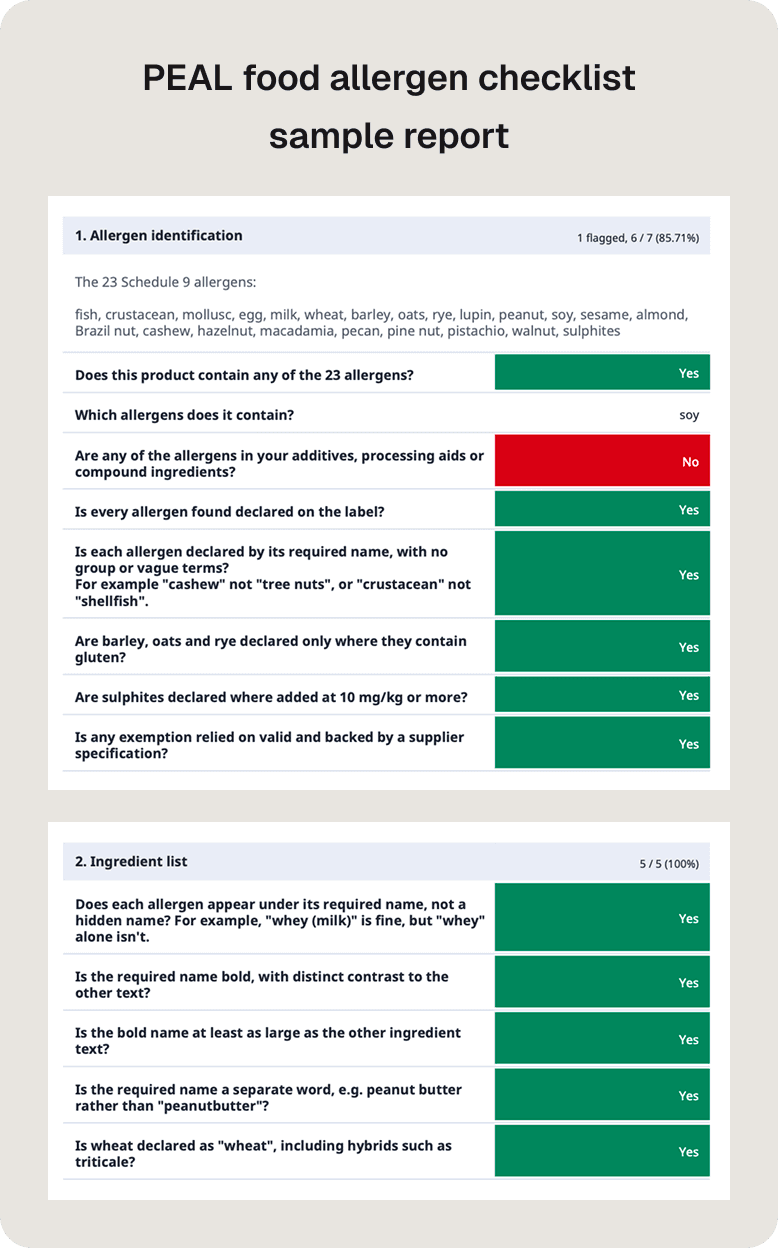
Sample PEAL allergen checklist PDF report
How do you use a PEAL allergen labelling checklist?
Run the checklist at three moments, each with a different owner.
Before the label is printed
Check the artwork against the recipe and supplier specifications, then confirm each required name, bold style and summary statement. Quality or technical staff usually own this step. Record the approval against a label version.
At the start of each run
Check the physical pack, not the proof, because a proof can look right and still print wrong. Packing leads confirm the right label is on the right product, old stock is cleared and the bold type and "Contains" line made it onto the pack. Take a photo as evidence.
After a change
A new supplier, a reformulated recipe or a swapped ingredient is when labels drift out of date. Treat any change as a trigger to rerun the checklist, even a minor one.
Score each question pass or fail. Any fail on required names, bold type or the summary statement holds the label until it's fixed, so name an owner and recheck once it's corrected. Pairing the checklist with allergen training helps the team know the required names by heart.
The checklist supports your judgment but doesn't replace it. For unusual labels, such as multi-packs or complex compound ingredients, ask your state or territory food regulator or a food technologist. FSANZ's allergen labelling guidance is the reference point for the rules.
How do you keep PEAL checks consistent across sites?
Paper checklists work for one line. They struggle across several sites and shifts, because results sit in folders and nobody sees the pattern. Digital checklists fix that by putting every result in one place.
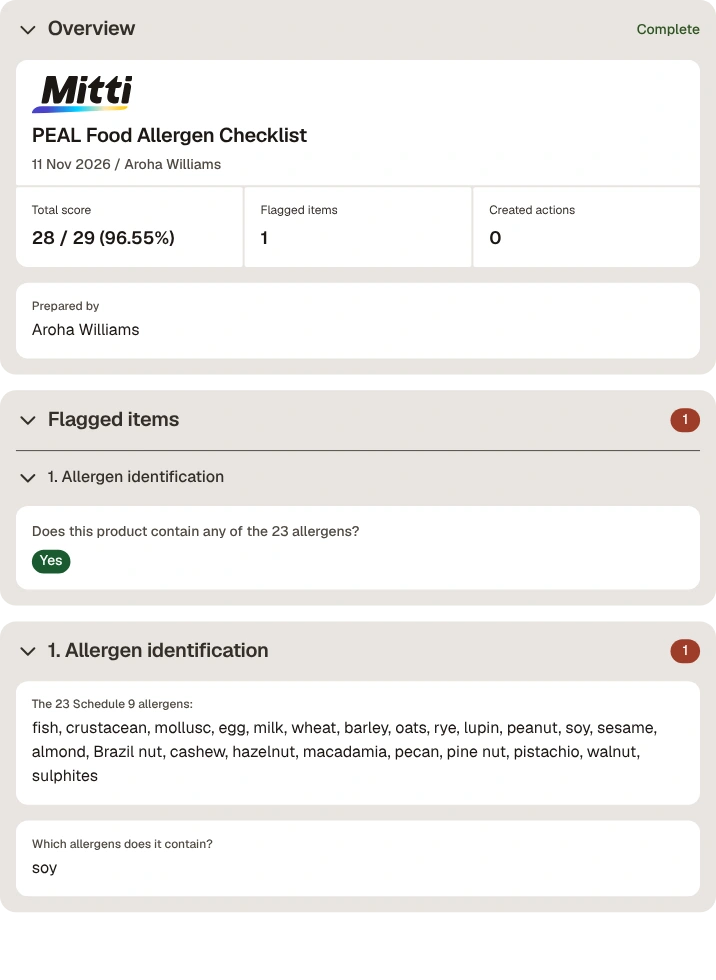
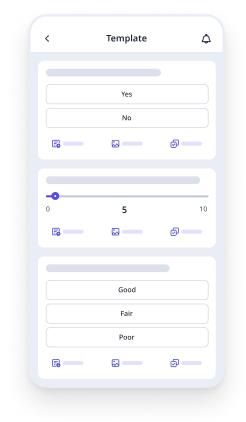
Platforms like Mitti (by SafetyCulture) let teams complete the checks on a phone, attach label photos and flag fails for follow-up. Sodexo used it to digitize more than 30 HACCP logs across 40% of its sites, saving over 83,000 pages and connecting frontline staff with management. Label checks fit the same habit, and they slot straight into your wider food safety routine.
The bigger payoff shows up over time. When every site answers the same questions, you can see which checks fail most often and where. If one line keeps loading the wrong label, or one supplier keeps changing specifications without notice, the pattern is visible after a few weeks instead of after a recall. That lets you fix the cause, not just the label.
Start with the questions above, then adjust them to your products. A bakery and a sauce maker won't share every line, but the structure of recipe, format and packaging holds for both. Keep the question set short enough that people finish it on a busy shift, because a checklist that takes 20 minutes quickly turns into one nobody completes.

Still looking for a checklist?
Search, filter, and customize 60,000+ templates across industries and use cases.
FAQs
Article by
Mitti (by SafetyCulture) Content Team
Mitti (by SafetyCulture) Content Contributor
View author profile