
Industry Insights
Who's watching your restaurant's coolers when you're not?
By Rafael Villamor31 Jul 20266 min read
Manual checks only show you the temperature at one moment, not what happens in between.
A single outbreak can cost a restaurant $4,000 to $2.6 million.
Sensors are backups, not a replacement for human judgment.
Important notice
The information contained in this article is general in nature and you should consider whether the information is appropriate to your specific needs. Legal and other matters referred to in this article are based on our interpretation of laws existing at the time and should not be relied on in place of professional advice. We are not responsible for the content of any site owned by a third party that may be linked to this article. Mitti disclaims all liability (except for any liability which by law cannot be excluded) for any error, inaccuracy, or omission from the information contained in this article, any site linked to this article, and any loss or damage suffered by any person directly or indirectly through relying on this information.
Here are the numbers that make it real: $4,000 to $2.6 million. That's the range a single foodborne illness outbreak can cost a restaurant, according to a Johns Hopkins Bloomberg School of Public Health study, from a small fast-food incident on the low end to a large outbreak at a fine-dining restaurant on the high end. That range takes into account lost revenue, fines, lawsuits, legal fees, and insurance premium increases.
Multiply that across an entire country, and you have the total annual cost of foodborne illness in the US at $74.7 billion based on the cost estimates of foodborne illnesses in 2023 by the US Department of Agriculture’s (USDA's) Economic Research Service. That's the baseline cost of an industry running on a system with built-in gaps.
However, there is an upside to just having good service and tasty food. A Harvard Business School study found that a single star shift on Yelp moves an independent restaurant's sales by 5 to 9 percent, and that same research found higher-rated restaurants sell tables 19 percent more often during peak periods. Run a tight kitchen, and it pays you back.
With the technology these days, automated temperature checks with the use of sensors are the best way to go.
Here are some of the advantages of automation:
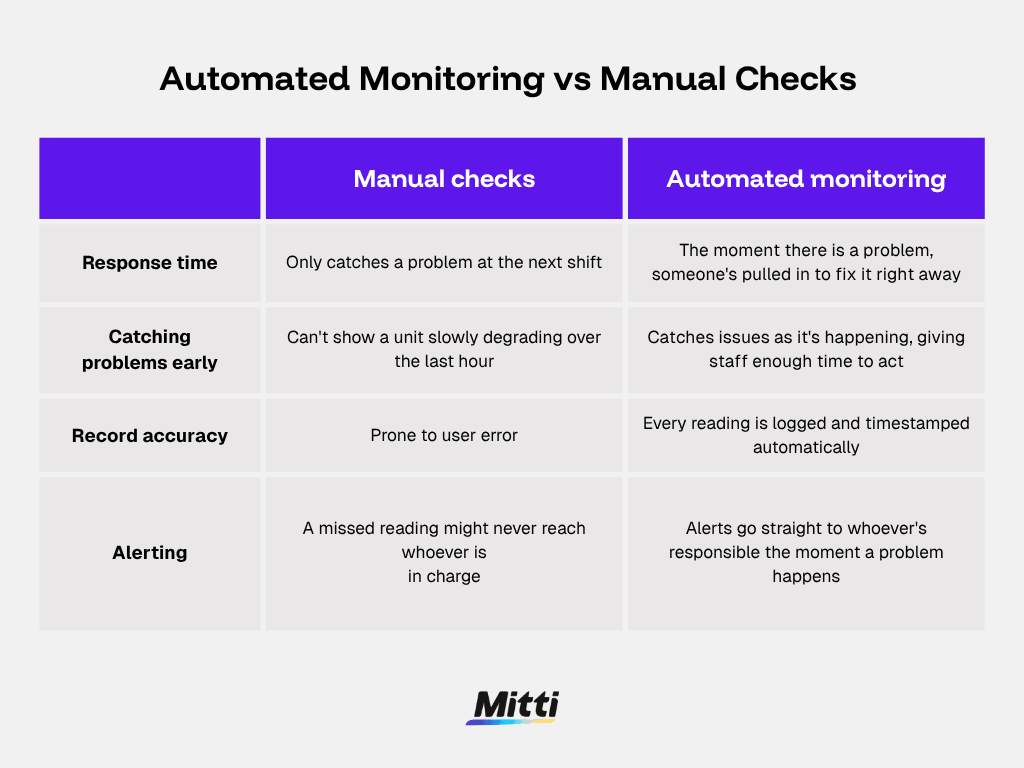
Automated Monitoring vs Manual Checks
A manual check only catches a problem whenever the next round happens, sometimes not even until the next shift. A sensor has no shifts. So the moment a reading crosses a threshold, someone gets pulled in to fix it right then, not whenever staff happen to walk by again.
A manual reading only shows you one moment in time, it can't tell you whether a unit has been slowly degrading over the past hour. A sensor catches that as it's happening, giving staff time to act while the food is still fine.
A paper log is always prone to user error. Someone might forget to log it, read the temperature wrong, or backfill it for later. A digital sensor does none of that. A reading is logged and timestamped, with no human variable to account for.
A missed reading on a clipboard might not reach a manager; maybe they're out, maybe they just forget. Sensor alerts go straight to whoever's responsible or next in charge, on their phone, the moment a problem happens.
None of this replaces a food safety culture. It replaces the assumption that someone can be everywhere, watching everything, all the time. That assumption never made sense, especially with artificial intelligence being so common these days.
A good food safety culture still comes from the people. Tech just makes sure it holds up even when no one's watching closely.
It's 2 a.m. at the neighborhood mom-and-pop's restaurant. The line cooks left hours ago. Nothing looks off from the outside, but inside, something's been quietly going wrong since closing.
The walk-in cooler's compressor has been struggling for six hours, climbing past 41°F (5°C), then past 50°F (10°C), and nobody knows. The last person to check it wrote "38°F (3°C), OK" on the clipboard by the counter and clocked out.
The morning prep isn't going to go well for this local restaurant. Four cases of protein have sat in the danger zone for most of the night. That's basically the whole shift, gone before it even started.
That's exactly how fragile manual temperature checks are. One small error could shut you down for the day.
A guest ordering a burger doesn't think about cold chain logistics or critical control points. They just expect the food to taste good and not make them sick. That expectation is what the whole hospitality industry is all about.
Mess that up, and that could be a whole PR campaign for your business because with social media these days, the customer has all the power. A single one-star review posted online can be devastating for your restaurant’s reputation.
And hotels carry that same expectation, maybe even more so, since a hotel banquet is often served buffet-style, with 300 guests eating off the same holding line. One equipment failure is enough to put everyone in the room at risk. The same goes for any business in the hospitality industry.
The stakes aren't theoretical. More than half of all foodborne illness outbreaks in the US are tied to restaurants, delis, and institutional food service. So if you run a kitchen, you're not near the risk; you're at the center of it.
These are paying customers who expect fresh food from you. That's the whole point behind why the Food and Drug Administration (FDA) set hard temperature numbers.
Cold Time/Temperature Control for Safety (TCS) food has to stay at 41°F (5°C) or below, hot food has to stay at 135°F (57°C) or above, and, if reheated, it has to climb all the way to 165°F (74°C) before it's safe again. The range in between, the danger zone, is where bacteria like Salmonella and E. coli can reproduce in as little as 20 minutes.
Hazard Analysis and Critical Control Point (HACCP) takes that science and applies it at the exact moments where temperature actually matters in a kitchen. It's looking for six checkpoints where things are most likely to go wrong:
Receiving: Is the delivery truck's food already in the danger zone when it arrives?
Storage: Is the walk-in actually holding at 41°F (5°C) or below?
Cooking: Did the food reach a safe internal temperature?
Cooling: Is it cooling down fast enough, not lingering in the danger zone on its way down?
Holding: Is it staying at 135°F (57°C)+ hot or 41°F (5°C)- cold while it sits?
Reheating: Did it climb back up to 165°F (74°C)?
That's what a TCS food safety plan actually manages, moment by moment.
All of a sudden, we needed to be able to give 850 people the same level of attention and training as we would have eight years ago when it was three people and just a handful of mixers


