What is a Car Service Checklist?
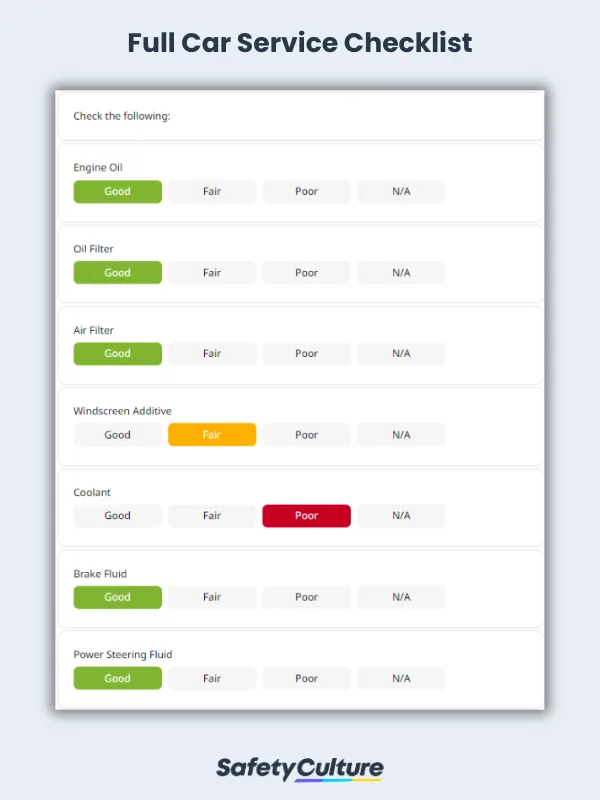
A car service checklist helps automotive technicians thoroughly check car components and assess repair needs. Cost-effective and convenient, a car service checklist assists automotive technicians in verifying car problems and advising customers on additional repairs and service work. Aside from being free and easy to complete, car service checklists also help solve some of the most common challenges that automotive technicians face when servicing cars.
The length of a car service checklist depends on whether the car service is interim (every 6 months), full (once a year), or major (once every two years).
What is a Car Service?
A car service is essentially a combination of car maintenance and auto repair. It is performed by automotive technicians for owners or operators of vehicles. During a routine car service, automotive technicians check core vehicle components and note their conditions in an assessment report. Often, a car service also includes changing or replacing worn-out car parts.
Types of Car Maintenance by Mileage
Car service intervals are based on mileage, time, or whichever comes first. There are three standard service types: interim, full, and major—each building on the last. That said, always refer to your vehicle manufacturer's recommended maintenance schedule, as service requirements can vary by make, model, and engine type.
Interim Car Service (every 6 months or 6,000 miles)
Since this car service type is the most basic of the three, the items checked during an interim or routine car service are also checked during a full car service and a major car service. The most basic service type, covering essential checks to keep the car running safely between full services:
Engine oil and oil filter check and replacement
Transmission oil leak inspection
Coolant, brake fluid, power steering fluid, and clutch fluid levels
Brake pad inspection
Windscreen condition, additive, wipers, and washers
Lights, horn, and seatbelt check
Tire pressure and visual condition check
Full Car Service (every 12 months or 12,000 miles)
A full car service is performed at least once a year or after the car has reached 12,000 miles. As the bridge between the most basic type of car service (interim) and the most extensive (major), full car service is likely the type most often performed by automotive technicians. Includes everything in an interim service, plus a more thorough vehicle inspection of mechanical components:
Shock absorber and wheel bearing condition
Timing belt interval check
Steering rack gaiters and suspension components
Antifreeze strength and radiator hoses
Hand brake, brake calipers, pipes, and hoses
Auxiliary drive belts and fuel system
Tire depth measurement and rotation
Major Car Service (every 24 months or 24,000 miles)
A major car service should be performed every 2 years or when the car has reached 24,000 miles. This type of car service is also recommended for vehicles that haven’t been regularly checked, maintained, or serviced for some time.
This is the most comprehensive service, covering everything in a full service plus higher-wear components that require less frequent attention:
Spark plug replacement
Air filter and cabin filter replacement
Transmission fluid change
Coolant flush and replacement
Detailed brake system inspection (discs, drums, and hardware)
Full steering and suspension component check
The 30/60/90,000-Mile Maintenance Schedule
Many manufacturers also recommend service milestones at 30,000, 60,000, and 90,000 miles regardless of annual servicing history:
30,000 miles - Replace air filter, inspect fuel filter, check coolant and power steering fluid
60,000 miles - Replace brake fluid, inspect brake pads and rotors, replace spark plugs, check timing belt
90,000 miles - Replace timing belt (if not already done), inspect water pump, replace all major fluids, check battery and charging system
These intervals are especially useful for vehicles with inconsistent service histories or those returning from extended periods without maintenance.
What’s Included in a Car Service Checklist?
Even for car services of the same type, the specific car parts checked can be different for each auto shop, vehicle, or client. Some auto shops specialize in the supply or replacement of a certain part or where the vehicle manufacturer has indicated in its manual that a certain part should be checked more often or given special attention.
Moreover, since the condition of each car largely depends upon its history, current usage, and maintenance, customers may have special requests or service inquiries that aren’t necessarily included in the auto shop’s car service package.
That being said, a car service should include the following at the very least:
Engine oil: check and refill if near “low” markings
Coolant level: check and refill if below the normal level
Power steering fluid: check and inspection for leaks
Tire pressure: check and inspection for holes
Timing belt: check and replacement
Brakes: inspection and fluid level check
Windscreen: additive and clutch fluid level check
Lights, wipers, and horn: testing and inspection
Oil filter and air filter: check and replacement
Car battery and antifreeze: strength check
For a general list of the car parts checked for each car service type, go to the featured car service checklist templates section.
Common Challenges in Car Maintenance
While most automotive technicians are experienced in car service, even veteran mechanics can still make mistakes. This is due to the repetitive nature of the job, making it easy to slip up and forget even the simplest but most important parts of car service.
Such mistakes can incur huge financial costs for the shop and irreparably damage its reputation among its clientele. Diligence is crucial for automotive technicians since they have a lot of responsibilities to deal with on a daily basis.
Here are the top three concerns of an automotive technician:
Safety Risks
Working on cars everyday takes a toll on one’s body. If automotive technicians aren’t aware of how to properly move and position themselves when doing certain tasks, they run the risk of injury or ending up with joint and muscle problems later on in life.
Aside from the medical expense, a serious injury could actually end an automotive technician’s career since the work does require them to be physically fit or capable, at the very least.
Overwhelming Tasks
For automotive technicians, the faster they finish a job, the more money they get from it. This is why, despite the long hours, they are always working against the clock. Notwithstanding the higher incentive, automotive technicians are also motivated by customer demands.
Most clients expect their car to be ready soon, regardless of the complexity of the work. Keeping up with the fast pace of the job and, at the same time, pulling 12-hour shifts can easily overwhelm and exhaust automotive technicians to the point of burnout.
Unfinished Work
Despite working nonstop all-day, automotive technicians still have to double-check their work. Aside from the very real threat of being fired for not being careful enough, automotive technicians also need to keep in mind that they are working on a piece of machinery that could potentially cause fatal accidents.
According to the National Highway Traffic Safety Administration (NHTSA), tires and wheel-related problems account for 35% of car accidents in the US caused by mechanical failure, and 22% are from bad brakes.
How Automotive Technicians Can Step Up and Perform Better
Though being an automotive technician is a difficult job, it can be incredibly rewarding for people who love tinkering with cars. Nevertheless, even those who know they are on the right career path can be sidetracked by inefficiencies in the workplace. Here are some suggestions on how automotive technicians can make their life easier and do their job better:
Have a Talk With Their Supervisor
While it can be tempting to just brush off safety concerns, it really pays in the long run to put one’s foot down when it comes to safety. Automotive technicians should be wary of working without proper safety equipment, especially in such a harsh environment that is full of hazards.
Aside from safety, automotive technicians should also have an honest discussion with their supervisor regarding their work hours and pay. While a shop’s pay structure and shift schedule may seem set in stone, it’s possible for both to change if a supervisor sees the benefit in doing so.
Having a reasonable discussion is always beneficial for both technician and supervisor because it’s an avenue where concerns can be raised and problems can be addressed.
Don’t Overspend on Tools
One of the biggest mistakes a newbie automotive technician can make is buying an expensive set of tools right away. While these tools may be of higher quality, they aren’t a good investment.
No matter how careful one is with tools, they’ll still end up getting damaged by one thing or another at the end of the day. A helpful tip is to let the shop buy the big tools and only pay a small amount ($500-1500 per year) out-of-pocket for other tools.
Use a Digital Checklist
A car service checklist is one tool that costs nothing, not even time and effort. Since a car service checklist is pre-made, automotive technicians can immediately begin using it without having to worry about creating their own checklist from scratch. It’s also relatively straightforward, making it easy-to-use and hassle-free.
Like any other tool, a car service checklist should do most of the grunt work, so that automotive technicians can focus on the task at hand, which is ensuring that vehicles are in good condition and are safe to use.

Still looking for a checklist?
Search, filter, and customize 60,000+ templates across industries and use cases.