Mitti by SafetyCulture
Pricing
Log inSign up for free
  1. Home
  2. Checklist guides
  3. Operations
  1. Home
  2. Checklist guides
  3. Operations
Mitti by SafetyCulture

The way the world works

Follow us

App Store
Google Play

Product

  • Pricing
  • Book a demo
  • Product updates
  • Mitti (by SafetyCulture)

Support

  • Help center
  • Contact us
  • API developer documentation
  • Digitize your checklist

Resources

  • Content library
  • App & software guides
  • Checklist guides
  • Topic guides
  • eBooks
  • Blog

Company

  • About
  • Careers
  • News room
  • Meet the leadership team
  • Events & webinars
Copyright © 2026 Mitti
StatusLegalPrivacyTerms & ConditionsSecurity

SafetyCulture has a new name. Say hello to Mitti. Learn More.

Powered by

HR Employee Record Template

Replace physical documents and avoid the hassle of data loss with a digital recordkeeping app

Rated 4.6/5 stars on Capterra | 3k+ app store reviews
Use templatePreview template
HR Records Checklist
Mobile Preview
See the template in action (opens in new tab)

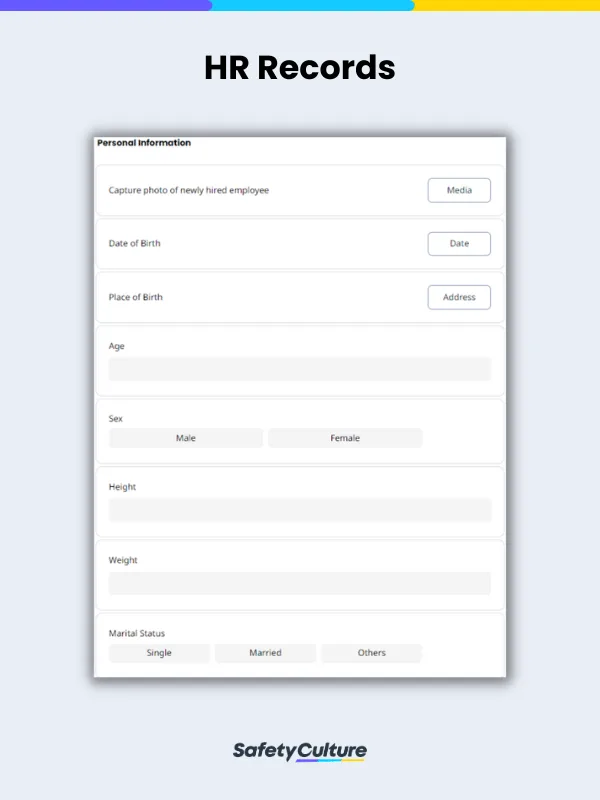
An HR employee checklist is used whenever there are newly hired employees. This template has been created to guide human resource professionals to do the following:

  1. Fill up the new employee personal profile

  2. Capture photo of newly hired employee

  3. Indicate the job information, family members, and educational background

  4. Capture photo of medical records and employment contract

  5. Indicate HR notes and recommendations

  6. Sign off with a digital signature to verify the account

HR Records Checklist
Mobile Preview
See the template in action (opens in new tab)

Why Mitti digital checklists?

  • Free to use for up to 10 users

  • Eliminate paperwork with digital checklists

  • Generate reports from completed checklists

Use template
  • What are HR Records?
  • Importance of HR Records
  • Types of HR Records
  • Proper Retention of HR Records

In this article

  • What are HR Records?
  • Importance of HR Records
  • Types of HR Records
  • Proper Retention of HR Records

Eliminate paperwork with digital checklists

Skip the setup and get to work in seconds.

Use template

Article by

Jona Tarlengco

|

4 min read

|

21 Feb 2024

What are HR Records?

HR records or Human Resource records are informational documents utilized by HR professionals and organizations to carry out their functions. It is a documented list of activities and evidence which helps employees and organizations support regulatory requirements, emergency plans, insurance claims, and employee qualifications and promotion.

Importance of HR Records

HR records are essential documents needed by a company, regardless of industry. It contains significant information such as employee transcripts, incident reports, budget, and organized events. Keeping and securing these records help the organization in:

  • analyzing existing problems at the workplace;

  • evaluating if policies are regulated, standardized, and up to date;

  • capturing information on how resources are managed;

  • preparing employee training needs; and

  • reinforcing safeguards against employee disclosure of confidential records.

Types of HR Records

HR records include data from minutes of meetings, orders, program implementation, and employee submissions. The following are essential types of HR records an organization, usually organized by the talent acquisition team, should gather:

Employee records

Employee records or files are a compilation of personal information, performance, and status of each employee. It is classified into four subcategories:

  • Pre-employment records New hires or employees are required to submit personal data documents such as medical and employment history, emergency contact numbers, and employment contracts including benefits and salary offers.

  • Onboarding records Upon joining the organization all employees must attend employee onboarding and induction to avoid tendencies of negligence to health and safety regulations. Attendance confirmation must be reflected in employee records.

  • Past and current Performance records All employees are measured and benchmarked according to their performances. It is a documented evaluation of contributions, achievements and any possible disciplinary actions. Keeping a record would help management’s decision for employee appraisal or termination.

  • Offboarding records Offboarding employees must complete a clearance form from the organization. It should be kept as part of employee records to ensure a seamless separation. This would ensure clear communication to avoid exposing organizations to legal, security and reputational risks.

Recreational Records

All company activities must be documented including the type of event, objective, plan, and budget. This would set transparency with business owners and serve as evidence on where the annual budget was allocated and used.

Incident Reports

All incidents including accident or near miss must be recorded to fulfill regulatory requirements (such as OSHA 300 Forms in the United States). These records may help the organization in analyzing safety and security improvement needs and can support personal or business insurance claims.

Training Feedback

It is a compilation of gathered feedback from the participant(s) regarding training programs, facilitators, and training facilities. This record would help identify employee skill gaps and training needs. Also, it helps in providing employee assistance, and assessing and improving the overall experience of training programs.

Inventory Records

All purchases must be properly documented including equipment, daily operation, facility improvement and more. These records will be used by the organization as evidence for business compliance with regulatory requirements. Also, it helps identify if assets are enough for business’ deliverables.

Proper Retention of HR Records

HR department retains and destroys employee records in accordance with federal and state laws governing record retention such as EEOC Regulations, ADEA, and FLSA recordkeeping requirements.

  • EEOC Regulations state that employers should keep all employment records for one year from the date of termination or separation.

  • ADEA recordkeeping requirements state that employers must keep all payroll records including benefit plans for three years. Also, any written merit and performance record should be kept at least one year after employee termination.

  • FLSA recordkeeping requirements applicable to the EPA state that employers must keep payroll records for at least three years, while other records such as wage rates, job evaluations, seniority, and merit systems should be kept for at least two years.

Content library templates

Still looking for a checklist?

Search, filter, and customize 60,000+ templates across industries and use cases.

Browse Library
JT

Article by

Jona Tarlengco

Mitti (by SafetyCulture) Content Specialist

View author profile

Related resources you might like

Templates

Powered by

Employee Onboarding Checklist

This employee onboarding checklist is used to assess if all onboarding processes were discussed with newly hired employees. This checklist allows you to:

  • Gather onboarding documents of new hire employee

  • Identify missing onboarding requirements

  • Ensure that new hires’ workstation is ready for use

  • Provide orientation on company policies, attendance, proper conduct, and job

  • Supply employee handbook and sign the document

View template in library

Powered by

Employee Offboarding Checklist

This employee offboarding checklist is used to identify if all exit requirements were completed by an employee to officially exit from the company. Utilize this checklist to:

  • Check off each required paperwork

  • Confirm proper knowledge turn-over

  • Make sure to recover issued company assets

  • Update any necessary items for security

  • Complete offboarding by signing digitally

View template in library

Powered by

Human Resource Policy Checklist

This Human Resource policy checklist was created by HR Genie Pty Ltd using Mitti (by SafetyCulture). HR Genie Pty Ltd has a dynamic and enthusiastic team with practical experience in consultancy – HR and Business. It was created to assess the status of Human Resource Management Policies.

View template in library

Powered by

Human Resource Client Review

This human resource client review is used by HR professionals to assess strategic and operational activities if effectively implement in the organization.

View template in library

Powered by

Training Feedback Form

Use this training feedback form to evaluate your HR-led training sessions by gathering feedback from participants regarding their experiences, the facilitator, and training facilities. This checklist can help you ensure training programs are clearly defined and contents are relevant to your employees’ roles and responsibilities.

View template in library

Powered by

Inventory Checklist

An inventory checklist is used to create a basic list of your stocks. It helps verify if supplies are enough for business’ deliverables.

View template in library

Powered by

Audit Checklist for HR

This human resource audit checklist can be used by HR departments to conduct a quick audit to ensure an organization’s compliance with important employee records and documents. This checklist includes a review of the presence of essential items such as minimum wage posters, USERRA posters, I-9 documents, and more. It can also be used as is or customized according to the specifications of a business.

View template in library

Articles

Recreation Management Software

Explore top recreation management software to streamline operations, enhance user experience, and simplify managing recreational activities.

Learn more

Transportation and Logistics: What’s the Difference?

Learn about the importance of transport and logistics within the supply chain and how it is used in business operations.

Learn more

Restaurant Checklist

Download free restaurant checklists for opening, closing, cleaning, safety, and health inspections—with templates for every shift.

Learn more