What is a Construction Risk Assessment?
A construction risk assessment is designed to identify potential workplace hazards and risks in construction projects. Using the completed risk assessment report helps project leads delegate responsibilities and implement control measures to address said risks. Conducting regular construction risk assessments also helps stakeholders comply with health and safety regulations while empowering teams to protect workers from health and safety threats.
What are the Risks in Construction?
The construction industry poses numerous hazards and risks accounting for a high number of serious injuries and accidents. Most accidents are due to the Fatal Four, namely falls, electrocution, struck by object and caught in/ between objects.
To help you avoid such incidents, we have listed each of the fatal four, their common causes and some safety best practices to follow.
FALLS
Injuries from falls are the most common cause of construction site fatalities. Incidents mainly account to lack of personal fall arrest systems, poor general safety equipment (safety net, guardrails etc), and improper use of ladders or scaffolds. Employers should establish effective fall preventive measures to protect employees from such risks:
Train employees on correct procedures when working at heights i.e. correct usage and choice of ladders, correct usage of personal fall arrest systems
Encourage workers to wear appropriate PPE (i.e. hard hats and complete safety harnesses)
Safety equipment on site must be in place at all times (i.e. horizontal lifeline, personal fall arrest system, safety net, guardrails, proper ladders and scaffolding)
Make sure elevated platforms are safe and secure
STRUCK BY OBJECT
Struck-by hazards are the second highest cause of fatalities among construction workers. According to Occupational Safety and Health Administration (OSHA), struck-by injuries accounted for 80 construction worker deaths in 2017. Struck-by object incidents include workers getting accidentally hit by a falling debris or by equipment moving parts. The following safety practices can help mitigate struck-by-objects injuries:
Wear appropriate PPE ( i.e. hard hats, safety goggles and steel-toe boots/ shoes)
Train employees to be aware of their working environment for possible discharge from equipment or any falling debris
Steer clear of swinging equipment/ load and equipment with moving parts
If possible, avoid areas where work is being performed overhead
ELECTROCUTION
Electrical hazards account for more than 300 deaths and 4,000 injuries each year. Injuries and other incidents are often caused by faulty wires or equipment, unsafe location of electrical outlets and improper use of extension or cords. Here are safety tips to follow to reduce risks from electrical hazards:
Implement Lockout-tagout (LOTO) procedure at all times
Always wear appropriate PPE (i.e. safety goggles/ glasses, face shield and insulated gloves)
Follow safe distances when working with overhead power lines
Provide training on proper usage of electrical equipment and electrical safety
CAUGHT IN/ BETWEEN OBJECTS
According to OSHA, accidents caused by getting caught in or between objects accounted for 50 construction worker deaths in 2017. Caught in/ between object accidents may happen when a worker’s body or hand gets caught, pinched, squeezed, or crushed in moving parts of unguarded machinery. Prevent caught in/ between risks through these safety tips:
Avoid wearing loose clothing and jewelry
If applicable, pull your hair up
Be aware of your surrounding work area
Avoid usage of equipment with missing parts or equipment that have been de-energized
Avoid the radius of moving equipment or equipment with moving parts
How to Perform a Construction Risk Assessment
Conduct a building site risk assessment with these four simple steps:
Identify hazards and the risk ratings: Describe the hazard and assign its risk rating. Use a table format to reduce manual entry errors.
Implement corrective measures: Assign actions to address identified hazards.
Ensure resolution: Confirm that the corrective measures have been effectively implemented to address and resolve the identified gaps.

Preview Construction Risk Assessment PDF Report
How to Write a Construction Risk Assessment?
To create a comprehensive construction risk assessment, follow these simple steps:
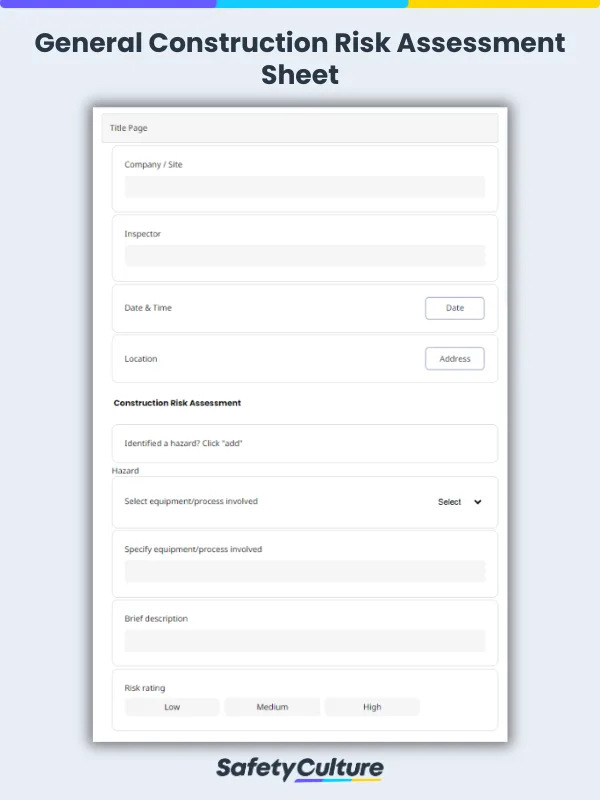
Provide all necessary details, such as company or site name, people involved, date and time, and location.
Identify all tasks being performed.
Determine the hazards associated with the tasks performed by the workers. Hazards can either be working at heights, electrical tasks, use of heavy types of machinery or lockout, and tag-out procedures.
Identify hazard risk rating – low, medium, high.
Describe the hazards.
Add photos and annotations to make the report more comprehensive.
Affix signatures from all involved personnel.
Construction Risk Assessment Example
Construction risk assessments contain 5 elements:
The task being performed
The risks associated
The probability of the risk occurring
The impact
The response strategy
One example of when a construction risk assessment would be performed is when a company is pouring concrete. There are a lot of safety and quality risks associated with this activity. Once the concrete is poured it is very difficult and expensive to correct, so getting it right the first time is critical. A concrete pour risk assessment would look something like this:
Task | Risk | Probability | Impact | Response |
Set up and planning | The weather could be too cold for the concrete to cure properly | 75% | High | Mitigate – Make sure the concrete plant has cold mix on hand just in case |
Curing | Concrete hasn’t fully cured before putting weight on it | 65% | Medium | Accept – Perform concrete break tests at 7, 14, and 21 days or until break strength minimums are met |
Pour | The location of the pour could be off from the plans | 70% | High | Avoid – Hire a survey company to lay out the location of the pour |
Pour | Concrete can get on the skin, causing burns and irritation | 90% | Medium | Mitigate – Wear proper PPE to cover the skin and prevent contact |
In this example, managers and field personnel would review the steps of pouring concrete and collaborate to identify all possible risks associated with them. From there, strategies and plans are developed on how to proceed in a manner that reduces the likelihood or impact of those risks.
Knowing the risks associated with construction sites such as falling, getting struck by or caught in between objects, and electrocution, employers are responsible for ensuring workers have a safe construction site. The best practice is to conduct a risk assessment that includes inspecting the key areas for hazards and risks that can cause incidents.

Still looking for a checklist?
Search, filter, and customize 60,000+ templates across industries and use cases.